

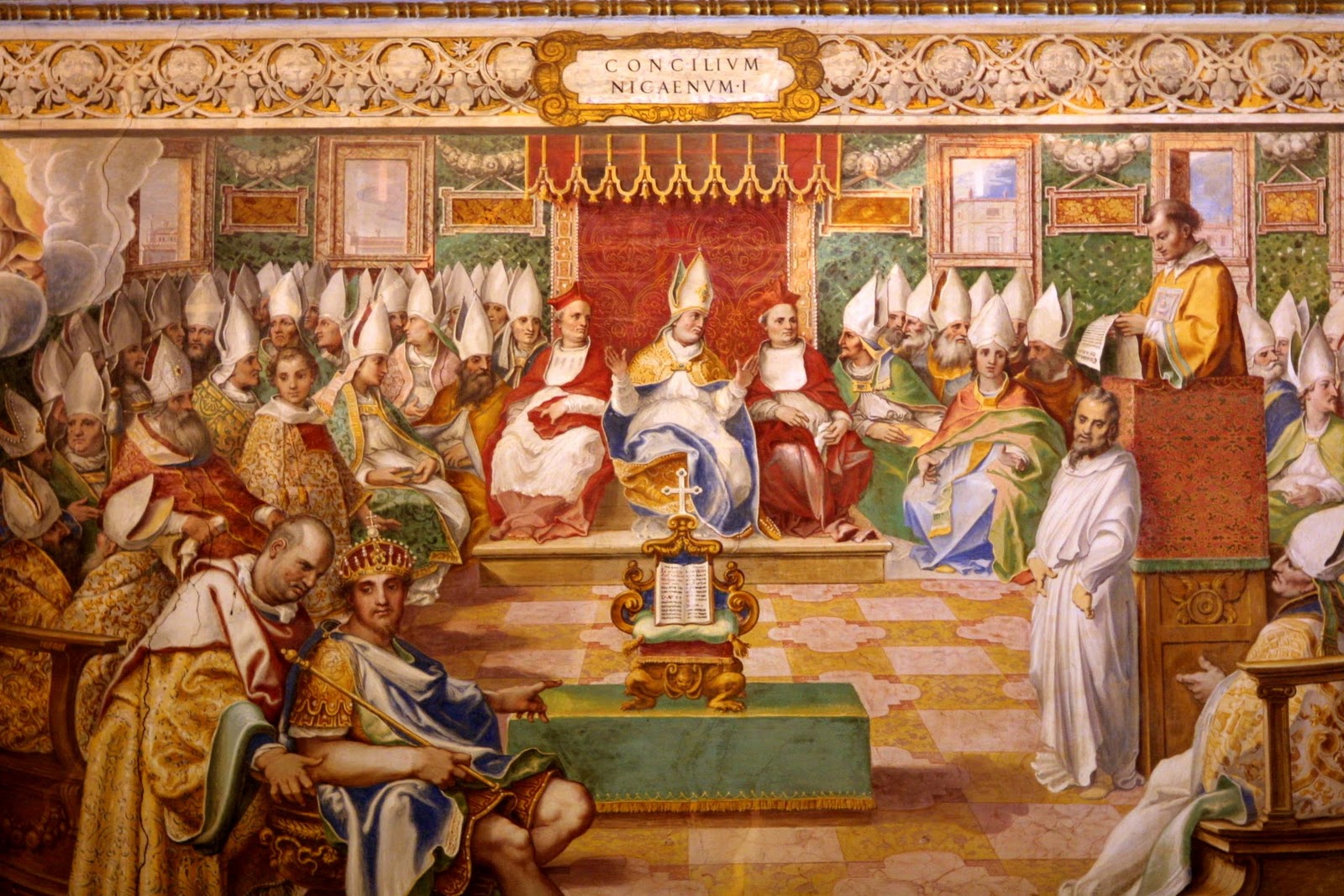

“Christology” is the study of the person of Jesus Christ and especially the mystery of the union in Christ of the divine and human natures. The first four ecumenical councils in the fourth and fifth centuries defined the personhood and natures of Christ, and the Nicene Creed we recite on Sundays expresses the official teachings of the Church in the liturgy.
A priest from Alexandria, Arius (250-336) taught heretically that Jesus is not God but only a unique creature. St. Athanasius was the champion who fought against Arianism.
During his General Audience on June 20, 2007, Pope Benedict XVI said, “In all likelihood Athanasius was born in Alexandria, Egypt, in about the year 300 A.D. He received a good education before becoming a deacon and secretary to the Bishop of Alexandria, the great Egyptian metropolis. As a close collaborator of his bishop, the young cleric took part with him in the Council of Nicaea, the first Ecumenical Council, convoked by the Emperor Constantine in May 325 A.D. to ensure Church unity. The Nicene Fathers were thus able to address various issues and primarily the serious problem that had arisen a few years earlier from the preaching of the Alexandrian priest, Arius.”
Shortly after the Council of Nicaea, Athanasius succeeded as bishop of Alexandria in 328. The Arians strived to impose their heretical teachings by influencing imperial authority. Though pressured by the emperor, Athanasius courageously refused to re-admit Arius into communion. During his life, Athanasius was banished five times and spent 17 years in exile.
Athanasius’ most famous work is On the Incarnation of the Word. He also wrote Discourses against the Arians. Athanasius wrote, “If the works of the Godhead had not taken place by means of the body, man would not have been made divine. If the properties of the flesh had not been ascribed to the Word, man would not have been thoroughly freed from them. But as it is the Word became man and took as his own the properties of the flesh. Thus, because of the Word which has come in the body, these attributes [i.e. death and corruption] no longer adhere to the body, but have been destroyed by the Word. Henceforth men no longer remain sinful and dead according to their own attributes, but they rise in accordance with the Word’s power, and persist immortal and incorruptible.”
A popular work of Athanasius is The Life of Anthony. Athanasius recorded an address of St. Anthony to the monks in which Anthony talked about the shortness of life: “The whole of man’s life is very short measured by the ages to come, so that all our time is as nothing compared to eternal life. And in the world, everything is sold at its worth and like value is bartered for like; but the promise of eternal life is bought for very little.”
Athanasius died in Alexandria on May 2, 373. Around 379, St. Gregory of Nazianzen delivered a panegyric or public address on the anniversary of his death. Gregory began the panegyric with these words: “When I praise Athanasius, virtue itself is my theme: for I name every virtue as often as I mention him who was possessed of all virtues. He was the true pillar of the church. His life and conduct were the rule of bishops, and his doctrine the rule of the orthodox faith.”
Gregory referred Athanasius as “the Father of orthodoxy.” St. John Henry Newman described Athanasius as “a principal instrument after the Apostles by which the sacred truths of Christianity have been conveyed and secured to the world.”
達修維護基督的天主性
「基督學」是研習耶穌基督的位格 ── 特別是祂的天主性與人性的結合。第四世紀至第五世紀之間,教會首四次的大公會議,定論了基督是一位和祂的雙本性。我們主日彌撒禮儀中誦唸的「尼西亞信經」,正是表達教會在這方面的教導。
約在公元250年、或公元256年至336年其間,一位來自亞歷珊大雅的亞略神父,提出了異端,認為耶穌並非天主,而只是一個獨特受造的人;聖達修就是主要反駁這種亞略主義異端的人。
2007年6月20日,教宗本篤十六世在公開接見謁見者時說:「種種蹟象指出,達修是約在公元300年,出生於埃及的亞歷珊大雅。他接受過良好教育,身晉執事品的他,任埃及的大都會亞歷珊大雅地方主教秘書,與主教合作無間。公元325年5月,君士坦丁大帝為教會的團結,召開尼西亞大公會議,他是當時列席的一位年輕聖職人員。尼西亞教父們發表不同議題,主要針對幾年前亞歷珊大雅的亞略神父所教授的異端。」
尼西亞大公會議結束不久,公元328年,達修繼任亞歷珊大雅主教牧職。亞略神父設法向權貴宣揚他的異端;達修卻不畏強權,堅拒亞略主義,因而曾五次被放逐,流徙了十七年。
達修為人熟悉的箸作,是「道成肉身」;他亦寫下「反亞略論文」,說:「假如天主的化工沒有藉肉體而且成就,人就不能成為神聖。假如血肉的屬性沒有歸因於聖言,人便不能徹底地被解救出來。但是,聖言真的成為人並取了肉身的屬性,因此,藉著聖言在肉身內來臨,這些屬性【死亡和腐朽】不再附著肉身,卻被聖言摧毀了。自此,人類再不會依照屬性地停留在罪惡和死亡中,但會依照聖言的能力而定提升,並能秉持於不死與不朽。」
達修另一受歡迎的箸作,是「安多尼生平」。他轉載聖安多尼向修道院院士們有關「生命短促」的講話:「以未來的世代來計算,人整個的生命,其實是非常短暫,所以我們今生的年歲,不能與永生相比。我們用相若的價值換取世物,但我們為永生付出的代價,卻又微不足道。」
公元373年5月2日,達修在埃及的亞歷珊大雅逝世。大約在公元379年,約贊森的聖國瑞在他的逝世週年中,發表對他的頌辭。頌辭開端是:「當我稱讚達修的,德行是我的主題:每當我提到擁有一切德行的他,我就是提到每一個德行。他確實是教會的中流砥柱:他的生平和操守,是主教們的訓誡;他的教義,是正統信德的規範。」聖國瑞稱達修為:「正統教義的教父」。聖若望.亨利.紐曼形容達修,是「繼宗徒之後,基督宗教聖道在世界上傳遞和守護的主要工具。」







