


From November last year to March this year, I wrote a series of articles on the Church Fathers. Due to the COVID-19 pandemic, the series was interrupted, and I wrote 14 articles regarding the pandemic and Canada’s 54-Day Rosary Novena. These articles are posted on the B.C. Catholic website.
Now I am happy to resume the series of articles on the Church Fathers. The article on March 16 was on the fourth-century St. Ambrose of Milan. Ambrose’s older brother and sister (Satyrus and Marcellina) are honoured as saints by the Church. Satyrus was a most efficient and successful administrator, looking after the temporalities of the Diocese of Milan for Ambrose. Marcellina inspired Ambrose with a love of virtue. She became a consecrated virgin on Christmas Day in 352 and received the veil from the hands of Pope Liberius.
In 374, Ambrose, as governor, was keeping order at the episcopal election in Milan where Catholics and Arians were at odds. Eventually the whole assembly unanimously acclaimed Ambrose Bishop of Milan.
Ambrose was still a catechumen when he was chosen as bishop. After due preparation, he was baptized, confirmed, ordained to the diaconate, ordained to the priesthood, and, on December 7, was consecrated bishop.
The new bishop began earnestly the study of Scripture. From the works of Origen, Ambrose learned the act of prayerful listening and meditative reflecting on the Word of God. He applied the teachings of the Bible to daily Christian life.
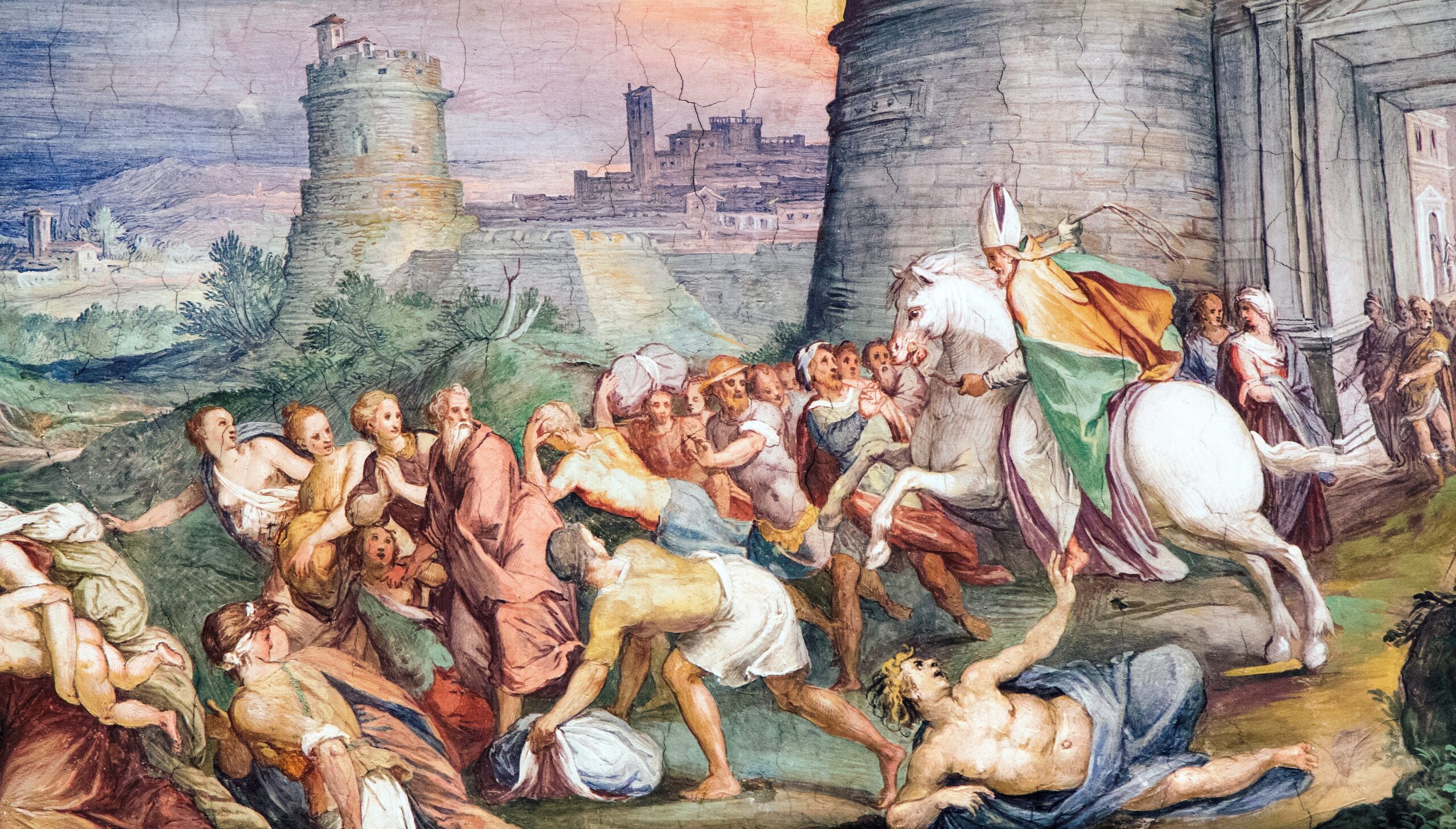
As bishop, Ambrose defended the Catholic faith against the Arians. He advocated the rights of the Church and was not afraid to confront emperors, three of whom acceded to him. He said, “The emperor is in the Church not above it.”
The sermons of Ambrose helped to convince Augustine of the reasonableness of the Catholic Faith. Ambrose had the joy of baptizing Augustine in 387.
Augustine described how when Ambrose was reading, his eyes scanned the pages and his heart searched out the meaning, but his voice and tongue were silent.
During a general audience, Pope Benedict XVI described the death of St. Ambrose: “Holy Bishop Ambrose – about whom I shall speak to you today – died in Milan in the night between 3 and 4 April 397. It was dawn on Holy Saturday. The day before, at about five o’clock in the afternoon, he had settled down to pray, lying on his bed with his arms wide open in the form of a cross. Thus, he took part in the solemn Easter Triduum, in the death and Resurrection of the Lord. ‘We saw his lips moving’, said Paulinus, the faithful deacon who wrote his Life at St Augustine’s suggestion, ‘but we could not hear his voice’. The situation suddenly became dramatic. Honoratus, Bishop of Vercelli, who was assisting Ambrose and was sleeping on the upper floor, was awoken by a voice saying again and again, ‘Get up quickly! Ambrose is dying …’. ‘Honoratus hurried downstairs’, Paulinus continues, ‘and offered the Saint the Body of the Lord. As soon as he had received and swallowed it, Ambrose gave up his spirit, taking the good Viaticum with him. His soul, thus refreshed by the virtue of that food, now enjoys the company of Angels’ (Life, 47). On that Holy Friday 397, the wide-open arms of the dying Ambrose expressed his mystical participation in the death and Resurrection of the Lord. This was his last catechesis: in the silence of the words, he continued to speak with the witness of his life.”
Ambrose wrote many important dogmatic, exegetical, moral, and ascetical works. Along with St. Gregory the Great, St. Augustine, and St. Jerome, St. Ambrose is honoured as one of the four great doctors of the Latin Church.
安博全心全意研究聖經
去年十一月至今年三月,我本在這裡談論教會聖父的事蹟,卻因為新冠肺炎疫症的爆發,改談有關疫症和54日玫瑰經九日敬禮。方便你們翻閱,已把這些上載網址https://bcatholic.ca/authors/father-anthony-ho。
現在,我們回到談論早期教會教父了。記得,三月十六日,我們談論的,是四世紀米蘭的聖安博。聖安博的弟弟塞弟儒和姊姊瑪策琳納,均被教會尊為聖人。
聖塞弟儒是一位能幹和成功的行政人員,替聖安博看管米蘭教區的俗務。聖瑪策琳納啟發安博修德。在352年的聖誕日,她從教宗立柏手中,領受貞女頭紗,把自己奉獻給天主。
374年,在天主教徒與亞略異端徒對壘的氛圍下,安博身為總督在維持秩序,結果在塲的人一致推選安博為米蘭主教。是時,他還是一位望教者,經過快速的必要程序後,他接受聖洗和堅振聖事,領受執事職務,繼而晉鐸,然後在12月7日領受主教聖職。
既為主教,聖安博熱衷研究聖經。從奧利靳的箸作裡,安博學會了用祈禱方式,聆聽及默想聖言,更以聖經的教導,融入每天的生活中。
主教職務上,安博悉力反對亞略異端,維護教會權責,他無懼對抗皇帝,並清楚聲明:「皇帝隸屬教會,非凌駕教會。」
安博的講道幫助奧斯定看到天主教的教導是非常合理的。在387年奧斯定從安博手中領受洗禮。
奧斯定形容安博在閱讀聖經時,往往雙目不離章節,內心追理尋道,神情肅穆沉寂,不發一言。
一次公開接見訪客時,教宗本篤十六世談起聖安博的離世,說:「今天我要向你們談談一位聖善的主教 ── 聖安博。397年,聖安博死在4月4日,是聖週六的清晨。前一天的下午五時,他躺在床上張開雙手十字形地祈禱。他藉此參與復活三日慶期,參與主的聖死與復活。一位名叫保祿的忠心執事,在聖奧斯定的建議下,寫下聖安博的生平。他憶記著:『我們看到安博主教雙唇微動,但聽不到他在說話。』但,一下子,情況卻變得戲劇化。來幫忙的衛爾切利主教韓諾肋度,正在上層睡覺,突然聽見聲音喚醒他,連續地說:〔快起來,安博快要死了!〕保祿繼續記著:『韓諾肋度主教趕到下層並給聖人送聖體,安博領了並吞下臨終聖體後,便交付了靈魂。他的靈魂被神糧更新,現與眾天使作伴了。』在那397年的苦難聖日,臨終的安博所張開的兩手表達他奧妙地參與主的聖死和復活。這是他教的最後一個教理課: 在無言靜默中,他以生命的見證繼續説話。」
聖安博有很多重要箸作,包括教義、釋經、倫理及神修。他與大聖國瑞、聖奧斯定、聖業樂齊名,統被譽為拉丁教會四大聖師。







