
As a practising Catholic, I do not shy away from the fact that I go to church or that I teach at a Catholic school. Consequently, I find that people are inclined to ask questions about my faith, and I am willing to answer them. Unfortunately, though, many times I realize afterwards that I have not taken full advantage of opportunities to witness my faith.
One missed opportunity occurred last summer. We were travelling with friends, and our family went to Mass. Our friends are not church-goers; yet, they always respect the fact that we are. They show interest and I appreciate their queries.
On this particular Sunday, however, I was surprised by the nature of the question from one of them. “How was Mass?” he asked, in what seemed like a simple pleasantry. When I responded with the vague response, “It was fine,” he pressed for details. He asked about the church building, the choir, and if there was anything “special” about this Mass.
In my mind, I wondered how on earth I could explain that which is special about every Mass, so I chose to simply explain that the Mass has the same structure everywhere in the world, meaning the daily readings and the format were the same as we had at home. I commented on the church itself and the welcoming nature of the people, and he was satisfied with my answers. Sadly, my omissions have caused this conversation to pop into my head several times since.
I am not embarrassed that I go to Mass. If I were, I wouldn’t have told anyone where I had been. What bothers me is not so much that I didn’t explain the essence of the Mass, but the fact that I would even consider uttering something as insignificant as “fine” to describe the magnitude of the Holy Sacrifice of the Mass.
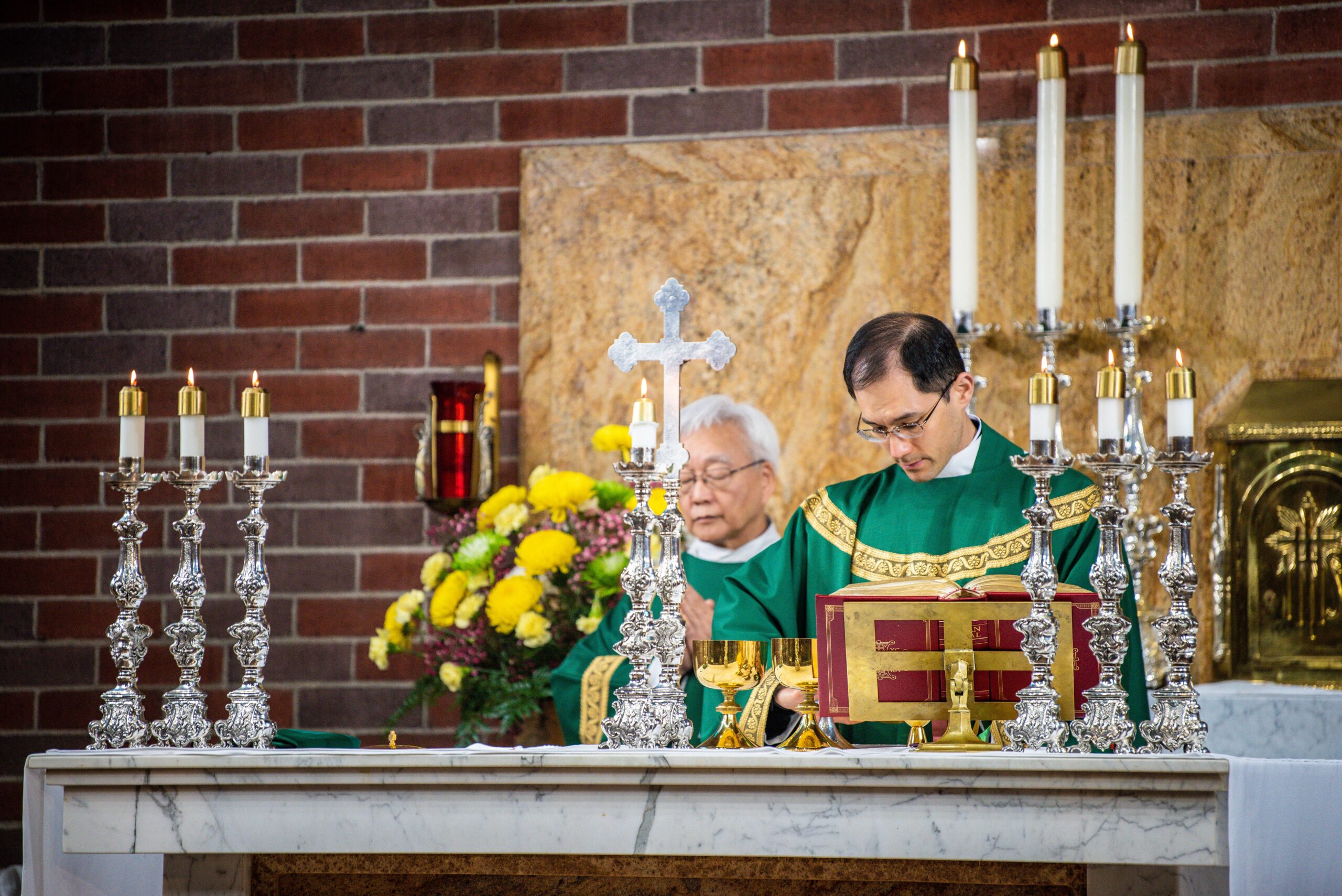
Instead of saying “fine,” I could have explained how the delivery of the Word of God, the sights of candles, sacramentals, and statues, the smell of incense, the sounds of bells and music, the gestures of genuflecting, kneeling, praying aloud together and giving gestures of peace are reverent, impressive and at the same time comforting forms of worship. Most importantly, I also could have explained that I believe in the transubstantiation: the true presence of Jesus Christ in the Eucharist.
“Fine” definitely doesn’t come close to describing any of that!
The Catechism of the Catholic Church, section 1376, explains this miracle of transubstantiation: “The Council of Trent summarizes the Catholic faith by declaring: ‘Because Christ our Redeemer said that it was truly his body that he was offering under the species of bread, it has always been the conviction of the Church of God, and this holy Council now declares again, that by the consecration of the bread and wine there takes place a change of the whole substance of the bread into the substance of the body of Christ our Lord and of the whole substance of the wine into the substance of his blood. This change the holy Catholic Church has fittingly and properly called transubstantiation.’”
My belief is that Jesus is truly present in the Eucharist; without him I’m not sure I would make Mass attendance such a priority. Yet perhaps I have become more complacent about this than I wish to believe. Do I overlook the fact that I am honoured to be in God’s presence when I attend Mass? If I am focussed on this reality, my body language and overall presence should reveal that I believe in something more miraculous than words can express.
Worshipping God in nature, through books, through charity work, through personal prayer, or even by listening to homilies online is wonderful. I do these things and receive great blessings from them, but I go to Mass at least once weekly to receive the nourishment of the Eucharist. When I’m asked how Mass was, shouldn’t I share these details? Shouldn’t I rave about the fact that Jesus would die for me and that I now have the chance to unite with him in holy Communion?
To encourage further questions when people ask me, “How was Mass?,” rather than sounding unenthused and brushing them off with a simple “fine,” I need to reply honestly and openly: “Mass, in and of itself, is indescribable.”