


On the fifteenth Sunday in Ordinary Time we hear many references to the natural cycle of farming. I find this timing relevant for many reasons, including the fact that my recently deceased father was a farmer.
At Dad’s funeral, the priest referred to the words of the Gospel of John: “unless a kernel of wheat falls to the ground and dies, it remains only a single seed. But if it dies, it produces many seeds (Jn. 12: 24).
He called to mind the fact that my dad spent a lifetime focused on the cycle of life. Wheat seeds planted in the spring grow into plants which need to die to give life. Wheat is harvested – both stalk and grain – to bed and feed animals and people, while remnants left in the fields compost, giving life to the soil. Each part of the process fuels another step and starts the cycle again, and as a farmer, Dad knew that cycle well.
Regarding faith, the priest reminded us that Dad also understood that, like wheat, he too had to die so that his earthly life could achieve its purpose and result in eternity with the Lord. Dad’s life of 83 years was not like a single seed that lived and merely died, but one that fed many, and one that will continue to grow in those he left behind.
As a result, the refrain to this week’s psalm, taken from Luke 8:8, speaks to me: “The seed that falls on good ground will yield a fruitful harvest.” Like the Gospel reading, it reminds me of how God’s seeds of faith “fell on rich soil” with my dad, “and produced fruit, a hundred or sixty or thirtyfold” (Matt. 13: 8).
As a man connected to agriculture, he worked with physical seeds; as a man of faith, he likewise planted spiritual seeds, nurtured by the trust in God he exemplified each and every day.
At Dad’s funeral, just as the incense was being prepared for the commendation, a loud crack of thunder was heard. Inside the church, we had been oblivious to the weather outside until that moment, and after the final blessing, the funeral director made everyone smile with his announcement that my dad would be very pleased that the skies had opened and the crops were receiving a much-needed rainfall.
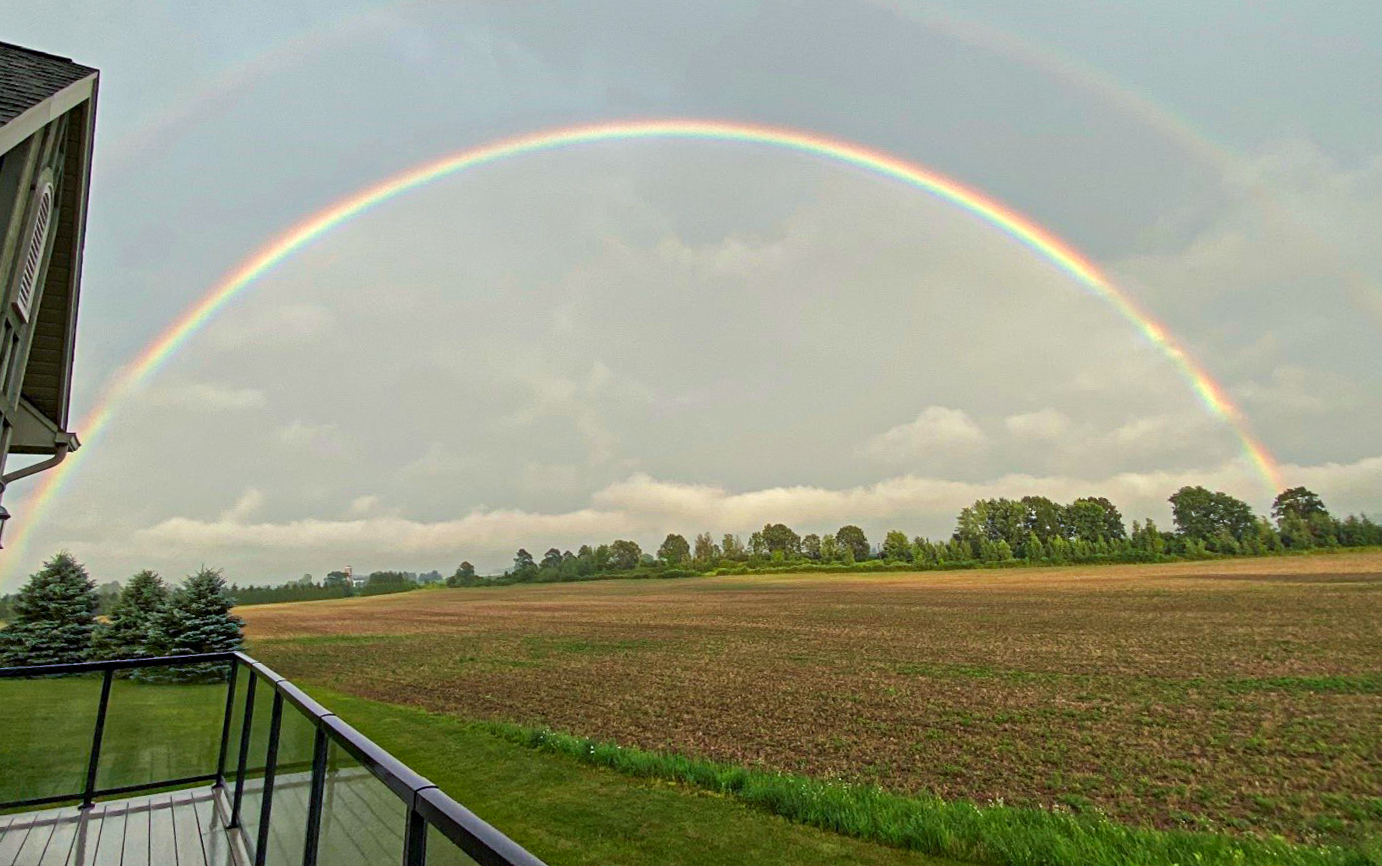
The rain soaked us during the burial and continued until evening, when my children and nieces looked outside and drew everyone’s attention to a large double rainbow right over my brother’s bean field. Sunday’s first reading reminds us: “Just as the heavens, the rain and snow come down and do not return there till they have watered the earth, making it fertile and fruitful, giving seed to the one who sows and bread to the one who eats.” (Is 55: 10).
I couldn’t help feeling that the rainbows were signs from God, reassuring us that Dad, like the rain mentioned in this reading, has returned to the heavens. While we all feel that he left us too soon, no one could argue that he hadn’t lived a fruitful and faith-filled life while he was here. He came down to earth and God called him to return home, after successfully planting seeds of faith in all of us.
The rainbow God set in the sky for Noah was a reminder of God’s covenant, promising that Noah and his family would remain under God’s protection. Whatever the scientific or meteorological reason behind “our” rainbow, I regard it as a promise of God’s protection for us.
In this Sunday’s Gospel, Jesus is asked why he speaks in parables. He explains that he uses relatable stories to reach people because he wishes to reveal the mysteries of the kingdom to those who “look but do not see and hear but do not listen.” (Mt 13: 13). I like to think of the rainbow as a parable written just for us. After the rain, there was sunshine and, in the midst of our grief and tears, we saw a breath-taking sign of hope.
In the rainbows, we saw a fraction of heaven’s beauty. We likewise trust that Dad is witnessing heaven’s full glory – his reward for a life rooted in trust in the Lord, a life well-lived.
“This is the sign of the covenant that I am making between me and you and every living creature with you for all ages to come: I set my bow in the clouds to serve as a sign of the covenant between me and the earth.” (Gn 9: 12-13)
We welcome letters to the editor about articles in The B.C. Catholic.







