

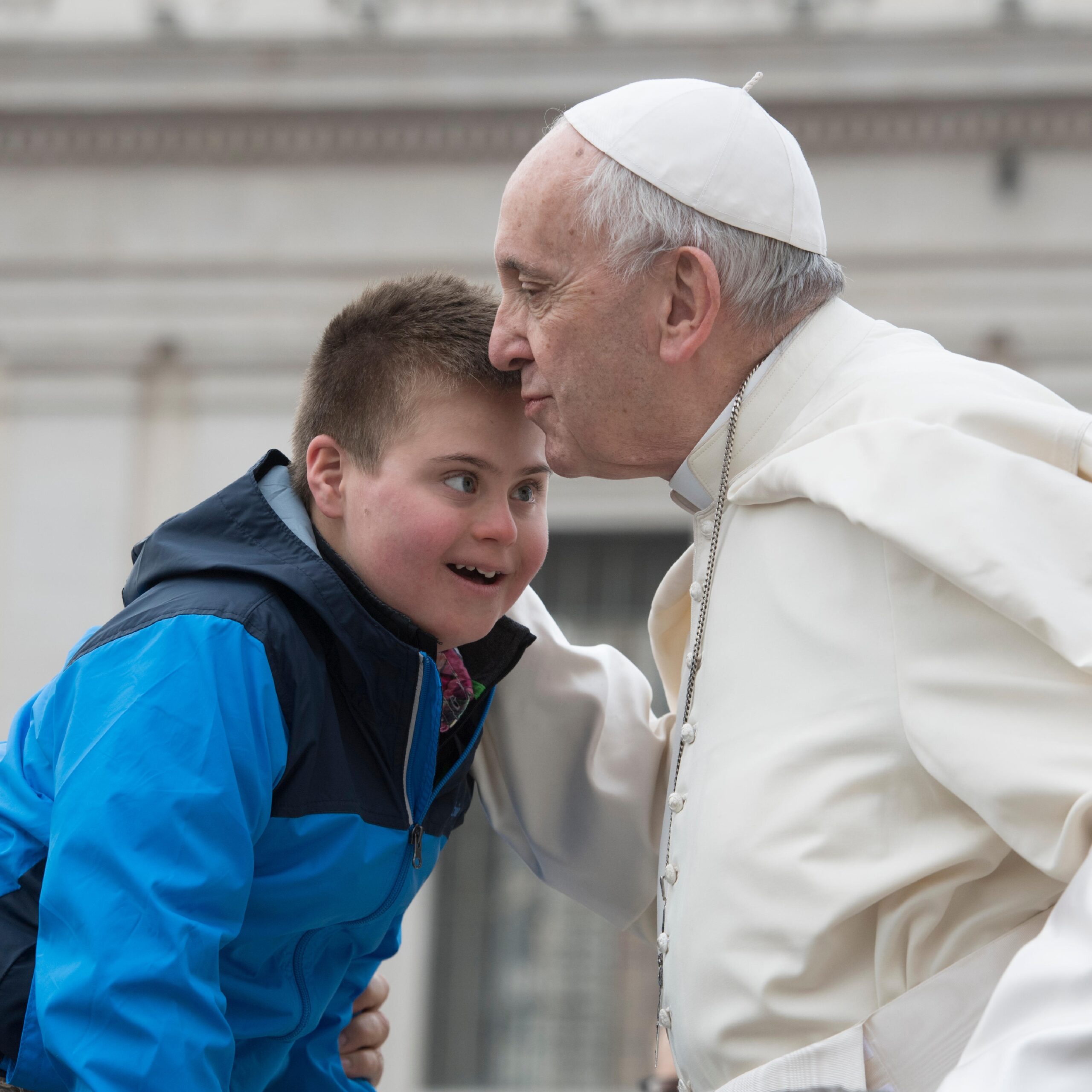

The last few Sundays I have been at Mass I have closely observed a young father bringing his son with Down syndrome to receive the Eucharist. I have cried every time.
I don’t know if my heart is sensitized from just receiving Jesus myself, but the sight of this man so tenderly and gently caring for his son has affected me deeply. I can both sense and see the great love of the father displayed in his every touch and action.
He brings his son last down the aisle, as he knows that his son will need extra time and doesn’t wish to inconvenience anyone else. I see both patience and pain etched on his face. I can sense the aura of his deep love from across the church. I have never met him personally, only observed him from afar.
As a physician and a father of four children myself, although all my children are physically healthy I know the hundreds of extra hours and days this man and his wife spend to love and support their disabled child. All the extra hospital and doctor visits, the extra care and attention for a child who as they grow older will not still be able to fully care for themselves. The prospect of many years of this care and attention stretching out ahead.
But I also know that this truly is a great man, for he loves greatly. He sacrifices greatly. He understands that life is not about comfort only. He lives and understands the redemption found in pure love.
As I heard about a doctor from the Quebec College of Physicians telling the Commons Special Joint Committee of Medical Assistance in Dying (MAID) that his organization proposes considering euthanasia for babies with severe syndromes or malformations, I pondered the life of children with a severe disability and the life of their parents.
The suffering of the innocent is an exceedingly difficult problem. If we are indeed random beings generated from a random universe, there is no avoidable suffering that is acceptable. Hence Dr. Louis Roy proposing that for children with severe disabilities who are likely to die anyway it would be merciful considering ending their lives early.
I don’t necessarily judge him; as a physician he has undoubtedly spent his times of sweat and suffering in the trenches of health care. However this perspective of stark utilitarianism is deeply troubling, as it denies the value of the human soul. For we are not just random bodies, but embodied souls.
You may question the value of a child destined for a short and difficult life. You may even question why a benevolent God allows the suffering of the innocent. But I have seen (and hopefully you have as well), parents, siblings, family and friends of children such as these come to experience an unforeseen blossoming of love that is overwhelming, tender, and of great beauty.
After all, we are created to love, and where love grows, the human spirit abounds. Shall we curtail suffering, if by it we curtail love?
What we are we losing, as medical assistance in dying (euthanasia) increases by the year? Yes, suffering is shortened, but we are also losing those precious moments where family breaches are repaired, where final stories are told, where our souls have a chance to do the existential work to prepare for eternity, where love can abound even in the suffering.
This is the greatness of our faith, we know that this suffering is not in vain, that within the suffering is the story of the Cross, of redemption, of the ultimate sacrifice of love.
To care and love in these circumstances hurts, and costs, but without paying the price of love we will lose the value of our children’s souls, and lose our own souls in the bargain.
Dr. Tim Kostamo is a clinical associate professor in the Faculty of Medicine at UBC and a parishioner at Christ the Redeemer in West Vancouver. He will be speaking Oct. 29 at the Catholic Physicians’ Guild White Mass for healthcare providers, the sick, and their families.







