


St. Benedict is the founder of Western monasticism and was born in Norcia, Italy, about 480.
While studying in Rome, Benedict was put off by the dissolute lifestyle of many of his fellow students and did not wish to make the same mistakes. He went to live as a hermit in a cave near Subiaco. After several years he was joined by disciples and then founded 12 monasteries, each with an abbot and 12 monks.
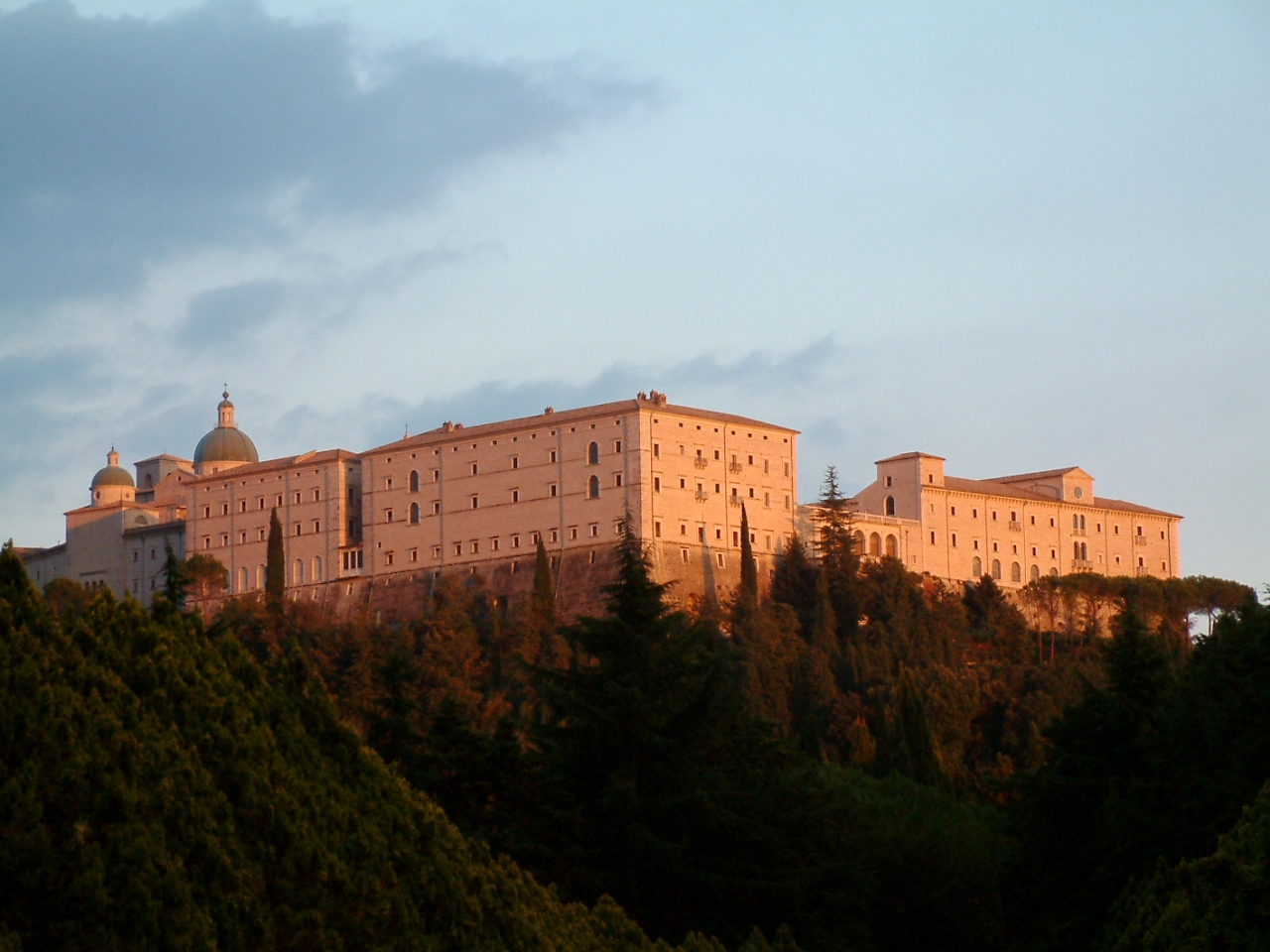
Around 525, Benedict and many of his monks went to Monte Cassino, where they built a new monastery among the woods and groves. Pope Benedict XVI pointed out that St. Benedict’s move from the remote Valley of the Anio to Monte Cassino – a plateau dominating the vast surrounding plain which can be seen from afar – has a symbolic character: “a hidden monastic life has its own purpose but a monastery also has its public purpose in the life of the Church and of society, and it must give visibility to the faith as a force of life. Indeed, when Benedict’s earthly life ended on March 21, 547, he bequeathed with his Rule and the Benedictine family he founded a heritage that bore fruit in the passing centuries and is still bearing fruit throughout the world.”
Regarding the Rule of St. Benedict, St. Gregory wrote, “With all the renown he gained by his numerous miracles, the holy man was no less outstanding for the wisdom of his teaching. He wrote a Rule for Monks that is remarkable for its discretion and its clarity of language. Anyone who wishes to know more about his life and character can discover in his Rule exactly what he was like as abbot, for his life could not have differed from his teaching.”
In his Lives of the Saints, Westminster Abbey’s Father Augustine Kalberer, OSB, wrote, “St. Benedict’s most characteristic stresses are on a very personal love of Christ and on discretion. Throughout the Rule he blends broad principles with concrete applications to guarantee and maximize the advantages community life can offer a well-motivated but otherwise quite ordinary Christian who is ‘truly seeking God.’ The abbot, always remembering human frailty, should order all things ‘in such a way that the strong have something to strive after and the weak nothing at which to take alarm.’”
A writer wrote, “By prayer he [St. Benedict] did all things: wrought miracles, saw visions, and prophesied.” Pope Benedict XVI said, “Throughout the second book of his Dialogues, Gregory shows us how St. Benedict’s life was steeped in an atmosphere of prayer, the foundation of his existence. Without prayer there is no experience of God. Yet Benedict’s spirituality was not an interiority removed from reality. In the anxiety and confusion of his day, he lived under God’s gaze and in this very way never lost sight of the duties of daily life and of man with his practical needs. Seeing God, he understood the reality of man and his mission.”
St. Gregory recounted the death of St. Benedict: “Six days before he died, he gave orders for his tomb to be opened. Almost immediately he was seized with a violent fever that rapidly wasted his remaining strength. Each day his condition grew worse until finally, on the sixth day, he had his disciples carry him into the chapel, where he received the Body and Blood of our Lord to gain strength for his approaching end. Then, supporting his weakened body on the arms of his brethren, he stood with his hands raised to heaven and as he prayed breathed his last.”
聖本篤寫下神聖的規章
聖本篤是西方隱修模式的創建者。
約在公元480年,本篤出生於意大利的諾爾恰;當他在羅馬進修時,已經過著異於同學們的散渙日子,避免和他們犯相若的錯謬。後來,他在蘇比亞科附近的洞穴,渡隱修生活。若干年內,擁有他的追隨者,並創立了十二所隱修院,每間隱修院有一名院長及十二名隱修士。
大概在公元525年,本篤偕同他很多的門生,到蒙特卡西諾的一處密林,建造一座新修院。教宗本篤十六世認為,聖本篤把隱修院從荒郊的厄尼奧山谷,遷移到蒙特卡西諾,座落在叢林高原,俯瞰大片遼遠平原,實有其象徵意義 ── 歸隱的生活旨在修道,但亦應該放眼教會及社會,促使眾人都活在信德中。不錯,聖本篤塵世生命在547年3月21日結束時,他給自己的團體,遺下有關隱修的「規章」;時至今日,他的遺作仍讓世界結出修德的善果。
聖國瑞讓我們意識到:聖本篤不止因他所行聖蹟而為人熟悉,他的教導智慧亦為人樂道。他給隱修士的『規章』,用詞謹慎簡易,並且能完全在他作為隱修院院長的生活中反映出來,確實坐言起行、言行一致。
本篤會會士、奧斯定.卡伯里神父指出:聖本篤的特點,是他十分強調個人對基督的愛,與及慎重。
在『規章』內,他廣泛地把不同的規條交織起來,使團體生活的優點顯示出來。修院院長們應該時刻記得人性的弱點,使強者更努力、弱者也不驚動。
另一位作家也寫道:「藉著祈禱,聖本篤似乎可以做任何事:行奇蹟、睹異象,和講預言。」教宗本篤十六世說:「論及聖本篤的生活,聖國瑞在他『對話』的第二本書冊內,形容聖本篤常浸淫在祈禱的氛圍裡,成為他活存的基礎。沒有祈禱,便感覺不到天主的存在。然而,聖本篤的靈修並非脫離現實。在當時憂慮和迷茫的日子,他活在天主的光照下,不忘克盡本分、以及近人與其所需。看到天主,他便明白人生的真諦和使命。」
聖國瑞憶錄聖本篤的彌留時刻:「他去世前六天,令人把他的墳墓打開作準備。差不多同一時間內,他發高燒,令他的精力消耗殆盡,情況急轉越下;第六天,他要弟子們把他帶進小聖堂,領受聖體聖血,以增強面對死亡的能力。在神昆們參扶下,聖本篤吃力地站起來,向上天張開雙手祈禱,才吐出最後一口氣。」







