

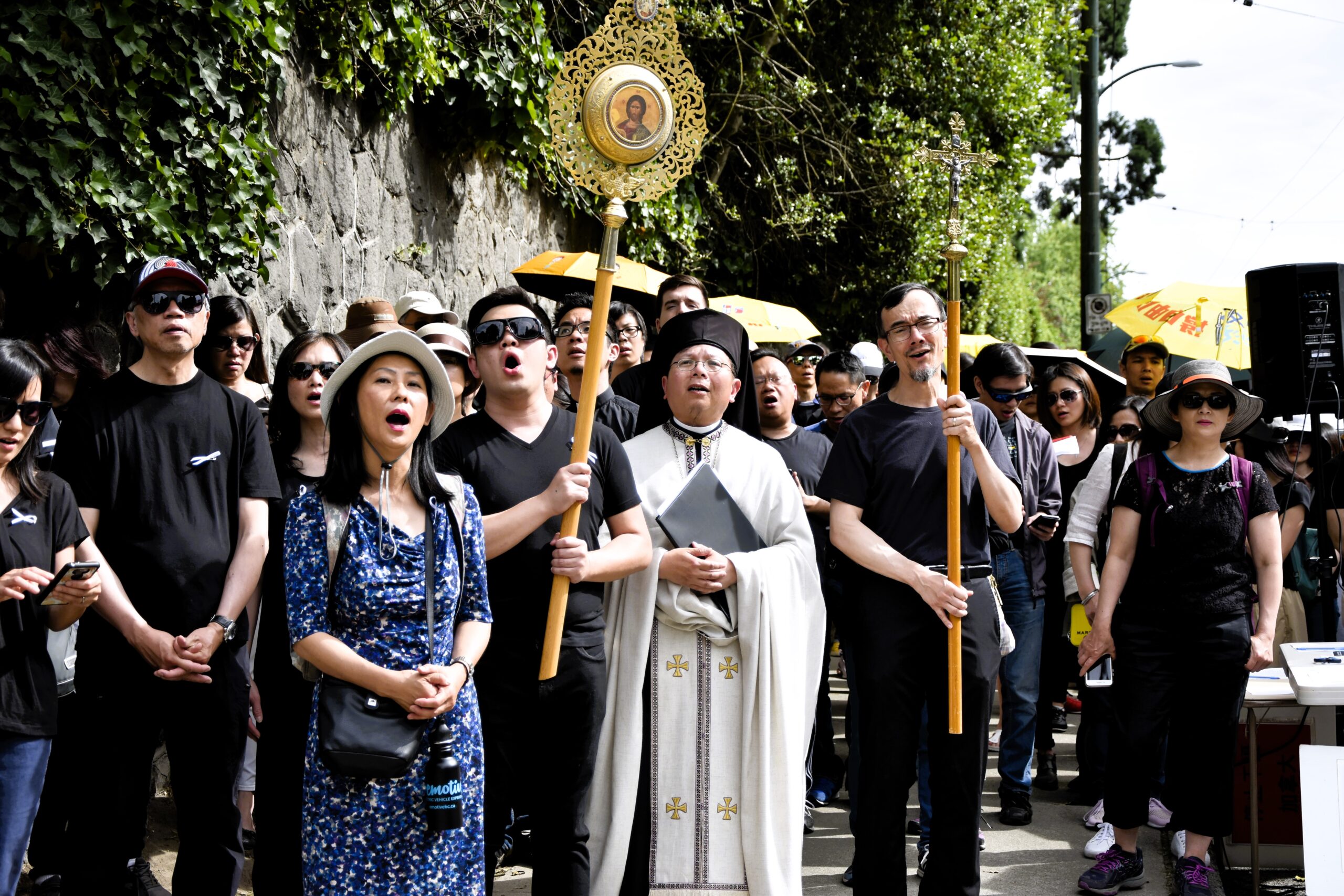

Does prayer really work? What if one were praying for the impossible—or practically impossible?
Christmas is a time of impossible prayers. The Infant Jesus, born into a world of oppression and persecution, was a light shining in the darkness, prevailing against the forces of death. Around June 4 each year, praying for the seemingly impossible is exactly what our little mission parish has been doing for years.
June 4 marks the infamous Tiananmen Massacre in Beijing in 1989, when thousands of students and supporters were murdered en masse by China’s Communist Party’s “People’s Liberation Army.” Students from across the country had gathered to ask for reduced government corruption, freedom of speech, and a little democracy. On the night of June 4, after six weeks of peaceful demonstrations, Beijing sent army tanks into the central plaza, Tiananmen (“Heavenly Peace” in Chinese), to crush the bodies of those young people.
The world was shocked and horrified by this atrocity. Protests erupted globally, including in Vancouver. Hongkongers, then still under British rule, had been inspired by the student demonstrations. They travelled to Beijing to support the Chinese students. When the massacre began, Chinese students desperately bundled the Hongkongers onto planes to get them out of China. The Hongkongers refused to abandon their friends, but the Chinese students insisted they escape “because somebody had to tell the world about what happened at the massacre.”
The massacre was not limited to Beijing. The government went after people all over China for months, and it continues persecuting people today for Tiananmen.
In Hong Kong, every year since 1989, there has been a Memorial Commemoration of the massacre victims, with attendance so massive it filled six football fields. Every year, the Catholic Church prayed Memorial Masses for those thousands of victims—until 2021. In 2020, Beijing, via its puppet government in Hong Kong, cracked down on all human rights and civil freedoms. By 2021, Masses could no longer be celebrated in Hong Kong for the June 4 massacre victims.
Here at our little mission parish in Richmond, we hold a prayer service around June 4 for the victims of the Tiananmen Massacre and for freedom—especially freedom for the Catholic Church in China.
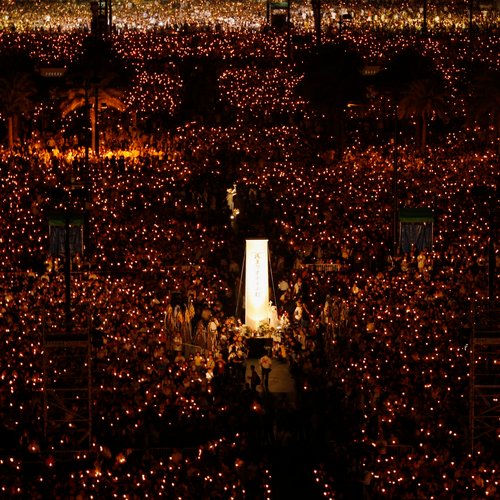
Tens of thousands of people take part in a candlelight vigil at Victoria Park in Hong Kong on June 4, 2009, to mark the anniversary of the crackdown on the pro-democracy movement in Beijing’s Tiananmen Square in 1989. (CNS photo/Bobby Yip, Reuters)
When the Diocese of Hong Kong could no longer have Masses for the Tiananmen victims, we felt we more than ever had to hold memorial services for the victims.
Now, our parish not only prays for the thousands of victims of the 1989 Tiananmen Massacre but also prays on behalf of Hongkongers who can no longer attend or hold these Masses.
Why do we pray? What can prayer do against such brutal totalitarianism and overwhelming military force?
Perhaps that is precisely why prayer is so important. As Ecclesiastes reminds us: “The race is not to the swift, nor the battle to the strong, neither yet bread to the wise, nor yet riches to men of understanding, nor yet favour to men of skill…” (Eccl. 9:11).
History and Scripture show us that reality is not reducible to military might or political forces. In the final analysis, we are engaged in a spiritual struggle, and prayer is our secret weapon.
A few years ago, I read about a political prisoner in China. He was not Catholic or any kind of believer. During torture, he experienced a profound insight: his torturer would one day have to answer for what he was doing. From a secular perspective, this seemed delusional, but for that man, it was a life-changing spiritual moment.
As Christians, even death cannot defeat us. Scripture reminds us, “We struggle not against flesh and blood, but against principalities, against powers, against the rulers of the darkness of this world, against spiritual wickedness in high places” (Eph. 6:12).
Around June 4, our humble mission parish prays for an “impossible” righteousness. We pray in the face of the impossible to the God for whom nothing is impossible.
The story of Christmas defies human logic—a baby born in a stable conquered sin and death. Likewise, prayers uttered in a small mission parish can stand against the might of tanks.
All are welcome to pray with us on May 30, 2025, at 7 p.m.
Father Richard S. Soo, SJ, is pastor of Eastern Catholic Church, Richmond.







