

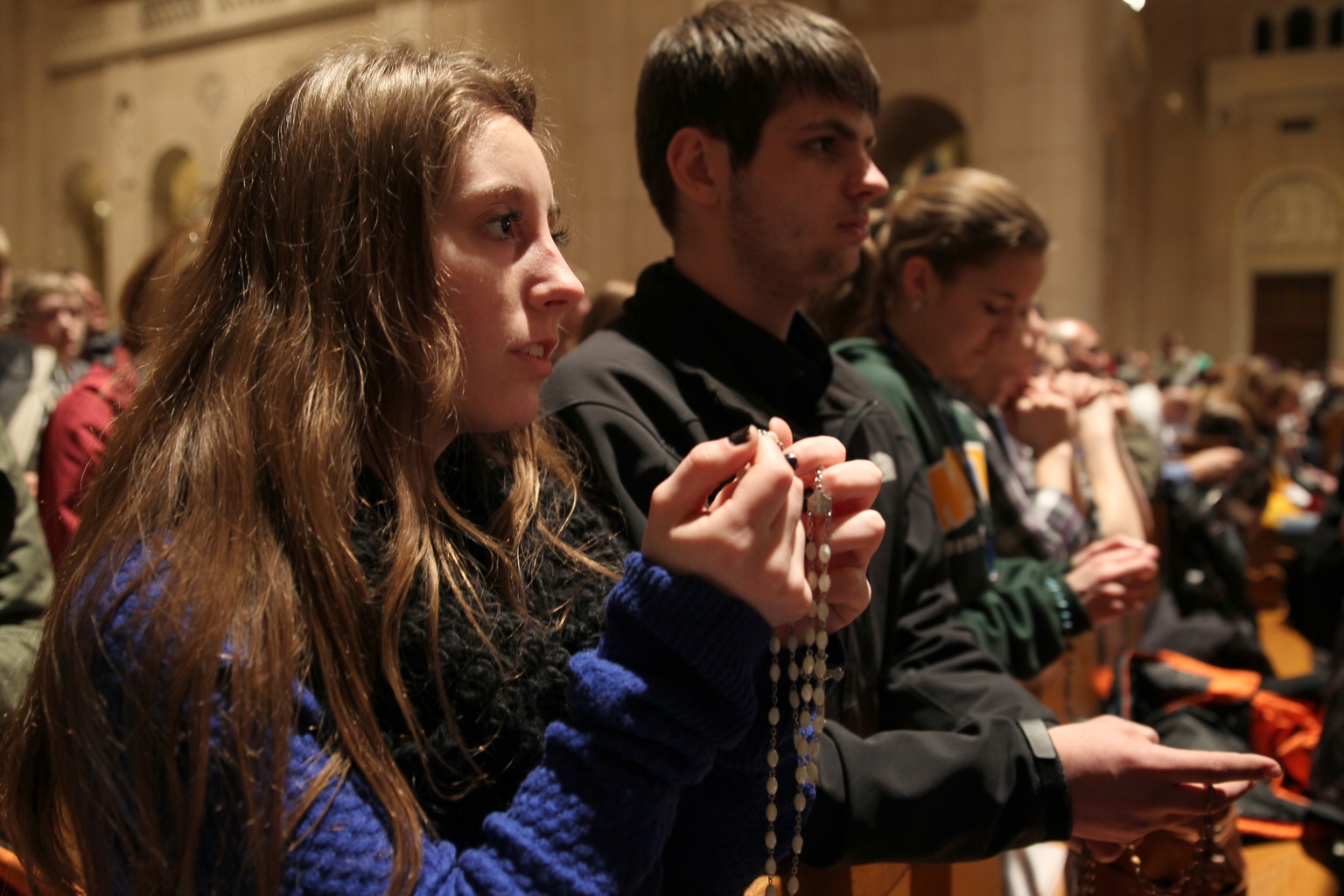

Pope Leo XIII wrote the first of his 11 Rosary encyclicals in 1883 and initiated the practice of praying the Rosary during the whole month of October.
The following year, to continue this beautiful practice, the Holy Father wrote the encyclical Superiore Anno. The encyclical began: “Last year, as each of you is aware, we decreed by an Encyclical Letter that, to win the help of Heaven for the Church in her trials, the great Mother of God should be honoured by the means of the most holy Rosary during the whole of the month of October.”
Pope Leo XIII stated his intention to continue the practice of the Month of the Rosary: “We have deemed it Our duty to exhort again this year the people of Christendom to persevere in that method and formula of prayer known as the Rosary of Mary, and thereby to merit the powerful patronage of the great Mother of God. Inasmuch as the enemies of Christianity are so stubborn in their aims, its defenders must be equally staunch, especially as the heavenly help and the benefits which are bestowed on us by God are the more usually the fruits of our perseverance.”
To encourage the spirit of perseverance, the Holy Father recalled the example of Judith, whom he referred to as “a type of the Blessed Virgin.” Judith “curbed the ill-judged impatience of the Jews when they attempted to fix, according to their own judgment, the day appointed by God for the deliverance of His city.” The Holy Father also recalled the example of the Apostles, “who awaited the supreme gift promised unto them of the Paraclete, and persevered unanimously in prayer with Mary the Mother of Jesus.”
In addition to the spirit of perseverance, Leo XIII also called for the spirit of piety. He wrote: “Care must be taken, therefore, that, in these times of mourning for the Church, the most holy devotion of the Rosary of Mary be assiduously and piously observed, the more so that this method of prayer being so arranged as to recall in turn all the mysteries of our salvation, is eminently fitted to foster the spirit of piety.”
St. John Paul II, in his Rosary encyclical (2002), stated: “The most important reason for strongly encouraging the practice of the Rosary is that it represents a most effective means of fostering among the faithful that commitment to the contemplation of the Christian mystery.”
Leo XIII urged the faithful to pray against the cholera: “To Mary, therefore, we must fly—to her whom rightly and justly the Church entitles the dispenser of saving, aiding, and protecting gifts—that she, graciously hearkening to our prayers, may grant us the help they besought, and drive far from us the unclean plague.”
During the cholera epidemic of 1884, St. John Bosco urged the faithful to: (1) frequent approach to Holy Communion with the due dispositions; (2) frequent repetition of the prayer Mary, Help of Christians, pray for us; (3) wearing a blessed medal of Mary Help of Christians around the neck and a contribution to some charitable or religious organization in her honour. Many people who followed the advice of St. John Bosco experienced healing and protection from the epidemic.
In the 1880s, Italy not only suffered from the cholera epidemic, faith and Christian morals were being attacked there as well. Hence, in 1887, Pope Leo XIII wrote his third Rosary encyclical, Vi È Ben Noto. The encyclical began: “You know how We place amid present dangers Our confidence in the Glorious Virgin of the Holy Rosary, for the safety and prosperity of Christendom and the peace and tranquility of the Church.”
For our Rosary to be effective, we must combine it with lively faith and penance. Addressing the bishops of Italy, Pope Leo XIII wrote: “Since the effects of such prayers will be proportionate to the dispositions of those offering them, we ardently exhort you, venerable brethren, to devote all your care and zeal to kindle among those committed to your charge a strong, living, and active faith, and to call on all to return by penance to grace and to the faithful fulfilment of all their duties. Among such duties, considering the state of the times, must be reckoned as paramount an open and sincere profession of the faith and teaching of Jesus Christ, casting aside all human respect, and considering before all things the interest of religion and the salvation of souls.”
Your voice matters! Join the conversation by submitting a Letter to the Editor here.
懷著信德與補贖精神誦念玫瑰經
教宗良十三於1883年頒布了第一篇關於玫瑰經的通諭,開啟了每年十月全月誦念玫瑰經的傳統。
翌年,為延續這美麗的敬禮,教宗撰寫了通諭《Superiore Anno》,開頭寫道:「去年,如你們所知,我們以通諭的方式頒佈命令,為使教會在困境中獲得天上的助佑,整個十月應藉至聖玫瑰經敬禮天主之母。」
教宗良十三表示,他有意延續玫瑰月的敬禮:「我們視此為義務,再次敦促基督徒於今年持續誦念聖母瑪利亞的玫瑰經,並藉此蒙受偉大的天主之母的強而有力的庇佑。由於基督信仰的敵人如此頑固堅決,其捍衛者更當堅定不移,尤其當我們所獲得的天助與恩寵,多半是來自堅持不懈的禱告成果。」
為了鼓勵信友懷有堅忍的精神,教宗提及了友弟德的榜樣,並稱她為「聖母瑪利亞的預像」。友弟德「制止了猶太人出於魯莽所產生的急躁,他們試圖按自己的判斷來決定天主為祂的城所安排的救援之日」。教宗也回顧了宗徒們的榜樣:「他們等待著護慰者所應許的至高恩寵,並與耶穌的母親瑪利亞同心合意地恆心祈禱。」
除了堅毅的精神,教宗良十三亦呼籲信友培養虔敬的精神。他寫道:「因此,在教會哀傷的此時,更應勤懇而虔誠地誦念玫瑰經,因為這種禱告方式能依序默想我們得救的各個奧蹟,極能培養虔敬之心。」
聖若望保祿二世在他於2002年發表的玫瑰經通諭中也指出:「我們極力鼓勵誦念玫瑰經的最重要理由,是因為可極有效地促進信友沉思投入基督的奧蹟。」
教宗良十三也呼籲信友為驅除霍亂而祈禱:「我們應當奔向瑪利亞 – 教會正確而公義地稱她為救恩、援助與保護恩惠的分施者 – 祈求她俯聽我們的呼求,允許我們所求的助佑,並將這污穢的疫病驅離我們。」
在1884年的霍亂疫症期間,聖若望鮑思高亦鼓勵信友:(1)懷著應有心態常領聖體; (2)常念:「基督徒之助瑪利亞,為我等祈」; (3)項戴經祝聖的「基督徒之助瑪利亞」聖牌,並捐獻予其名下的慈善或宗教機構。許多遵從聖若望鮑思高勸告的人,都經歷了醫治與疫病中的保護。
1880年代的義大利不僅遭逢霍亂肆虐,信仰與基督徒道德也同時遭到攻擊。因此,教宗良十三在1887年撰寫了第三篇關於玫瑰經的通諭《Vi È Ben Noto》,開首便寫道:「你們知道,在當前的險境中,我們如何將希望寄託在榮福童貞瑪利亞的玫瑰經上,以求基督信仰世界的安寧與教會的平安。」
為使玫瑰經真正發揮效力,我們必須以活潑的信德和悔改的精神來誦念。教宗良十三世致函義大利主教們時寫道:
「由於祈禱的效果將視祈禱者的心態而定,因此,我們懇切地勸勉你們 – 可敬的弟兄們 – 要竭盡心力和熱忱,在你們所託付的羊群中燃起堅強、活潑且積極的信德,並呼籲眾人藉著悔改,重返天主的恩寵,忠實履行他們一切的本分。鑒於當前的世局,在這些本分當中,首要的,應當是公開而真誠地宣認耶穌基督的信仰與教導,摒棄一切人情壓力,把宗教的利益與靈魂的得救置於一切之上。」
Your voice matters! Join the conversation by submitting a Letter to the Editor here.







