

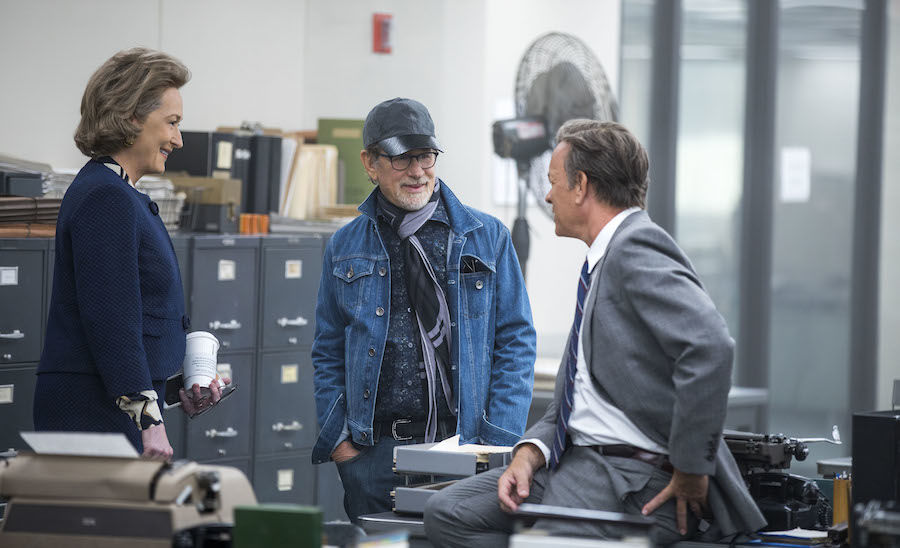

A movie can often take on a resonance far beyond that which its makers may at first have intended. This is certainly the case with The Post, which, despite some weaknesses, carries with it two very powerful and relevant messages for today’s world.
Ostensibly The Post is about the publication of the Pentagon Papers. These secret documents were leaked to the press and revealed that successive presidents had lied to the public about America’s involvement in the Vietnam War. As such, they did much to bring about America’s withdrawal from Vietnam – and not a little to discredit the White House. While this forms a largely over-simplified background to the movie, it is certainly one in which Daniel Ellsberg’s vital and brave part in the matter is grossly minimized. Instead, The Post concentrates on the decision by the leadership of The Washington Post to publish the Pentagon Papers at risk of imprisonment since President Nixon had filed an injunction against such publication.
This approach allows for an emphasis on the part played by Kay Graham, chairman of the newspaper. This role she assumed when her husband, who had been handed the role of chairman by her father, committed suicide. In large measure, this becomes the focus of the film which assumes a distinctly feminist tone as it shows an intelligent and independent woman assuming a leadership role in a man’s world. In the light of recent developments and the torrent of sexual harassment charges, The Post becomes another cry for long overdue recognition of the need for women to be able to assume their proper role in society.
At the same time, the film also emphasizes the need for a vibrant and eloquent newspaper industry. It reminds viewers of the demise of the print newspaper as a result of the impact of on-line media, not to mention attacks on the press in the form of President Trump’s rejection of what he calls “fake news.” The result is that lengthy, thoughtful, and careful analysis by reporters has been replaced by superficial headlines emphasizing only the sensational – and only for a brief period of time since the media have managed to shrink audience attention span to a minimum. The most powerful contribution of the movie The Post is that it is a timely reminder of the vital role that the Fourth Estate plays in a democracy.
However, this does not mean that the film is flawless. Apart from its dubious recounting of the actual events, it is a film which is decidedly scattered in its approach, in large measure because of its focus. Moreover, Andrew Nicol’s script suffers from a number of lapses in credibility, most notably in a syrupy portrait of family life, part of a decidedly softened representation of Ben Bradlee, editor of the newspaper, in reality a man of considerable iron.
Of course, this does allow Tom Hanks to retain his jovial and popular image. Similarly, Kay Graham is depicted as not only the well connected socialite that she was, but also as a warm and caring mother and friend, which she may well have been. This, of course, enables Meryl Streep to show her as a complex person in yet another finely nuanced performance – another likely Oscar nomination.
Then, too, Steven Spielberg has tried to lend the proceedings more coherence than the script provides, and in a number of scenes – including pandemonium at the Bradlee house where the editorial staff try to make sense of a tangle of papers – he nicely bridges the gap between comedy and suspense.
And nothing is more thrilling – or nostalgic – than the climactic depiction of an old-fashioned newspaper printing. It certainly makes one more fully aware of what is being lost as newspaper after newspaper goes out of print, to be replaced by television’s “in depth” coverage of issues in three minutes between commercials, and mass media’s texts and tweets.
Following as it does such superb (and superior) films as All the President’s Men and Spotlight, The Post, for all its flaws, delivers a powerful and timely message in a generally entertaining fashion.







