

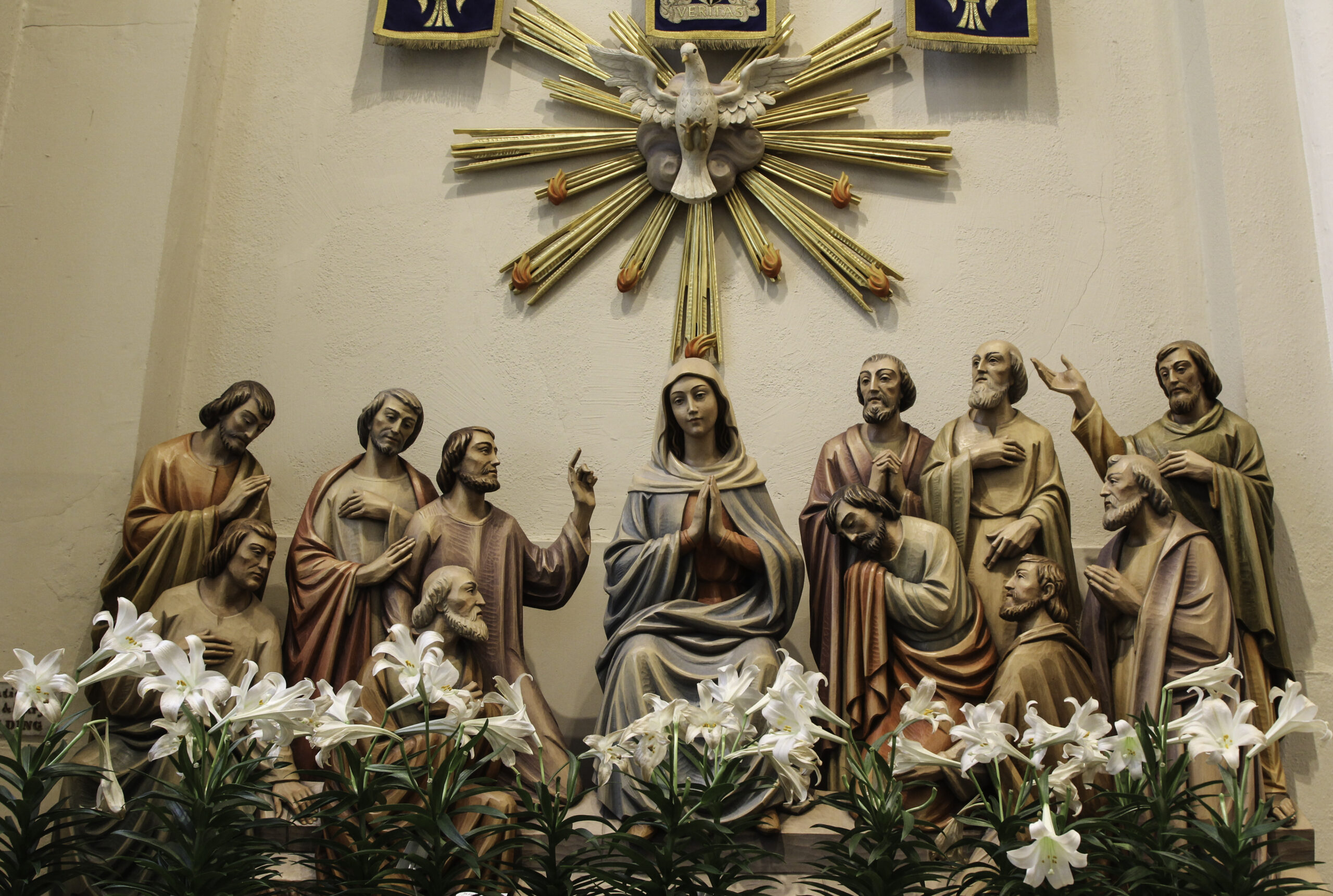

Some events change everything. For Christians, Pentecost is one of them. It is the day the Holy Spirit came down upon the apostles and the Church was born.
The story is told in the Acts of the Apostles, Chapter 2. The disciples were gathered together in Jerusalem when suddenly there came a sound like a mighty wind. Then tongues of fire appeared and rested on each of them. About 3,000 people were baptized that day. The Church had begun.
In the Old Testament, God had revealed himself through wind and fire—especially at Sinai, where he gave the law to Moses. As St. Leo the Great saw it, the parallel was deliberate: “The same Spirit who instituted the first established the Second Covenant.” Pentecost was already a great Jewish feast—originally a harvest thanksgiving, later a commemoration of the giving of the law. Now it became the day of a new harvest: the gathering of souls into the Church.
The fire that appeared over the apostles carried deep meaning. St. Cyril of Jerusalem described its effect on those who received it: “This is a fire that consumes the thorns of sins but gives lustre to the soul.” St. Bede drew out its double significance: “All those whom he fills he makes simultaneously to burn and to speak—to burn because of him and to speak about him.” The wind, too, was a sign of irresistible power. As St. John Chrysostom noted, it showed that the apostles would “blow away all adversaries like a heap of dust.”
Filled with the Holy Spirit, the apostles began to speak in different languages. This was the reversal of the Tower of Babel. There, human pride had shattered the unity of language and divided the nations. Here, the Spirit was beginning to undo that division. The Second Vatican Council teaches that the Church “speaks every language, understands and embraces all tongues in charity, and thus overcomes the dispersion of Babel.” St. Cyril of Jerusalem called it “a second confusion, in contrast to the first evil confusion at Babylon”—but a confusion that restored rather than scattered, that united rather than divided.
Yet the greatest transformation at Pentecost was not in languages. It was in people. St. John Chrysostom marvelled at the change in St. Peter: “He who could not endure the questioning of a poor girl now discourses with such great confidence in the middle of people all breathing murder upon him… Wherever the Holy Spirit is present, people of clay are changed into people of gold.”
St. Cyril of Alexandria said, “Where once we were cowardly and full of fright, he makes us spiritually brave and dauntless.”
St. Peter’s sermon is a model of pastoral wisdom. He does not begin with accusation. He begins with Scripture. St. John Chrysostom commented: “They stood in awe of the gentleness of Peter, because he was speaking like a father and caring teacher to those who crucified his master and breathed murder against himself and his companions. They were not merely persuaded; they even condemned themselves. They came to a sense of their past behaviour.”
The crowd was pierced. They asked what they must do. St. Peter’s answer was direct: repent, be baptized in the name of Jesus Christ, receive the forgiveness of sins and the gift of the Holy Spirit. About three thousand were baptized that day.
These thousands of new believers, drawn from dozens of nations and languages, formed a community. They devoted themselves to four things: the apostles’ teaching, fellowship, the breaking of bread, and prayer.
St. John Chrysostom observed: “The sacred writer draws attention to two virtues in particular—perseverance and fellowship—and tells us that the apostles spent a long period instructing the disciples.”
Chrysostom also commented on their voluntary sharing of material things: “This voluntary poverty and detachment cut at the selfish root of many evils, and the new disciples showed that they had understood the Gospel teaching.”
St. Augustine saw in this community life a reflection of the Trinity itself: “If the love of God poured forth in our hearts by the Holy Spirit is able to make of many souls but one soul and of many hearts but one heart, how much more are the Father and the Son and Holy Spirit but one God, one light, one principle?”
Your voice matters! Join the conversation by submitting a Letter to the Editor here.
聖神降臨:教會的誕生
有些事件改變了一切。對基督徒而言,五旬節正是如此的一天。那一天,聖神降臨宗徒身上,教會由此誕生。
宗徒大事錄第2章記載了這段歷史。門徒們聚集在耶路撒冷時,一陣響聲,好像暴風颳來。有些散開好像火的舌頭,停留在他們每人頭上。那一天大約有三千人受了洗,教會就此開始。
在舊約中,天主曾以風和火彰顯祂自己—尤其是在西乃山,祂把法律交給梅瑟。聖良一世指出,這種對照並非偶然:「建立第一次盟約的聖神,也建立了第二次盟約。」五旬節原本是猶太人的大節日—最初是收穫感恩祭,後來成為紀念法律頒布的日子。如今,成為新的收穫之日:把靈魂聚集進入教會。
出現在宗徒頭上的火具有深刻的意義。耶路撒冷的聖濟利祿描述這火在領受者身上的效果:「這火焚毀罪惡的荊棘,卻使靈魂光耀。」聖伯達也指出這火的雙重象徵:「凡被這火充滿的人,同時被點燃並開始宣講—因這火而燃燒,並為這火而說話。」至於那陣風,則象徵不可抗拒的力量:金口聖若望說,那陣風顯示宗徒將「像吹散塵土般吹走所有敵對者」。
宗徒們被聖神充滿後,開始說起不同的語言。這是巴貝耳塔的逆轉。當年,人類的驕傲破壞了語言的統一,使萬民分裂。如今,聖神開始修補這裂痕。梵蒂岡第二屆大公會議教導說,教會「以愛德說各種語言、理解並擁抱一切語言,因而克服了巴貝耳的分散」。聖濟利祿稱之為「第二次混亂,與巴比倫第一次邪惡的混亂相反」—但這次的混亂是為了重建而非破壞,為了合一而非分裂。
然而,五旬節最大的轉變並不在語言,而在人心。金口聖若望驚嘆伯多祿的轉變:「那位連一個侍女的質問都承受不了的人,如今竟能在滿是想殺害他的人群中如此自信地講道…。凡有聖神臨在之處,泥土般的人都會變成黃金般的人。」
亞歷山大的聖濟利祿說:「我們曾經懦弱、恐懼,但祂使我們勇敢無畏。」
伯多祿的講道是牧靈智慧的典範。他並非從指責開始,而是從聖經開始。金口聖若望評論說:「他們對伯多祿的溫和感到敬畏,因為他像一位父親、一位慈愛的老師般對那些曾釘死他師傅、並想殺害他和同伴的人說話。他們不僅被說服,甚至自我譴責,開始反省自己的行為。」
群眾深受觸動,問他們該怎麼做。伯多祿的回答直接明確:悔改,以耶穌基督之名受洗,領受罪赦和聖神的恩賜。那一天約有三千人受洗。
這些來自不同國家和語言的數千名新信徒形成了一個團體。他們專務四件事:宗徒的教導、團體共融、擘餅、祈禱。
金口聖若望指出:「聖經作者特別強調兩種德行—恆心與共融,並告訴我們宗徒花了很長時間教導門徒。」他也評論他們自願分享財物的做法:「這種自願的貧窮與超脫,切斷了許多罪惡的自私根源,新門徒顯示他們真正理解了福音的教導。」
聖奧斯定在這團體生活中看見了至聖三位一體的反映:「如果天主的愛藉聖神傾注在我們心中,能使眾多靈魂成為一個靈魂、眾多心成為一顆心,那麼聖父、聖子和聖神更是超越萬有的唯一的天主、唯一的光、唯一的本原。」
Your voice matters! Join the conversation by submitting a Letter to the Editor here.







