


Movie audiences, both Christians and others, have becomes so familiar with so-called Biblical epics, ranging from The Ten Commandments to The Passion of the Christ, depicting dramatic, action-filled sequences, that it is understandable that they might have similar expectations of Paul, Apostle of Christ.
After all, most Christians and many non-believers will be somewhat familiar with the action-packed journeys of Paul as he spread the word of Christ to Jews and Gentiles. However, this is far from the focus of this film.
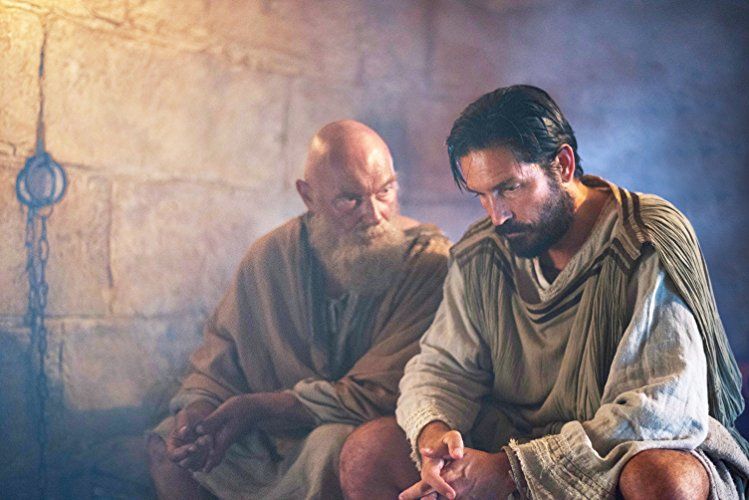
In fact, the film is concerned only with Paul’s imprisonment in Rome, leading up to his death. Instead of concentrating on dramatic action, this film in current release is rather more an invitation to meditation and reflection.
While it is set against the horrific persecution of Christians by Nero, whom he accused of the burning of Rome, the film eschews any attempt at depicting the martyrs in the arena. Indeed, there are only passing glimpses of the horrors inflicted on the Christians.
This is certainly no Quo Vadis; there is no Peter Ustinov shamelessly having a good time as a self-indulgent Nero while the Roman mob cheers on the lions attacking the martyrs. Indeed, there is no attempt at all to show Paul actually carrying out his active preaching mission; even his dramatic conversion is confined to a brief flash-back.
Instead of concentrating on the more obvious aspects of epic deeds, the film offers little in the way of plot, but is instead a concentration on the dilemma of the early Christian community.
Should they stay in Rome at risk of martyrdom and attempt to convert the city, or should they flee to safety? Should Luke, a physician, attempt to save the life of the daughter of a Roman general, a supporter of Nero and a worshipper of pagan gods, especially when to do so he is risking the lives of fellow-Christians?
So it is that one group of Christians in hiding welcomes Luke, the author of The Acts of the Apostles, as he visits Paul for the last time. This allows for the development of themes of love, forgiveness, patience, and acceptance. Even in a scene in which another group of Christians awaits martyrdom, the concentration is upon the rewards of faithful fidelity, rather than the suffering itself. The result is a film heavy on dialogue, light on action.
For many, Paul, Apostle of Christ will be a welcome alternative to the overblown religious sagas which have been a Hollywood mainstay since the early days of cinema. It is a quiet, dignified film that has clearly been produced to provide a restrained, thoughtful view of the Christian dilemma.
In this, it is both a comment on a particular period in early Church history and, by implication, a comment on the Christian response to a world which frequently attacks religious belief in general and Christianity in particular.
It is a sincere and unusual project: well-acted, convincingly depicted, and deliberately (almost ponderously) developed. This is, of course, totally praiseworthy from a faith perspective. Doubtless, for many believers it will serve as a timely reminder of Christian values, totally appropriate to the Easter season.
However, for those going to the cinema in search of dramatic action, of stirring deeds in the face of cruel tyranny, and impressive large-scale scenes, the film will be a disappointment. Because of this, the film is unlikely to find an audience, for though it is well-intentioned and loyal to its vision, it is certain to have limited appeal to film audiences as a whole.







