


Overall approval for Pope Francis’ historic apology on Canadian soil was dampened by fault-finding from media and other critics who focused on finding aspects of his visit and apology that could be condemned as falling short.
Two particular controversies continue to dog the Pope in the wake of the visit: his failure to repudiate the so-called Doctrine of Discovery led to media faulting him for seemingly not being informed well enough about the doctrine. He was also taken to task for not using the word genocide in his apologies, until he agreed to utter the word on the plane home.
In the following commentaries, writers examine the criticisms and what was behind the media narratives.
The Catholic ‘Doctrine of Discovery’ is already null and void
By Brendan Steven
At last, the Pope has apologized on Canadian soil for the Catholic role in this country’s shameful history of residential schools.
Will the apology be accepted? A friend reminded me that forgiveness is an act of the will. Every residential school survivor and family member will choose for themselves what this apology means to them. An APTN correspondent described the reaction of one woman: “The moment [the Pope] apologized, she felt all her sadness and anger leave her body.” If for that alone, this visit is worth it.
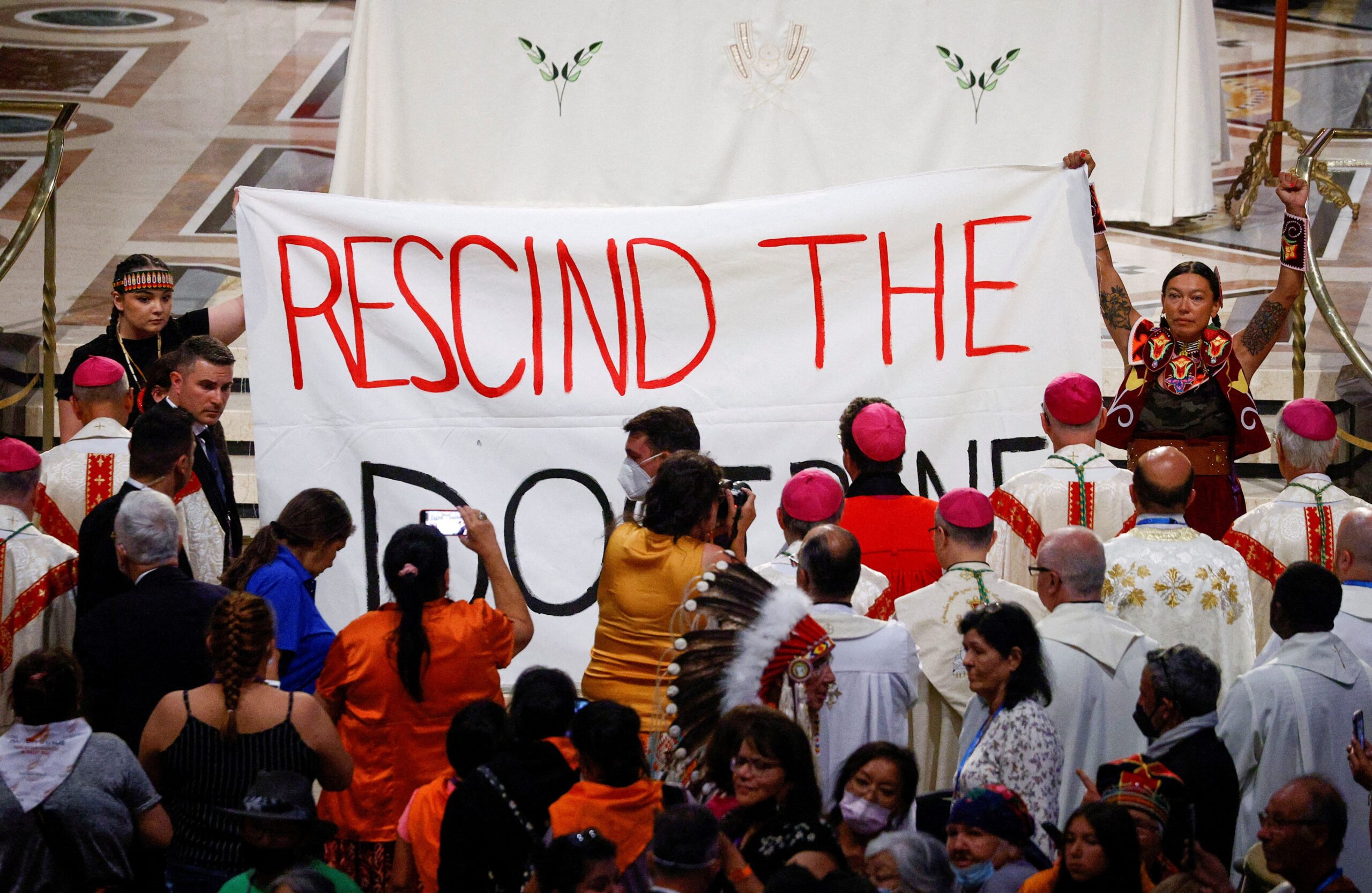
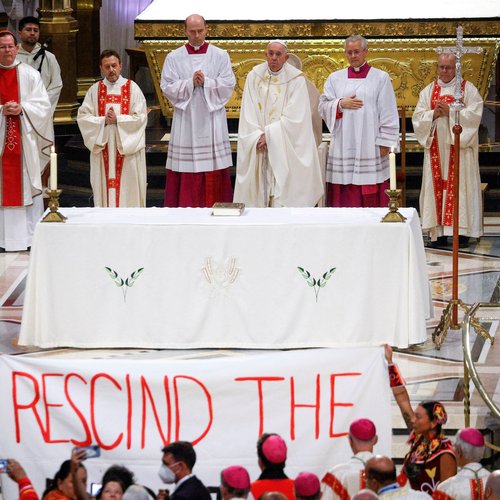
It is not my place to say whether the apology should be accepted. But for some of those rejecting it, one reason why casts a long shadow: the Doctrine of Discovery. The issue inflames passions. Just last week, at a papal Mass in Quebec, activists unfurled a banner that read “RESCIND THE DOCTRINE”.
To them, I am happy to report that the Church has done exactly that. There is no Catholic Doctrine of Discovery. The claim that one is part of contemporary Catholic teaching is simply untrue.
So, what is the Doctrine of Discovery? Things get a little confusing here. The term “Doctrine of Discovery” was first articulated by the U.S. Supreme Court in 1832. It describes a principle whereby sovereignty over “new” lands was claimed by Europeans who first “found” them, whether or not Indigenous peoples already lived there. Today’s use of the term is broader. It is a catch-all that takes in a separate concept, terra nullius–the false notion that Europeans discovered empty land for the taking.
When you hear the Doctrine of Discovery and the Catholic Church referenced together, what is most often being described is a series of papal bulls promulgated during the Age of Discovery. What is a papal bull? First, it is not a doctrine in the theological sense. There is a misconception that, for Catholics, everything the Pope says is infallible, issued forth as if from the mouth of God himself. Only in some very specific cases is what the Pope declares considered an infallible teaching. Papal bulls are not one of those cases.
Bulls are political declarations made by the Pope. They are retractable. They come from a time when the Vatican had hard political power. There is not space here to give the fullest explanation for each of these papal bulls and their content. For that, I refer you to the Canadian Conference of Catholic Bishops’ own condemnation of the Doctrine of Discovery and terra nullius. Suffice to say, together, these papal bulls provided something like permission for certain Catholic European powers to exert sovereignty over new territories.
Of course, those countries did what they pleased, with or without the Vatican’s permission. For instance, these infamous papal bulls include Inter Caetera of 1493. It gave Spain approval to rule over a large part of the Americas. This bull aimed to settle territorial disputes between Spain and Portugal. It failed in that purpose. Spain broke terms soon after, expanding past the boundaries the bull had set. Spain then went further, using the bull as justification for robbing local Indigenous peoples of land and sovereignty. No wonder the Truth and Reconciliation Commission’s Calls to Action reference the Doctrine of Discovery and terra nullius at multiple points, including a call for religious denominations to repudiate it.
That is what the Catholic Church has done. It did not take long to do it. Inter Coetera began abrogating a year after it went into effect, all because Spain violated it. Keep in mind, as the Vatican itself has stated, subsequent papal bulls abolish previous ones. In 1537, Pope Paul III issued a new bull, Sublimus Deus, declaring that “Indians and all other people who may later be discovered by Christians, are by no means to be deprived of their liberty or the possession of their property… and that they may and should, freely and legitimately, enjoy their liberty and the possession of their property; nor should they be in any way enslaved; should the contrary happen, it shall be null and have no effect.” The Canadian bishops list several papal decrees that follow the path set by Sublimus Deus:
- Pope Urban VIII in the bull Commissum Nobis, condemning Portuguese abuse of Indigenous people under their rule;
- Pope Benedict XIV in the bull Immensa Pastorum, condemning the enslavement and abuse of Indigenous peoples and excommunicating any Catholic involved in the slave trade;
- Pope Gregory XVI’s apostolic letter In Supremo, condemning slavery in Africa and the Indies; and,
- Pope Leo XIII’s encyclical In Plurimis, calling for the abolition of slavery in Brazil and worldwide.
Turning to the modern era, the Vatican repudiated the bulls before the U.N. in 2010, saying that “Inter Coetera has already been abrogated” and is “without any legal or doctrinal value. They go on to say, “the fact that juridical systems may employ the ‘Doctrine of Discovery’ as a juridical precedent is therefore now a characteristic of the laws of those states and is independent of the fact that for the Church the document has had no value whatsoever for centuries.”
More recently, in a 2016 statement condemning the principles which undergirded the Doctrine of Discovery and terra nullius, the Canadian bishops alongside other leading Catholic Canadian organizations declared that “we firmly assert that there is no basis in the Church’s Scriptures, tradition, or theology, for the European seizure of land already inhabited by Indigenous Peoples” and “we reject the assertion that the principle of the first taker or discoverer, often described today by the terms Doctrine of Discovery and terra nullius, could be applied to lands already inhabited by Indigenous Peoples.”
And, of course, we have the words of Pope Francis himself, spoken earlier this week: “I am deeply sorry. Sorry for the ways in which, regrettably, many Christians supported the colonizing mentality of the powers that oppressed the indigenous peoples. I am sorry. I ask forgiveness, in particular, for the ways in which many members of the Church and of religious communities cooperated, not least through their indifference, in projects of cultural destruction and forced assimilation promoted by the governments of that time, which culminated in the system of residential schools.” Organizers of the papal visit point to this last statement as a repudiation of the Doctrine of Discovery.
Beyond denouncing the Doctrine, the Canadian bishops have strongly supported the implementation of the United Nations Declaration on the Rights of Indigenous Peoples (UNDRIP), and that UNDRIP “resonates strongly with statements already made by the Catholic Church.” These include Indigenous self-determination, self-government, right to traditional territories, right to their own educational institutions, and more. The principles contained in UNDRIP are the antithesis of the Doctrine of Discovery. In his pilgrimage to Canada, the Pope explicitly says Canadian Catholic communities are committed to promoting Indigenous peoples and cultures “in the spirit of UNDRIP.”
Still, as Archbishop Don Bolen of Regina said, “those papal bulls are not operative, [yet] on the other hand, we resonate with the Indigenous desire to name those papal bulls, to say we completely distance ourselves from them.” The archbishop shared that a Vatican document is being produced that will provide even more clarity on the issue.
Clarity is only ever a good thing. But despite the confusion, we cannot forget the reality: when it comes to Catholic teaching, the Doctrine of Discovery is null and void.
Brendan Steven is a writer based in Toronto and serves with several organizations as part of the city’s Catholic community.
Doctrine of discovery first repudiated in 1537
Efforts to get Pope Francis to take back the words of two 15th-century popes got another boost during his trip to Canada with calls for him to repudiate the “Doctrine of Discovery.”
“I am asking the Holy Father to renounce and formally revoke the 1493 Doctrine of Discovery and replace it with a new papal bull that decrees Indigenous peoples and cultures are valuable, worthy and must be treated with dignity and respect,” Assembly of First Nations National Chief RoseAnne Archibald told The Catholic Register in an email before 13 AFN delegates were scheduled to meet with Pope Francis in Rome.
The 2008 to 2015 Truth and Reconciliation Commission recognized the importance of the Doctrine of Discovery to any process of reconciliation. Its Call to Action #49 said, “We call upon all religious denominations and faith groups who have not already done so to repudiate concepts used to justify European sovereignty over Indigenous lands and peoples, such as the Doctrine of Discovery and terra nullius.”
However, the papal bull has already been repudiated by other popes, going back as far as 1537.
The declaration is a legal principle that passed from Church law into common law. It granted the European discovering powers a kind of unrestricted sovereignty over the lands and peoples they discovered. It began with a series of papal bulls issued by Pope Nicholas V and Pope Alexander VI before and just after Christopher Columbus returned from his first contact with the Americas.
In his 1455 bull Romanus Pontifex, Pope Nicholas V gave Portuguese King Alfonso a licence to “invade, search out, capture, vanquish, and subdue” the people in new lands of discovery. The bull encouraged the king to “reduce their persons to perpetual slavery, and to apply and appropriate to himself and his successors the kingdoms, dukedoms, counties, principalities, dominions, possessions and goods, and to convert them to his and their use and profit.”
Applied mainly to Portuguese discoveries along the coast of Africa, it was meant to encourage King Alfonso in his battle against the Muslim Saracens.
By 1493 Pope Alexander VI had a broader scope of discovery to consider, courtesy of Columbus. He granted rights to the kings of Castile and Leon to establish dominions in most of the Americas, and the Portuguese to have the same rights in any lands east of a line from North Pole to South Pole 100 leagues west of the Azores and Cape Verde. That majestic line drawn by Pope Alexander is how Brazil ended up speaking Portuguese.
Within these New World dominions, Alexander made the respective kings responsible for baptizing the natives.
“We exhort you very earnestly in the Lord and by your reception of holy Baptism, whereby you are bound to our apostolic commands, and by the bowels of the mercy of our Lord Jesus Christ, enjoin strictly, that inasmuch as with eager zeal for the true faith you design to equip and dispatch this expedition, you purpose also, as is your duty, to lead the peoples dwelling in those islands and countries to embrace the Christian religion,” wrote the Pope.
European kings could exploit New World land and people, but they also had to convert them.
It’s not hard to imagine today that Pope Francis might find these bulls worth repudiating – if only other popes hadn’t already done the job, beginning with Pope Paul III in 1537. In another bull Pope Paul attributed all this talk of enslaving and exploitation to “the enemy of the human race.”
“We… consider… that the Indians are truly men and that they are not only capable of understanding the Catholic Faith but, according to our information, they desire exceedingly to receive it,” wrote Paul III.
“Indians and all other people who may later be discovered by Christians, are by no means to be deprived of their liberty or the possession of their property, even though they be outside the faith of Jesus Christ; and that they may and should, freely and legitimately, enjoy their liberty and the possession of their property; nor should they be in any way enslaved; should the contrary happen, it shall be null and have no effect.”
The bull, called Sublimus Dei, is somewhat controversial because it’s unclear whether it was ever promulgated outside the Vatican. In Medieval and Renaissance Europe it fell to popes to issue bulls, but it was the job of kings to promulgate and enforce them in their kingdoms. The Spanish and Portuguese kings were already up to their eyeballs in New World gold and silver and seem to have lost track of Sublimus Dei.
But repudiation of the Doctrine of Discovery didn’t end with a one-page papal bull in 1537. In 1992 in Santo Domingo, on the 500th Anniversary of Christopher Columbus landing there, Pope John Paul II confessed and begged forgiveness for the sins of the Church in the Spanish conquest of America.
At Fort Simpson in 1987, Pope St. John Paul II invoked Pope Paul III’s brief Pastoral Officium as he laid out Church teaching for Indigenous people.
“The Church extols the equal human dignity of all peoples and defends their right to uphold their own cultural character with its distinct traditions and customs… He (Pope Paul III) affirmed their (Indigenous people’s) dignity, defended their freedom and asserted that they could not be enslaved or deprived of their goods or ownership. That has always been the Church’s position,” he said.
In 2000, kneeling before the Holy Doors as he opened the Great Jubilee, John Paul II begged forgiveness for the times the Church had relied on violence in its efforts to evangelize.
“John Paul II’s statements on Indigenous rights were inspiring to me and I wish that more Roman Catholics (especially most of the Canadian bishops) were familiar with them,” MacDonald said. “I personally do not feel that repudiation (of the Doctrine of Discovery) is necessary. What is critical is the apology.”
In 2007 Pope Benedict XVI acknowledged “the shadows that accompanied the evangelization of the Latin American continent,” while in 2015 at Santa Cruz in Bolivia Pope Francis asked forgiveness for sins, offences and crimes committed by the Catholic Church against Indigenous peoples during the colonial era.
In 2016, Canada’s Catholic bishops released a document responding to Truth and Reconciliation Call to Action #49, which asks “all religious denominations and faith groups who have not already done so to repudiate concepts used to justify European sovereignty over Indigenous lands and peoples, such as the Doctrine of Discovery and terra nullius.”)
The Catholic Register
Canadian bishops renounced doctrine in 2016
In 2016 in response to Call to Action #48 by the Truth and Reconciliation Commission and to questions raised on the legal concepts known as the “Doctrine of Discovery” and terra nullius, four Canadian Catholic organizations representing bishops, institutes of consecrated life, societies of apostolic life, Indigenous people, and laity issued a document entitled “The ‘Doctrine of Discovery’ and Terra Nullius: A Catholic Response.
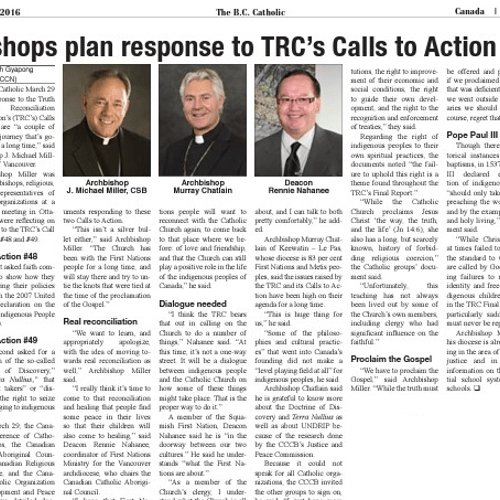
The document’s introduction says it “considers and repudiates illegitimate concepts and principles used by Europeans to justify the seizure of land previously held by Indigenous Peoples and often identified by the terms ‘Doctrine of Discovery’ and terra nullius.”
The signatories said “now is an appropriate time to issue a public statement in response to the errors and falsehoods perpetuated, often by Christians, during and following the so-called Age of Discovery.”
To read the document click here.
Genocide question was crafted by journalists on flight
Pope Francis didn’t use the word “genocide” when he apologized three times while touring Canada – in Maskawicis, Alta., Quebec, and Iqaluit – for Catholic involvement in “cultural destruction” wrought by Canada’s residential school system for Indigenous children. But asked about it on the flight home from Iqaluit to Rome, the Pontiff quickly agreed the g-word fit.
“Yes, genocide is a technical word, but I did not use it because I did not think of it. But I described – yes, it is a genocide, yes, yes, clearly. You can say that I said it was a genocide,” he said. “I asked for forgiveness for this genocidal work.”
The question, authored collectively by the Canadian journalists travelling with the Pope, was posed to Pope Francis by Indigenous reporter Brandi Morrin. She asked whether Pope Francis would use the word in a spirit of honesty, forthrightness and parrhesia.
The answer was, “Yes.”
The papal apologies issued in Quebec City and Iqaluit referred to “evil perpetrated by not a few Catholics who contributed to the policies of cultural assimilation.” The “not a few” wording was seen as an effort to blunt criticism that the first apology seemed to leave room for the “a-few-bad-apples” argument.
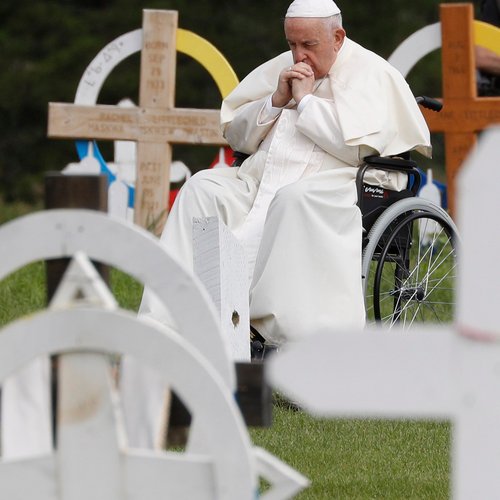
Pope Francis prays at the Ermineskin Cree Nation Cemetery before meeting with First Nations, Metis and Inuit communities at Maskwacis, Alta. where he apologized for the Catholic role in the history of residential schools. (CNS photo/Paul Haring)
Catholic religious orders and dioceses ran about 60 per cent of the schools that separated 150,000 Indigenous children from their families, communities, language, and traditions between 1881 and 1996. A tradition of Catholic entities taking collective responsibility for the damage done throughout the residential school history began with the Oblates of Mary Immaculate issuing an apology at Lac Ste. Anne in 1991.
A papal apology, to represent broader Catholic complicity in and support for the system, was sought by Canada’s Truth and Reconciliation Commission in Call to Action #58, issued in 2015.
Canadian reporters also asked whether Pope Francis had missed an opportunity by not saying something about the Doctrine of Discovery. Both in Quebec and Iqaluit, protest signs appeared asking Pope Francis to rescind the doctrine.
In this case, Pope Francis challenged the journalist to define the term.
Some journalists interpreted this as the Pope, perhaps not briefed on the issue, trying to avoid giving an answer. But Pope Francis hinted, as have several bishops travelling with the Pope in off-the-record conversations, that some sort of statement about the long history of Church involvement in colonialism is on the way.
The Catholic Register
One papal flaw – genocide?
Whether Pope Francis proves correct that the Indian residential school system constituted “genocide,” he erred three times during the concluding media conference for his otherwise near-flawless penitential pilgrimage across Canada.
“Yes, it was a genocide, yes, yes, clearly,” the Holy Father said using language that made headlines globally.
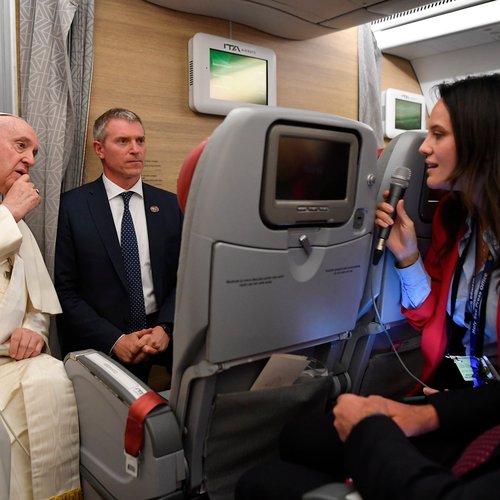
Pope Francis listens to a question from a journalist aboard his flight from Iqaluit to Rome July 29. (CNS photo/Paul Haring)
But no. Not “clearly.” Arguably. In the pontiff’s opinion self-evidently, as in the opinion of many others. But it was an error of established fact, history, and international law to call it “clearly” genocide. Raging debate remains among Canadian historians about whether “genocide” applies to the residential school system. Views differ on whether even the coinage “cultural genocide” in the final report of the Truth and Reconciliation Commission satisfies genocide’s meaning.
The obstacle is logical. The word originates in the horrors of the Holocaust. Given the totalizing madness of the Nazi “Final Solution,” is it even possible to alter genocide’s nature with modifiers such as “cultural”? The United Nations Office on Genocide Prevention and the Responsibility to Protect seems to clearly answer “No.”
“To constitute genocide, there must be a proven intent on the part of perpetrators to physically destroy a national, ethnical, racial, or religious group. Cultural destruction does not suffice, nor does an intention to simply disperse a group. It is this special intent, or dolus specialis, that makes the crime of genocide so unique,” the UN Office’s website says.
The emphasis on “proven intent on the part of perpetrators” explains why the Irish Famine of 1845-1850, which killed a million people, fails to qualify as genocide. For, contrary to the pontiff’s second error at the media conference, geno (Greek for race or tribe) cide (Latin for killing) is not merely a “technical term” denoting generalized horrendous acts.
Genocide is “codified as an independent crime in the 1948 Convention on the Prevention and Punishment of the Crime of Genocide (the Genocide Convention),” the UN Office says. Codification followed negotiation of specific meaning. It has evolved through case law based on five explicit and “exhaustive” criteria. The case law now associates genocidal intent “with the State or an organizational plan or policy.”
Here, Francis’ “clearly genocide” error exceeds mere lexical nitpicking. The Pope is a head of state. He was a head of state on a state visit to another state. As head of state, he declared the Canadian state guilty of genocide, and also declared the state he heads guilty of the same internationally codified crime. The Holy Father’s third misstep, then, was far more serious than claiming clarity for what remains undetermined. Nor did he just reduce legality to technicality. With all the great good he did on his penitential pilgrimage, he also placed the Church at existential risk by, however inadvertently, convicting her of a crime for which she has not even been charged, much less found guilty. Walking back “clearly genocide” is clearly essential.
Catholic Register editorial







