

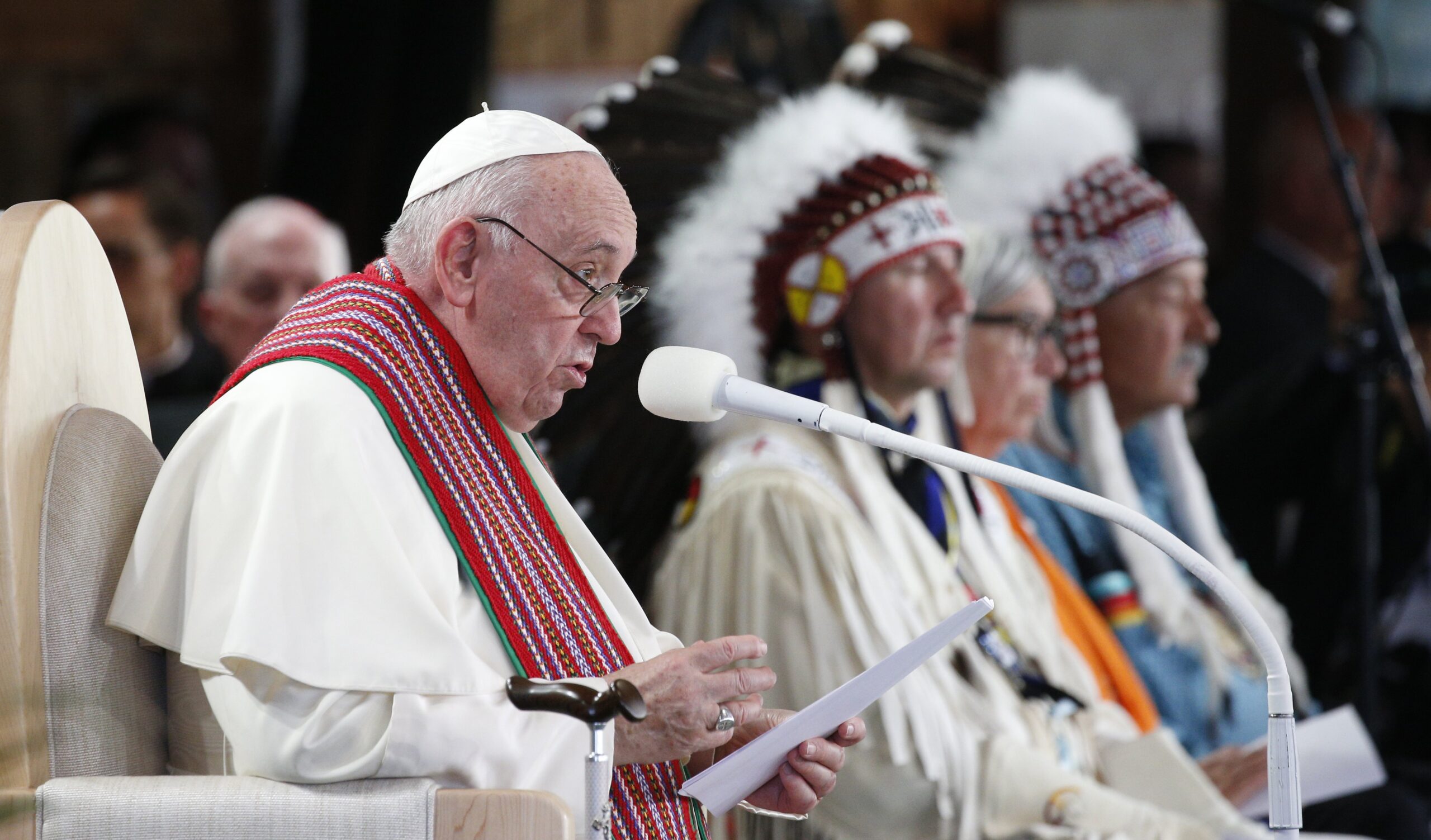

Prominent Canadians engaged in First Nations issues and ministries were generally supportive of the Vatican’s repudiation of the “doctrine of discovery.” Below are some of their responses.
The ‘doctrine of discovery’ is built on lies
By Deacon Rennie Nahanee
I am happy to see that the Catholic Church has finally repudiated the so-called “doctrine of discovery,” or as I call it, “How to steal Indigenous land and get away with it American-style, followed by the 51st state we call Canada.”
Fifteenth-century papal bulls were twisted around by the two countries to their advantage, trying to make everything churchlike by creating a new name, the doctrine of discovery, which every Christian should know is not a Church teaching.
The doctrine spawned from the idea of terra nullius (land empty or unused by Christians), which fooled the masses because it sounded canonical. In the 19th century, the U.S. government forcibly placed native Americans on reservations, essentially removing their ancestral lands from their ownership. The ancestral territories became terra nullius.
Canada followed suit and turned more than 99 per cent of Native Canadian lands into Crown land. All the Canadian reserves could fit into one of the larger reservations in America.
Although the papal bulls were written with the intention of protecting Indigenous people, the “doctrine of discovery” and terra nullius became a Pandora’s box that released many evils upon Indigenous people who were not immune to the viruses that killed so many of them. Nor were they immune to all the other evils these policies released upon them.
The “doctrine of discovery” is built on lies. Perhaps someday, it will be removed from the legal systems in both countries, and our land and resources will be returned to their rightful owners.
Deacon Rennie Nahanee is a Squamish elder who served for 11 years as coordinator of First Nations Ministry for the Archdiocese of Vancouver.
Indigenous people were Christian-like before converting
By Kevin Barlow
As an Indigenous Catholic, I welcome these statements to further acknowledge historical harms with a renewed commitment to seeking forgiveness for the failings of the past.
Pope Paul III even had to issue an edict confirming that Indigenous people were human beings with souls. This speaks to the violence of those seeking to conquer and exploit lands occupied by Indigenous people throughout the world.
Here in Canada, it is important to note that Indigenous people were Christian-like even before converting to Christianity. For example, my people, the Mi’kmaq, welcomed newcomers to this land who arrived sick with scurvy and very challenged to withstand the harsh winters here. We aided them as a Christian would do. The breakdown came afterward, likely with sights on taking over land instead of living in harmony with the Indigenous people here.
I know there are many Indigenous people with very deep wounds to their souls. Yet, I call on them, as I have done with my life and experiences, to seek out forgiveness so we can move forward. We do this for our own good, so we can have peace.
Kevin Barlow is a Catholic member of the Mi’kmaw nation who has advised the Archdiocese of Vancouver on Indigenous issues.
A key signpost on path to reconciliation and forgiveness.
By Deacon Andrew Bennett
Today’s statement is both necessary and welcome as it clarifies and affirms that the so-called “doctrine of discovery” has never been the teaching of the Catholic Church.
However, this does not deny that such a belief or a version thereof was employed by imperial powers in the colonization of the Americas to justify their abhorrent attempts at assimilation of Indigenous peoples. These moves to assimilate them and denigrate their culture were motivated not by an authentic proclamation of the Gospel but by crass political motives. It is essential that this distinction was made.
Indeed, the Vatican’s reaffirmation of the inherent dignity of Indigenous persons created in the image and likeness of God, and the role of many Catholics, lay, clergy, and religious in defending their dignity over the centuries, are a key signpost on the path to reconciliation and forgiveness.
Catholics in Canada, both Indigenous and non-Indigenous, must lead the way in championing the human dignity of so many Indigenous Canadians who continue to struggle due to poor economic and social conditions. Reconciliation and forgiveness are achieved through recognition and apology but also through corporal works of mercy that bring us face-to-face with Christ in all those who suffer indignities.
All Catholics and people of goodwill should welcome the Vatican’s statement. As Christians, we must pray that the clarity it brings allows us to move ever forward toward making the peace, great mercy, forgiveness, and love of Jesus Christ more fully present in our beloved Canada.
Deacon Andrew Bennet is a religious freedom advocate who serves as a Ukrainian Catholic deacon in the Eparchy of Toronto and Eastern Canada.







