
Feast of Christ the King, Year C
First Reading: 2 Sm 5:1–3
Second Reading: Col 1:12–20
Gospel Reading: Lk 23:35–43
The Bible calls Jesus Christ “Lord,” “Son of God,” “the alpha and the omega,” “the author of life,” and “my Lord and my God.”
However, perhaps the most telling phrase is the one in this Sunday’s Second Reading: “Christ is the image of the invisible God, the firstborn of all creation,” the one in whom “all the fullness of God was pleased to dwell.”
To make sure that we do not miss the implications, St. Paul spells them out: “in him all things in heaven and on earth were created, things visible and invisible, whether thrones or dominions or rulers or powers” (the names of the angelic choirs).
Jesus is the prototype of all finite existence, even of the great angelic powers that transcend the world and govern human affairs. He is the origin of all creation without exception, after whom everything else is just a copy or representation. That includes planets, stars, individuals, societies, cultures, animals, plants, molecules, and atoms.
Christ is not only the one in whom all things were created, but also the one in whom they currently exist and abide together: not only things, but also intangibles like virtue, power, knowledge, and love.
Moreover, it is Christ through whom God will, at the end of the world, “reconcile to himself all things, whether on earth or in heaven, by making peace through the blood of his cross.”
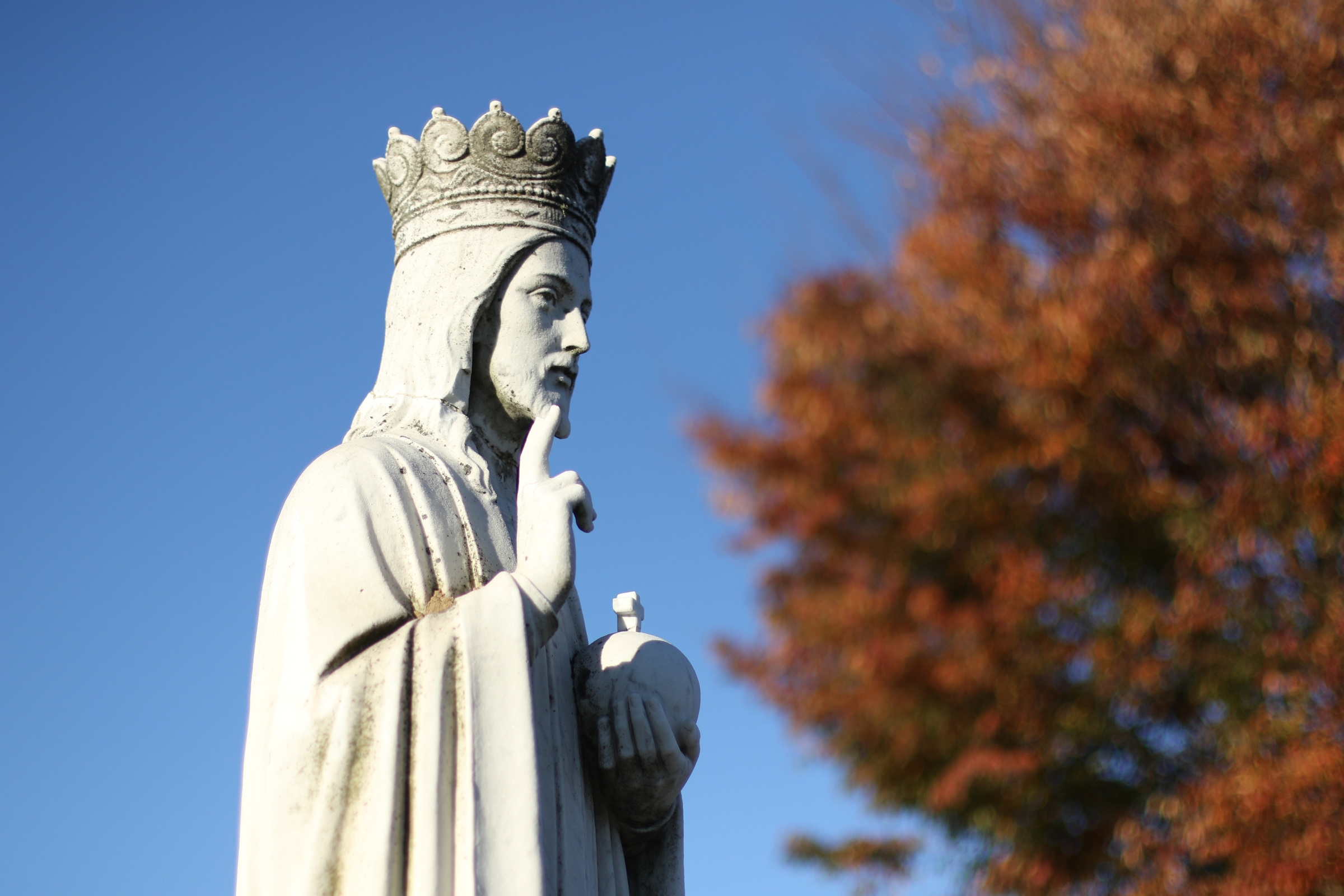
Jesus is not merely the symbol of intelligibility, coherence, and reconciliation; he is the active and indispensable, all-embracing, all-including, all-reconciling Lord of everything to be found in the created universe. No wonder the Church takes the final Sunday of her liturgical year to celebrate the kingship of Christ!
That kingship was foreshadowed in this Sunday’s First Reading, around 1000 BC. God had been Israel’s only king, but the people begged the prophet Samuel to give them a human king and God agreed. The first king he chose was Saul, but Saul disobeyed him and God rejected him and his descendants as rulers.
The second king God chose was David, the youngest son of Jesse, who lived near Bethlehem. David unified Israel’s twelve tribes and established Jerusalem as the nation’s capital and spiritual centre. “And your kingdom shall endure forever before me,” God promised him; “your throne shall stand firm forever.”
David’s house and kingdom seemed to come to an end in 588 BC. However, the prophet Isaiah had foretold that “a shoot shall sprout from the stump of Jesse” and had proceeded to describe the Messiah and his kingdom. Moreover, shortly afterward, God had foretold that a virgin would be with child, and bear a son, and name him “God with us.”
From these prophecies, the Jews understood that the Messiah, the Saviour, who would be of the house of David, would restore the Kingdom of Israel. As Jesus preached about the Kingdom of heaven, the Jews who believed addressed him as “son of David,” while others asked, “Might not this be David’s son?” On Palm Sunday, the people cried “Hosanna to the Son of David!” and Jesus accepted the title.
The Jewish authorities resolved to kill Jesus because he claimed to be God’s Son. However, in order to inveigle the Roman governor Pontius Pilate into ratifying their death sentence, they stressed that he had claimed to be King of the Jews—the charge nailed to the cross: “Jesus of Nazareth, King of the Jews.”
Again, Jesus accepted the title. As we hear in the Gospel Reading, the “good thief” said, “Jesus, remember me when you come into your kingdom,” and Jesus promised, “Today you will be with me in Paradise.”
The truth of the universe, heaven, and all created things is that Jesus is its King. If we accept him as such, he will welcome us into his kingdom for all eternity.
If we do not, there is, quite literally, nothing for us.
Father Hawkswell is again teaching The Catholic Faith in Plain English with new insights, in print and YouTube form at beholdvancouver.org/catholic-faith-course. He is also teaching the course in person on Sundays (2–4 p.m. at the John Paul II Pastoral Centre, 4885 Saint John Paul II Way, 33rd Avenue and Willow Street, Vancouver) and Mondays (10 a.m.–noon in St. Anthony’s Church Hall, 2347 Inglewood Avenue, West Vancouver). The title of next week’s talk is Divine Revelation.
Your voice matters! Join the conversation by submitting a Letter to the Editor here.