

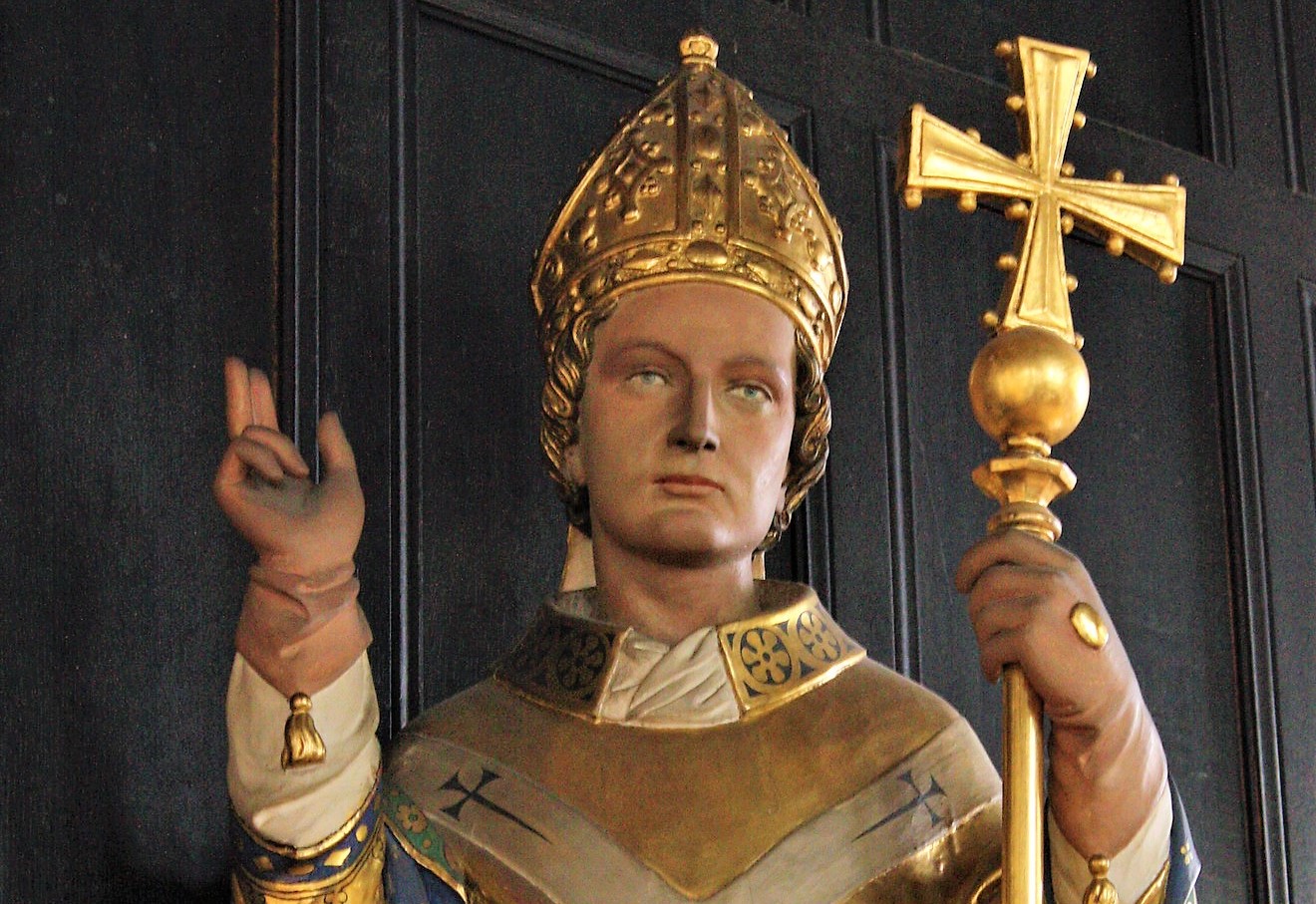

St. Cyprian was born in Carthage in North Africa around the year 210. He was a professional rhetorician and was converted to the Catholic faith about 246. He became Bishop of Carthage in 248.
As Bishop, Cyprian faced the first two persecutions sanctioned by imperial decree: that of Decius (250) and that of Valerian (257–258). He survived the Decian persecution by going underground. During the dispute about readmitting those who had denied the faith during times of persecution, Cyprian agreed with Pope Cornelius that these lapsed should be readmitted to the Church after doing penance. During the persecution under Valerian, Cyprian was first exiled (August 257) and then was brought back (August 258) to Carthage. He was beheaded on Sept. 14, 258.
Regarding St. Cyprian, Father Augustine Kalberer, OSB, wrote: “A man of action, dedicated to his flock, sympathetic yet firm and conscious of his authority, he showed a keen sense of the need to act in concert with other bishops as well as with the clergy and laity of his own diocese. His interesting letters, concerned as they often are with local problems and personal faults, give the best insight into mid-third century Church affairs. They are among the finest examples of the way a bishop can teach and reprove in the name of the Gospel.”
Pope Benedict XVI said, “The numerous treatises and letters that Cyprian wrote were always connected with his pastoral ministry. Little inclined to theological speculation, he wrote above all for the edification of the community and to encourage the good conduct of the faithful.”
During the General Audience on June 6, 2007, the Holy Father highlighted two important themes of Cyprian’s writings: Church and prayer.
In 251, Cyprian wrote the treatise, On the Unity of the Church, when the Novatianist schism had just begun. He warned: “if a man deserts the Chair of Peter upon whom the Church was built, does he think that he is in the Church?”
Cyprian wrote, “He can no longer have God for his Father, who has not the Church for his mother.” Cyprian taught that the unity of the Church was symbolized by Christ’s seamless garment. He also saw the ark of Noah as an image of the Church.
Regarding the unity of the Church, Cyprian wrote, “God is one and Christ is one, and his Church is one, and the faith is one, and the Christian people is joined into a substantial unity of body by the cement of concord. Unity cannot be severed. And what is one by its nature cannot be separated.”
Cyprian wrote a treatise on the Lord’s Prayer (Our Father) which contained three parts. In the first part, Cyprian pointed out the Our Father is the most excellent of all prayers. In the second, he undertook an explanation of the Our Father. In the third, he considered the conditions of prayer and explained what prayer ought to be.
Cyprian insisted the Our Father was a prayer for the community. He wrote, “Before all things, the Teacher of peace and the Master of unity would not have prayer to be made singly and individually, as for one who prays to pray for himself alone. For we say not ‘My Father, which art in heaven,’ nor ‘Give me this day my daily bread;’ nor does each one ask that only his own debt should be forgiven him; nor does he request for himself alone that he may not be led into temptation, and delivered from evil. Our prayer is public and common; and when we pray, we pray not for one, but for the whole people, because we the whole people are one.”
In his treatise on mortality, Cyprian wrote, “We must account paradise our country. There friends, and parents, and brethren, and children without number, wait for us, and long to congratulate our happy arrival.”
啟廉致函鼓勵信眾
約在公元210年,聖啟廉出生於北菲的迦太基,是一位修辭學專才。公元246年,他皈依天主教信仰,並在公元248年成為迦太基的主教。
作為主教,聖啟廉面對兩次羅馬皇帝頒令的迫害:分別是公元250年迪斯塞,及公元257-258年瓦萊里安。聖啟廉利用隱蔽的地下活動避過第一次的迫害。在爭辯應否接納因受迫害而背教的信徒時,他與教宗高略同意在背教的信徒做過補贖後,全部接納他們回歸聖教會。瓦萊里安的迫害,使聖啟廉在公元257年八月被放逐,一年後被解送回迦太基,同年的9月14日被砍頭致命。
本篤會會士奧斯定.卡伯勒神父指出:聖啟廉是幹實事的人,獻身於他的羊群,富同情心,卻又恩威兼備,明白要與其他主教、本教區的聖職人員和教友衷誠合作。他的書信,常提到當地的問題,以及人性的謬誤,讓我們對第三世紀中葉的教會實況,有透徹的認識;它們是一位主教能以福音之名訓導和指責的最好榜樣。
教宗本篤十六世說:「啟廉很多的專著和書信,均與他的牧職有關,他教誨團體及鼓勵信眾守好行為,並不傾向於神學的推測。」
2007年6月6日公開接見群眾時,教宗本篤十六世強調聖啟廉箸作的兩大主題:教會及祈禱。
公元251年,聖啟廉的「有關教會團結」的專著,已經對當時分裂的宗派作出警告:「如果有人擯棄教會所建基於的伯多祿宗座,你會認為他還是在教會內嗎?」
啟廉寫道:「不以教會為其母的人,等於他不以天主為其父。」他形容團結的教會,猶如基督所穿著的無縫衣裳,又視「諾厄方舟」是教會的象徵。
聖啟廉闡釋團結的教會,就如「天主是唯一、基督是唯一、教會是唯一、信德是唯一;基督徒在堅定的和睦中,加入這團結的強大軀體。團結並不能截斷的。本性就是一體的是不能被分開。」
聖啟廉的「天主經」的專著是分開三個部份。首先,他指出「天主經」是所有經文之冠;然後,他解釋了「天主經」;最後,他説明要善作祈禱所應有的條件。
聖啟廉堅稱「天主經」是團體的經文。他解釋,由始至終,作為和平的導師,和團結的主宰,耶穌教授的經文,從未意指單一或個人的祈禱。聖人指出: 主耶穌沒有教我們祈禱說『我的天父』,或『賞給我日用的食糧』,沒教我們祈求『寬恕我的罪過』、『不要讓我陷於誘惑,但救我免於凶惡』,反而是集體和普眾的『我們』祈禱。我們祈禱不只為一個人,而是所有人 ── 因為我們所有人就是一體。
在論『死亡』的專著,聖啟廉寫道:「我們必須想念天堂—–我們的家鄕。那裡有我們的朋友、父母、、兄弟姊妹及無數的孩子們,在那裡等待我們,渴望祝賀我們愉快地抵達天國。」







