


Fans of Quentin Tarantino will undoubtedly approach his Once Upon a Time in Hollywood with great expectations. After all, it stars Leonardo DiCaprio and Brad Pitt and has a whole host of other stars in lesser roles. However, many will be disappointed.
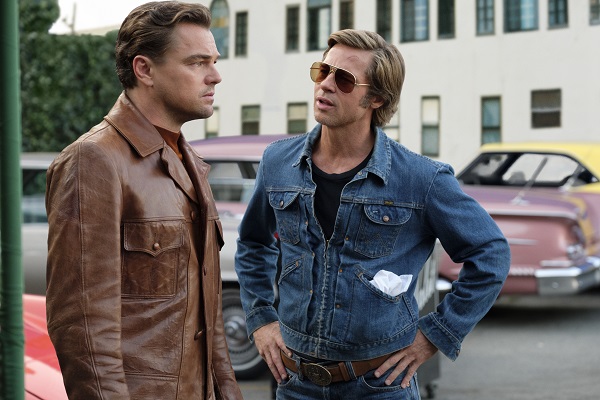
From the outset, Once Upon a Time in Hollywood pays homage to the end of the Sixties, an era that doubtless influenced Tarantino as a movie maker. He displays the year on the screen as scenes begin. Signs, cars, and cultural references, especially crime dramas and Westerns popular on television, recreate that period.
The film focuses on one of the leads in a popular series of cowboy movies, Rick Dalton, played superbly by Leonardo DiCaprio. With the support of his stunt double, friend, and general factotum, Cliff Booth, portrayed equally well by Brad Pitt at his most charming, Dalton faces the reality that his career is in decline. For much of the film’s 165 minutes, one watches Dalton cope ineffectually with impending failure and alcoholism.
All of this symbolizes the end of a golden age, but so much else seems to be going on here. The opening warns of something much darker, especially with a reference to the murder of Sharon Tate and companions in their Hollywood mansion at the end of the decade. It is decidedly unclear why Tarantino included this, other than that it allows him to build (somewhat inevitably for him) to a brutally bloody climax – which is ultimately unconvincing in that it is too clearly artificially staged.
Does Tarantino simply wish that history could be otherwise? Certainly he boldly rewrites history, much as he did in his best film to date, Inglourious Basterds. After all, his new film is clearly intended as a fairy tale of sorts – hence its title. However, things become even more confused when one of the followers of Manson who organized the Sharon Tate murders justifies killing Hollywood celebrities because they had drenched the television screens with acts of murder and thus validated killing.
As the main filmic references indicate, much of the entertainment of the late sixties indeed involved killing (often without any indulgence of gore), though the same could be said of virtually any period of film or television. Some might claim that such entertainment is partially responsible for the violence in today’s society. However, Tarantino himself has been responsible for so much bloodshed on the screen that he can hardly moralize.
Or is he trying to say that if one is to portray acts of murder, one should do so in realistically gory fashion? If so, why?
It is difficult to know just what the film is trying to say as it meanders alongside its deeply flawed characters. As a result, it simply becomes tiresome.
Yes, one can applaud moments of truly bravura filmmaking. Yes, it is diverting to see great actors such as Bruce Dern and Al Pacino engage in walk-on parts. Yes, the period recreation is superb. Yes, there are memorable and touching scenes. But the whole doesn’t have any clear logic or focus. Much of the film could be cut with no apparent loss.
Moments that are clearly intended to be humorous get no laughter from the audience. Moreover, there does seem to be something tasteless about turning an actual murder of innocent people into an excuse for entertainment.
Despite the many fine performances, Once Upon a Time in Hollywood doesn’t meet the essential requirement of fairy tales: it doesn’t entertain.
Warning: the film contains much sexual innuendo and objectional language.







