

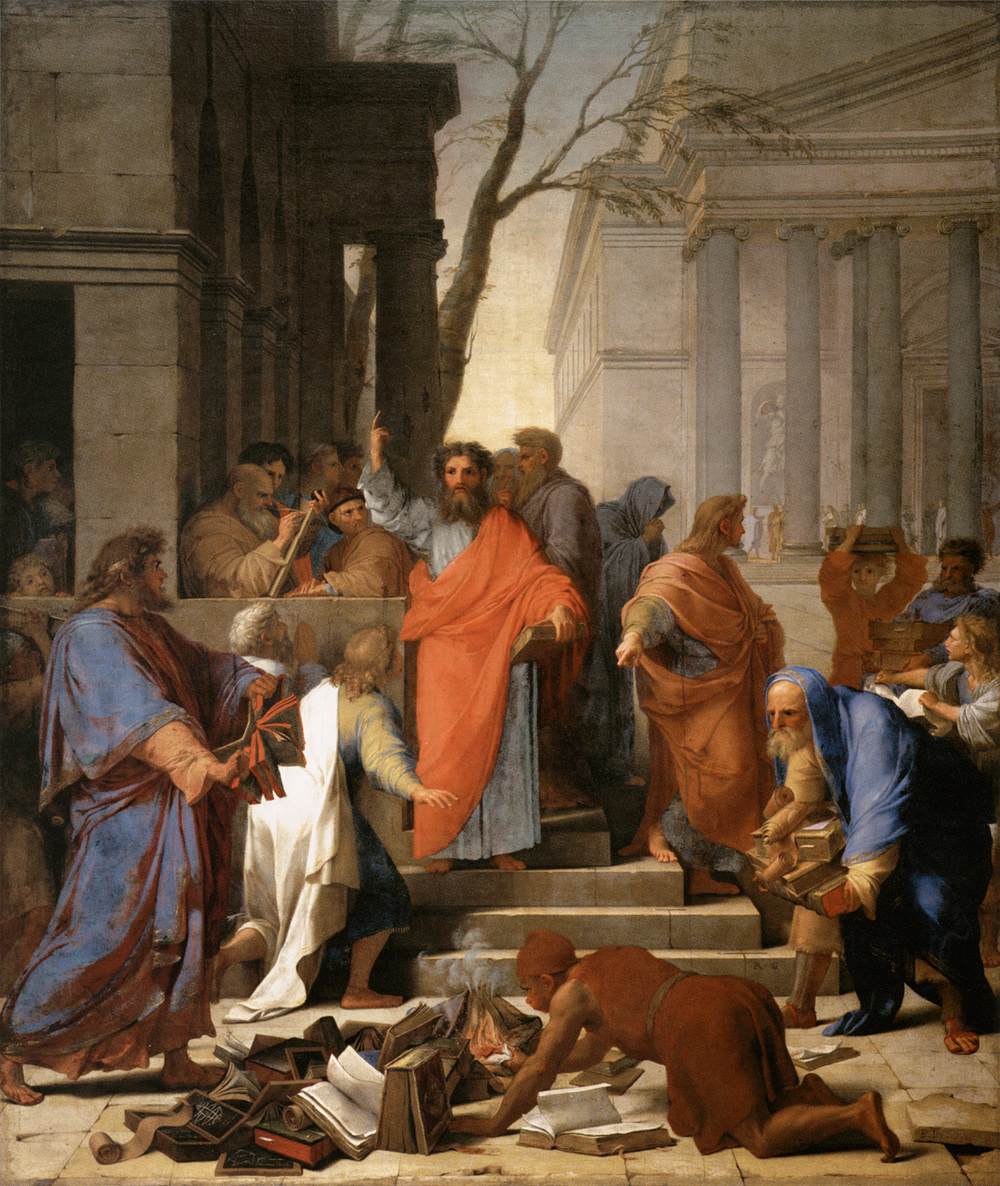

Acts 19 tells three stories about Paul’s time in Ephesus: he meets believers who have not yet received the Holy Spirit, he faces false spiritual power in the city, and a riot breaks out over money. William Kurz notes that throughout Acts, “the missionaries need to keep adjusting both their evangelizing approaches and their defence against attacks.”
When Paul arrives in Ephesus, he meets a small group who “had received only John’s baptism.” Paul does not ask if they believe in Jesus, but if they received the Holy Spirit. St. John Chrysostom explains why: “he knew that they had not. And he wished them to acknowledge this, so that they might learn what they lacked and ask for it.” Their answer is honest and simple: “We have never even heard that there is a holy Spirit.” (Acts 19:2)
Kurz says this answer “rules out the possibility that they could be full-fledged Christians, since Christian initiation entails receiving the Spirit.” John’s baptism was good, but it could only prepare the way. St. Thomas Aquinas points out that it worked through penance, which prepared men to receive the effect of Christ’s Baptism, but could not give grace by itself.
Once Paul baptizes them “in the name of the Lord Jesus” and lays hands on them, the Spirit comes, and they speak in tongues and prophesy. The Navarre Bible adds a word from St. John Paul II on what these disciples lacked: real formation in the faith “must be systematic, not improvised but programmed to reach a precise goal.” Repentance alone is not enough. It must lead all the way to Christ and the Spirit.
Paul teaches in the synagogue for three months, then moves to “the lecture hall of Tyrannus” for two more years — long enough that “all the inhabitants of the province of Asia heard the word of the Lord, Jews and Greeks alike.” St. John Chrysostom draws a lesson from Paul’s choice to walk away from conflict: “let us learn not to meet the evil-speaking people but to withdraw from them.”
Next, Luke shows that grace and magic are not the same thing in different names. Some Jewish exorcists, the seven sons of Sceva, try to use Paul’s authority like a magic word: “I adjure you by the Jesus whom Paul preaches.” The evil spirit answers, “Jesus I recognize, Paul I know, but who are you?” Chrysostom explains what went wrong: “the name has no power unless it is spoken by faith.” The Ignatius Catholic Study Bible agrees: they failed because “they wielded the name of Jesus without faith in him or a commitment to his teaching.”
Paul’s own ministry is very different. Luke writes that “face cloths or aprons that touched his skin were applied to the sick,” and their sickness and evil spirits left them — not because the cloth itself has power, but, because God works wonders both through His saints and through created objects. Kurz notes this passage is the biblical root of what the Church calls second-class relics: “items of clothing or other objects used by a saint and venerated by the faithful, through which, on occasion, God works miraculously.” Once the people see real power, they give up the fake kind, and “a number of those who had practiced magic arts brought their books together and burned them in the sight of all.” (Acts 19:19)
Paul now plans to travel “through Macedonia and Achaia, and then to go on to Jerusalem.” But a new problem appears — not an argument about doctrine, but an attack on business. Demetrius the silversmith sold small statues of the goddess Artemis, and Paul’s preaching that “gods made by hands are not gods at all” was hurting sales. Demetrius gathers his fellow craftsmen and is honest about his real concern: “our prosperity derives from this work.” Father Joseph Ponessa puts it plainly: “Money is the true object of Demetrius’ worship.”
The crowd rushes into the city’s huge theatre. Luke notes, almost with humour, that “most of the people had no idea why they had come together,” yet they shout for two hours, “Great is Artemis of the Ephesians!” Finally, the town clerk calms the crowd and points them to proper legal process: “If Demetrius and his fellow craftsmen have a complaint against anyone, courts are in session, and there are proconsuls.” The Navarre Bible calls him “admirably impartial.”
These three stories help us to beware of an unfinished formation in the faith, a taste for spiritual shortcuts, and love of money.







