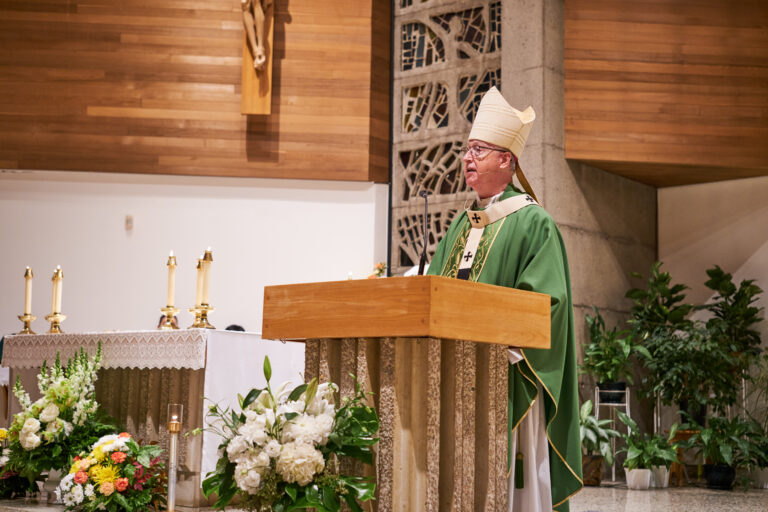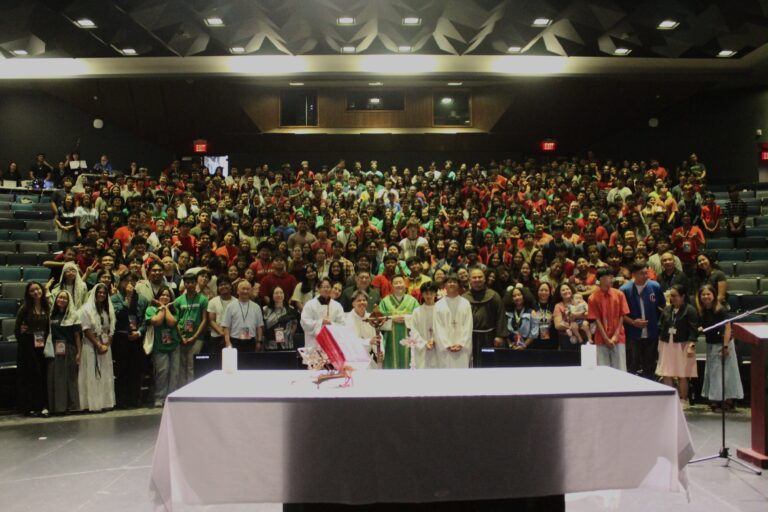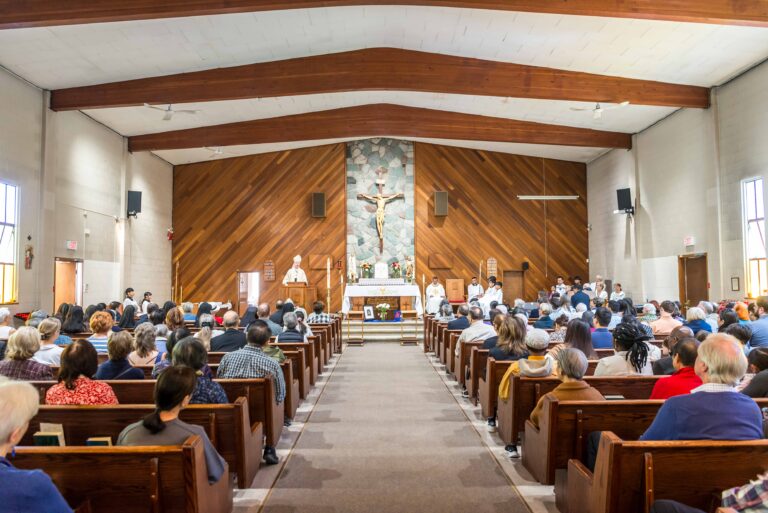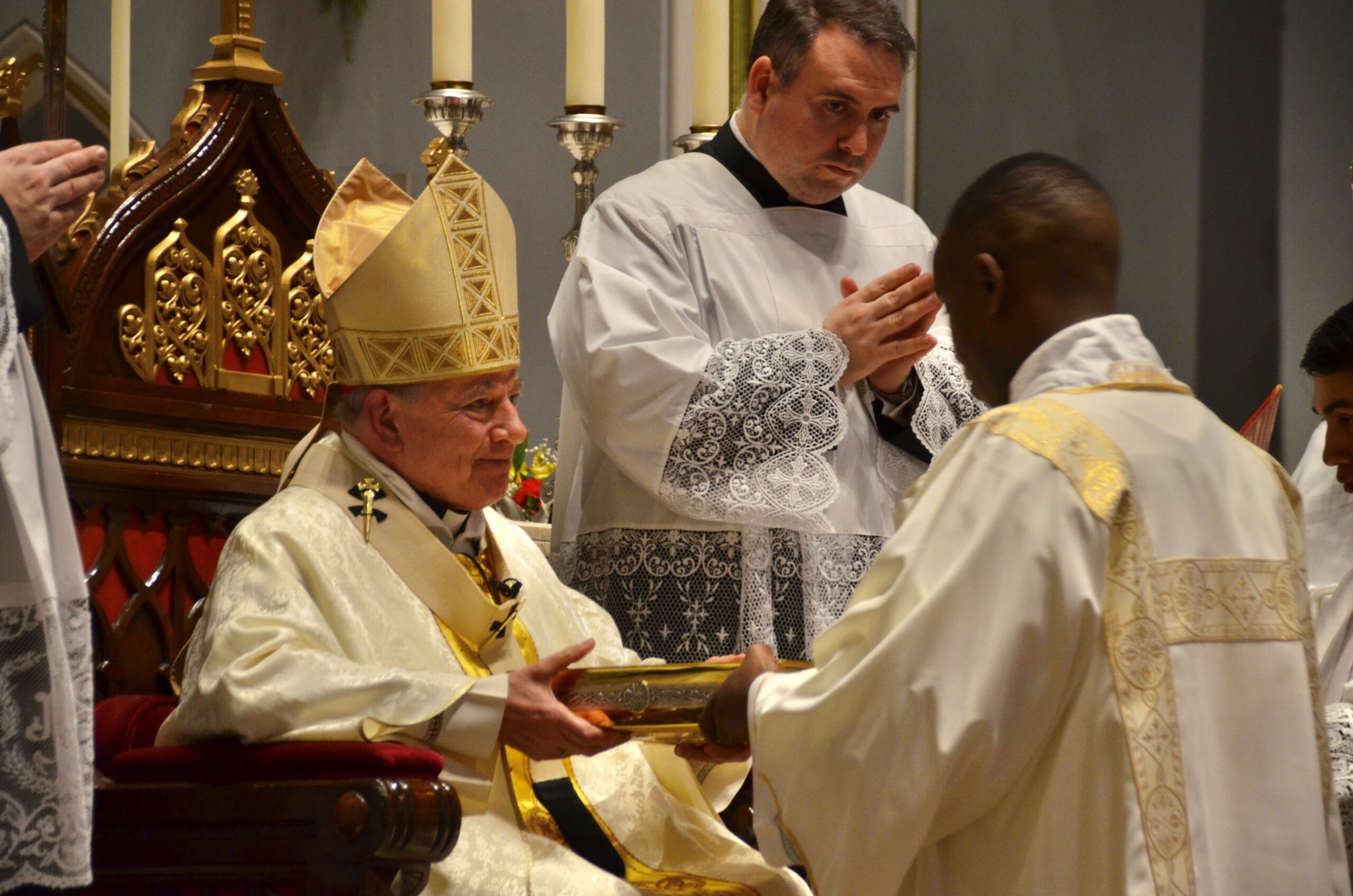

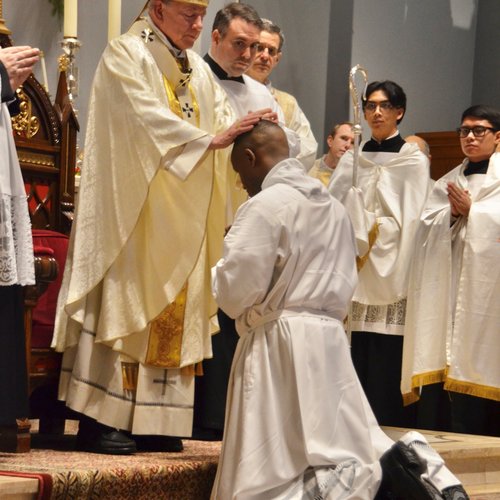
On Dec. 9, Medard Kamanzi and Patrick Le were ordained deacons at Holy Rosary Cathedral in preparation for ordination to the priesthood next year. In his homily at the ordination Mass, Archbishop J. Michael Miller addressed the two men and the role of the deacon.
“Both ordinandi have been preparing themselves for this day for many years, aware that it was Jesus who first chose them before they responded to his call,” said the archbishop.
“Medard has been formed in the Archdiocesan Missionary Seminary Redemptoris Mater and the Seminary of Christ the King, and Patrick at SCK since his entry into the minor seminary.”
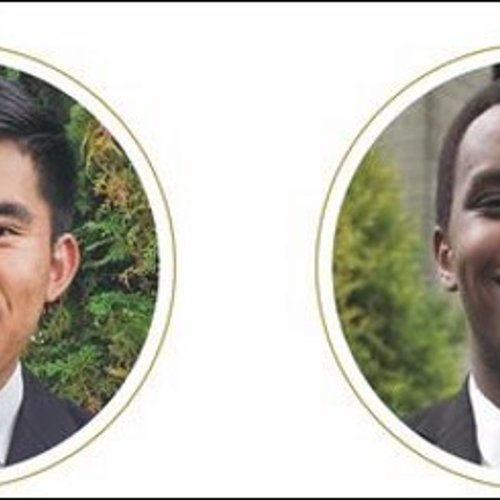
Marked with an “indelible character,” the two men “will do something radical, something counter-cultural, something extraordinary, something courageous,” said the archbishop. “Each of them will make a solemn promise, committing himself forever to celibacy for the sake of the Kingdom of Heaven, in service to God and others.”
That commitment, he said, “is one of the most fundamental expressions of Jesus’ call to radical discipleship, which in the words of Pope Benedict XIV confirms that “there are men who believe so much in the Gospel that they do for it something that in earthly terms is irrational.”
The two men are called to be “spiritual fathers to those entrusted to their pastoral care, bearing fruit in the generation through baptism of many new sons and daughters in the faith.” In their vow of celibate chastity, he said, “they aren’t consecrating themselves to bachelorhood, individualism, or to a life of friendless isolation,” but rather “promising to put themselves completely and unreservedly in the Lord’s hands. Celibacy will enable them to serve the Lord with undivided heart, thereby expressing their gift of self to God and to their people.”
Deacons are called to be on the front line of the Church’s mission of evangelization, said the archbishop. “While everyone is called to love others, as Jesus loves us, by laying down their life for them, his command makes specific demands upon those ordained for his service,” dedicating them to works of charity on behalf of the world’s suffering.
“When it comes to service, no task is too menial or too lowly for a deacon. Because our new deacons will be consecrated to live and serve in persona Christi Servi, “in the person of Christ the Servant, . They will spur all of us on to lives of greater service to others and passion for justice, thereby responding to a world hungry for convincing signs of God’s love and compassion.
The B.C. Catholic spoke with the two new deacons about their journeys.
Deacon Patrick Le
By Nicholas Elbers
Reflecting on the “surreal experience” of his ordination to the transitional diaconate, Patrick Le told The B.C. Catholic he feels immense meaning in the new role, but also an ordinary sense of God’s presence and power.
The laying on of hands during the ceremony at Holy Rosary Cathedral Dec. 9 was a profound moment for him. “It was very powerful,” Deacon Le said. “It’s quiet while you have your bishop pressing down on your head. More than any part of the liturgy it is very felt.”
The experience after being ordained is “very wonderful – the gift that we receive – but it is also very ordinary,” he said, pausing. “God is the master of understatement, like the way he came as a child at Christmas.”
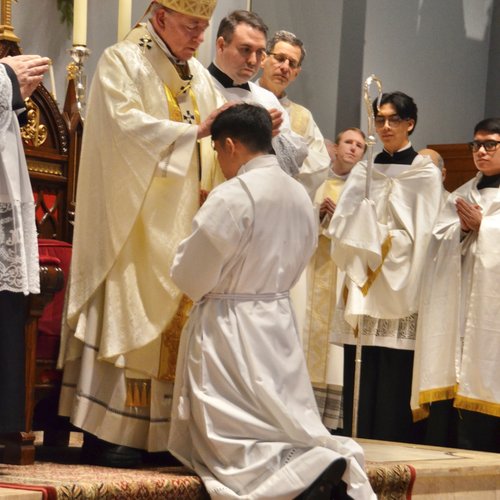
The transitional diaconate is the stage before priesthood and allows men in the advanced levels of priestly discernment better transition into the pastoral role of the priesthood.
“Before we would be in the seminary for a year and then be thrown into a parish with full responsibilities and powers, but this allows me to get my bearings,” he said.
While there is usually a gradual build-up to full duties, the seminarian was thrown in the deep end during his pastoral internship at St. Matthew’s in Surrey, taking on preaching while assistant pastor Father Raffaele Salvino recovers from surgery.
Deacon Le says he finds writing and delivering homilies interesting.
“I do enjoy doing the homilies,” he said. “It’s a lot of work – almost like writing a paper every week, but it’s more than that too. It’s about building a bridge between life and the Gospel.”
Deacon Le appreciates the way preaching reflects the total role of the priest and how it helps him connect to the community.
“You are trying to find the particular part of the Scripture that helps facilitate theosis,” the Eastern spiritual ideal in which the individual becomes one with God, he said.
The community informs how he crafts his homilies, but he still sees he has a lot of room to grow. “I am newer than some of the new parishioners here,” he mused, adding that the community “will take on a more significant role as he gets to know them more.”
To guide his preaching he likes to rely on something called the Four Pages of the Sermon, which offer a simple but effective formula:
1. Find the trouble in the Scripture – there is often some suffering or problem at the centre of the Gospel.
2. Connect that to the troubles people have in their own lives.
3. Look for the grace that is given to solve the problem.
4. Relate that grace to the grace we receive in our own lives.
“You are trying to hit people’s hearts,” he said, “it’s universal. We are all different, but our hearts are the same.”
Deacon Le has also been spending time teaching the students at St. Matthew’s Elementary school.
“We visit the schools once a week to spend some time with the students.” he said. “I have a different relationship with them than their teachers. Usually they are happy to see me because I am interrupting something they weren’t enjoying, like math,” he joked.
Deacon Le said he tries to go beyond simple catechism with the students by helping them direct their questions towards bigger and more beautiful things – a lesson that is not just for the students.
“Sometimes we don’t ask the best questions; we sometimes miss the bigger picture,” he said. “It’s about trying to show them the reality of Christ.”
“In some ways teaching and preaching are very easy because there is one point: Christ,” he said. “But at the same time they are difficult because you need to show how Christ is there in all aspects of life.”
Deacon Medard Kamanzi
By John Shepherd
Deacon Medard Kamanzi completed the latest milestone of his faith journey on Dec. 9 when he was ordained as a transitional deacon.
As a step on his way to the priesthood, his journey started eight years before, in Porto San Giorgio, Italy. Like all Redemptoris Mater seminarians, Deacon Medard did not choose to be formed in Vancouver. The seminarians put their names into baskets and by casting lots learned where they would be sent for seminary. Deacon Kamanzi travelled halfway around the world to the newly created Redemptoris Mater Seminary in Vancouver.
His personal story started 28 years earlier when he was born in the Democratic Republic of the Congo, one of six children, a year before the Rwandan genocide. His grandparents had left Rwanda as refugees during the 1959-1962 civil war. His parents returned home in 1994 to Rwanda, a country destroyed and unsafe in the aftermath of the genocide. The new government tried to unite the country, create a safe environment, and rebuild its economy.
His father was a government official, still travelling extensively and often away from home in a still dangerous country. Kamanzi’s parents’ marriage suffered and he lost his faith.
It was a team of Neocatechumenal itinerant missionaries from Europe who changed their lives. His parents attended a series of catechesis and were touched by the preaching of the Kerygma. The itinerants, who still live in Africa, stayed in the Kamanzis’ home and helped his parents rediscover their faith. His family life changed as his parents put Christ in the centre of their lives.
Deacon Kamanzi experienced his own faith journey as he grew up. In school, he was bullied and rejected by his classmates and teachers because of a medical condition that caused him to drool. He lost confidence in himself and felt alienated until he was invited by his father to join a faith community.
In his community, he felt accepted and respected. He listened to the Kerygma and could speak honestly about his experiences without self-filtering what he said to be accepted. Little by little, he came to know the love of Jesus Christ.
The next step in his journey occurred when he was 15 and at a youth conference. He felt a deep sense of gratitude to God for helping him transform his life. At the end of the pilgrimage, he felt a call to the priesthood and stood up when a vocation call was made.
Over the next five years, he attended weekly vocational meetings with catechists who helped him discern his vocation. He went to World Youth Day 2011 in Madrid, where he met other youth who were discerning vocations to the priesthood.
After high school graduation, he had to choose between a university scholarship in agricultural engineering and becoming a seminarian. He chose to go to the Redemptoris Mater Seminary of Goma, Congo, to spend a year exploring his call to a religious vocation.
At Porto San Giorgio, he was chosen to go to the newly established Redemptoris Mater Seminary in Vancouver, where he was hosted by a local family for six months while the seminary building was under renovation.
Coming to Canada was a shock. All his education had been in French and he had never lived outside Rwanda or the Democratic Republic of the Congo. While living with a Vancouver family, he had to learn a new language, a new culture, and experience new foods.
Six months after he arrived, his father experienced kidney failure and passed away during his first year of studies. He returned to Rwanda for his father’s funeral.
His mother was very supportive of his vocation and encouraged him to stay in Canada. Like his fellow seminarians, Kamanzi joined a local faith community where he got to know people, feel at home, and was immersed in the word of God.
An important part of the discernment and formation of seminarians is service, both in parishes and as a missionary. Kamanzi spent a year with a team that evangelized in various Canadian cities such as Ottawa, Winnipeg, Fort McMurray, Calgary, and Saskatoon. It was a grace-filled time for him, announcing the good news and staying in people’s homes, feeling very much like the missionaries who had come to his hometown.
After giving his first homily last weekend, Deacon Kamanzi said he felt a sense of peace that God will give him the graces needed to accomplish his mission, which he knows is a gift from God.
Click here to send us a letter to the editor about this or any other article.