

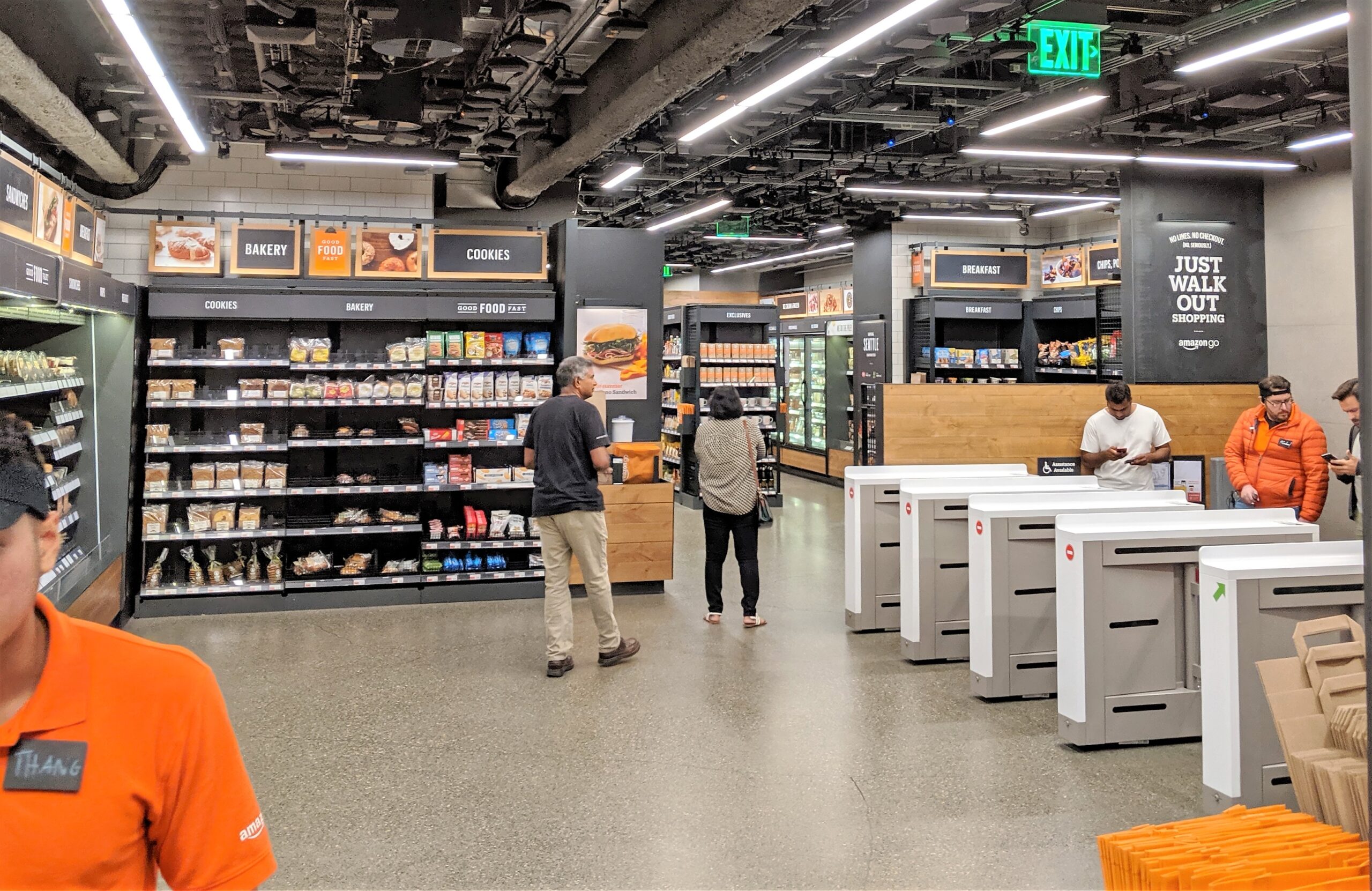

Recently I had several opportunities to experience a completely new type of shopping in the form of an Amazon Go store (amazon.com/go).
In January 2018, the Seattle-based retailer opened its first Amazon Go outlet, a unique store with no cashiers, or self-checkouts. In fact the only employees in the store are shelf stockers and food handlers who prepare some of the items sold at the outlet. The store is located in one of the fifty or so buildings that Amazon owns in or near downtown Seattle.
In simplest terms, the Amazon Go shopping concept depends on a special mobile phone app that is linked to an Amazon account and a credit card, a store packed with cameras and sensors, mainly in the ceiling, and entry and exit gates.
That’s it. Customers gain entry through a gate by scanning a QR code on their mobile device. Family members without the app, let’s say, are scanned in ahead of the person with the app. At that stage, the store management system knows all members of the group and anyone who walks out with one or more items from the Go store shelves will incur a charge to the account of the person who scanned everyone in.
It doesn’t matter if items are in a bag, in a pocket, or if person A passes an item to person B, or if person C puts an item back on the shelf in favour of something else, the Go system is continuously updating a virtual shopping cart for the app owner.
Once everyone has walked out, the system generates a receipt that then appears within the app on the mobile device. In my experiences, the receipts appeared between one and five minutes after I had left the store.
On my initial visit with my family, we were all somewhat hesitant about the process. We hadn’t yet installed the Amazon Go app on a mobile; once that was done, it had to be linked to an Amazon or Amazon Prime account. Even then, we were leery about walking out without overtly paying for the items we were holding.
Subsequent visits were quite different. In fact for one visit we arrived just one minute before closing time. That was more than enough time, as it turned out. Entrance scanning took, say, five seconds. We grabbed the items we wanted and walked out through the exit gates. Done!
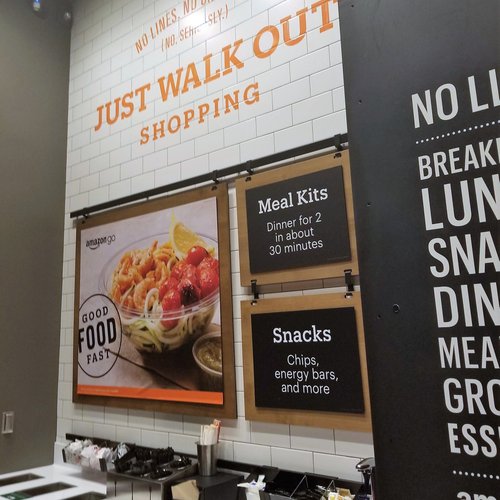
As currently configured, the store itself can’t make money. I saw five employees. It’s about the same size as a small 7-11, which typically operates with just one employee. If Go can be scaled to a typical supermarket inventory, then it may indeed represent the future of retail.
Just how Amazon Go operates is somewhat proprietary. What we do know is what Amazon Go describes on its web site. The company says its checkout-free shopping experience is made possible by the same types of technologies used in self-driving cars: computer vision, sensor fusion (data from multiple sensor types combined for better location and orientation information), and deep learning. It says its Just Walk Out Technology automatically detects when products are taken from or returned to the shelves, and keeps track of them, as noted above, in a virtual cart.
In these concept stores, of which there are presently 16, the product lineup is small, consisting mainly of prepared food items, snack foods, breads, and drinks, including alcohol. However, Amazon is surely considering the Walk Out technology for its Whole Foods subsidiary, which has several hundred stores across North America, including here in the Vancouver area.
Amazon Go stores are not without their detractors. Clearly they discriminate against those without smartphones, not to mention the credit cards required to complete a transaction. San Francisco recently passed a law requiring the acceptance of cash at all retail stores in the city, including at the four Go stores there.
In the meantime, it is difficult to see the advantage of a Go-type store over one with enough self-scan stations to prevent a backlog. All those cameras and the behind-the-scenes computing power to process the images can’t be cheap.
Follow me on Facebook (facebook.com/PeterVogelCA), on Twitter (@PeterVogel), or on Instagram (@plvogel)
pvogel@outlook.com







