

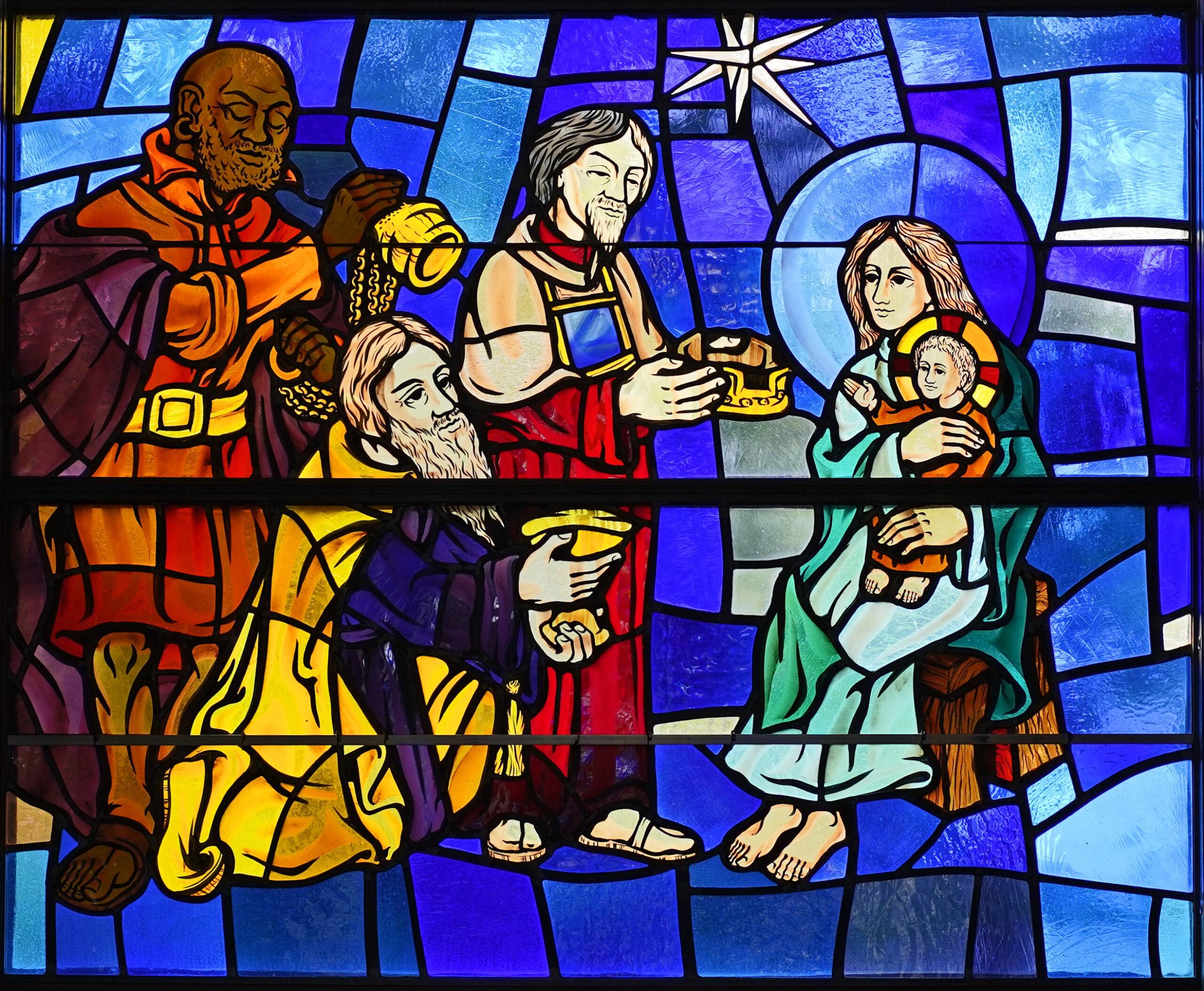

Epiphany of the Lord
First Reading: Isa 60:1-6
Second Reading: Eph 3:2-3a, 5-6
Gospel Reading: Mt 2:1-12
At the beginning of the new calendar year, the Church honours Mary for bringing God’s Son to us. First there is the Solemnity of Mary, the mother of God (a holy day of obligation). Then there is the solemnity of the Epiphany, Greek for “appearance” or “manifestation” of Jesus Christ to the world.
There is an ancient rule that in any picture of Our Lady mounted above the tabernacle in a church, she must be represented as Theotokos, the “God-bearer.” That is, she must be shown presenting, or manifesting, Christ to us.
Through this manifestation, described in the Gospel Reading, we have become “fellow heirs” with the Jews, St. Paul says in the Second Reading. The Catechism of the Catholic Church says we have been “made worthy of the heritage of Israel.” The First Reading praises Jerusalem, for “nations shall come to your light, and kings to the brightness of your dawn.”
In the canticle we now call the Magnificat, from its first word in Latin, Mary said, “My soul magnifies the Lord.” We magnify something so that it looks bigger, so that we can see it in more detail. The magnifying glass does not take our attention away from what we are looking at; nor does it change it, except to make it clearer.
Similarly, our Lady “magnifies the Lord” for us. When we look at her, we see what God intended for us and what he wants of us. In the words from My Fair Lady, Mary does not just “talk of love”: she shows us.
“Meditate on the Magnificat,” the late Archbishop Adam Exner, OMI, said to a young nun making her profession in 1993. “Mary found that when she said ‘yes’ to God, God did great things for her and, through her, for others. Be assured that as you say ‘yes’ to God, God will do great things to you and, through you, for others.”
Another title we have for Mary is “Mirror of Justice.” Her soul reflects God’s justice perfectly. Like a magnifying glass, a mirror enables us to see something we could not otherwise see. Again, it does not take our attention away from what we are looking at, nor does it change it, except to make it clearer.
For example, Jesus manifested his Father to us because he reflected him perfectly. “Whoever has seen me has seen the Father,” he told Philip. St. Paul calls Christ “the image of the invisible God.” The Letter to the Hebrews calls him “the reflection of the Father’s glory, the exact representation of the Father’s being.”
Today, we are the instruments God uses to manifest, magnify, and reflect him to others. When we consider that, 2023 years after the birth of Christ, almost 75 per cent of the human race still knows nothing about him, we may be inclined to despair. However, when we consider what Mary’s cooperation with God accomplished, we should recognize the importance of our own cooperation and realize that it can indeed change the world.
Nevertheless, we must remember that neither a mirror nor a lens can do its job properly if it is dirty, scratched, or distorted. Our souls, distorted by original sin and scratched and clouded by our own personal sins, have to be continuously cleaned, polished, and reground.
In this job, we have Mary for our model. “The ultimate purpose of any devotion to Mary is to glorify God and to lead Christians to commit themselves to a life in absolute conformity with the will of God,” said Pope St. Paul VI.
Ever since her Assumption into heaven, Mary has continued her saving work, says the Catechism. In her maternal love, she continues to intercede for those of her Son’s siblings “who still journey on earth.” Thus her spiritual motherhood “continues uninterruptedly from the consent which she loyally gave at the Annunciation and which she sustained without wavering beneath the cross, until the eternal fulfillment of all the elect.”
Father Hawkswell is again teaching The Catholic Faith in Plain English with new insights, in both print and YouTube form, at beholdvancouver.org/catholic-faith-course. He is also teaching the course in person on Sundays from 2 to 4 p.m. at the John Paul II Pastoral Centre, 4885 Saint John Paul II Way, 33rd Avenue and Willow Street, Vancouver, and Mondays from 10 a.m. to noon in St. Anthony’s Church Hall, 2347 Inglewood Avenue, West Vancouver. There is no presentation next week or the week after; the title of the presentation three weeks from now is “Grace and the Sacraments.” The course is entirely free of charge and no pre-registration is necessary.
Share your thoughts and contribute to the ongoing conversation by sending us a Letter to the Editor.







