

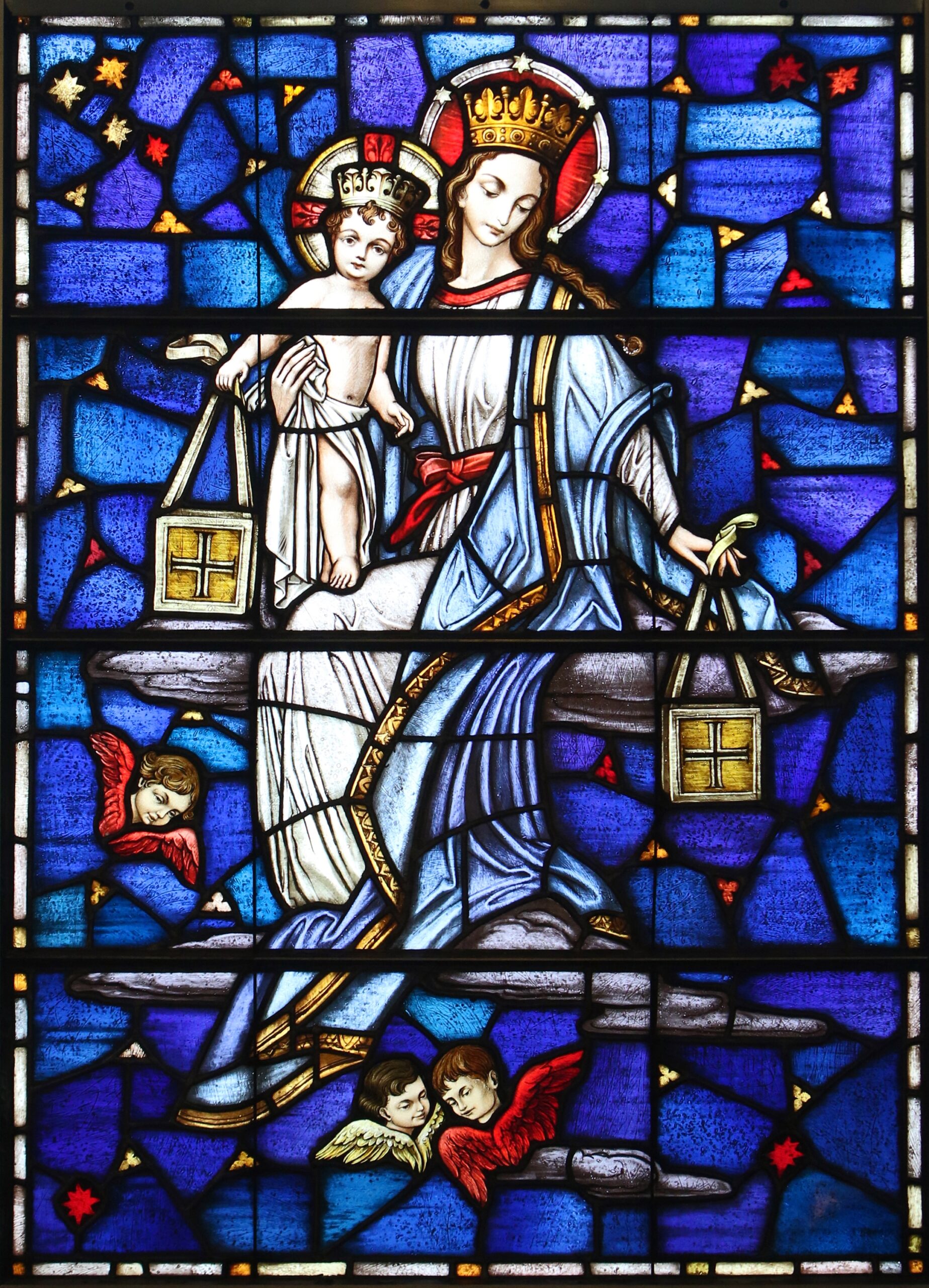

Mary, Mother of God
First Reading: Num 6:22-27
Second Reading: Gal 4:4-7
Gospel Reading: Lk 2:16-21
“God sent his Son, born of a woman, born under the law, in order to redeem those who were under the law, so that we might receive adoption as children.”
The Preface of the Mass says that “through the power of the Holy Spirit,” Mary, a virgin, became the mother of God’s only Son, Jesus, through whom even the angels and the powers of heaven worship God, and through whom humans, God’s adopted children, join the angels’ hymn.
None of this would have been possible had Mary not said yes when the Angel Gabriel asked her to become God’s mother.
“God’s mother”—it seems intrinsically contradictory.
However, as the Catechism of the Catholic Church says, “the one whom she conceived as Man by the Holy Spirit, who truly became her Son according to the flesh, was none other than the Father’s eternal Son, the Second Person of the Holy Trinity. Hence the Church confesses that Mary is truly ‘mother of God.’”
God the Father trusted Mary when he initiated the Incarnation. Jesus, her Son, trusted her during the 30 years he spent in her home. Therefore we – God’s adopted children and so Jesus’ brothers and sisters – can trust her, too.
We can trust her as a baby trusts its mother: to nourish us, care for us, comfort us, and always have our welfare in mind – our eternal welfare, our eternal happiness in heaven.
Because Mary trusted God completely, submitting herself utterly to his will, we honour her as second only to Jesus. In fact, Catholics are accused of giving her too much honour, of putting her on a level with Jesus.
Therefore, in order to make it clear that we do not misunderstand the honour due to Mary, Pope St. John Paul II declined to declare her “co-redemptrix,” or co-redeemer, with Christ.
If a committee has two chairpersons, the co-chairpersons are equal. Calling Mary “co-redemptrix” would imply that her role in our redemption was equivalent to Christ’s. In contrast, the very title “blessed Virgin Mary” shows that we attribute her greatness to God.
The word “blessed” means “holy,” “consecrated,” “exalted,” or “praised.” However, those cannot have been its only meanings originally. For example, when Christ said, “Blessed are the poor,” he was not saying that the poor were holy or praised.
Some biblical translators, realizing this problem, tried substituting the word “happy,” but that did not quite work either. For example, one can feel happy when one is committing sin!
I think the best modern word might be “favoured,” as in “most highly favoured lady” – the way Gabriel addresses Mary in the hymn The Angel Gabriel From Heaven Came.
According to the beatitudes, the poor, the sorrowful, the pure, etc., are favoured by God: their poverty, sorrow, purity, etc. are gifts from him.
Similarly, the Virgin Mary was “most highly favoured” by God: “For know: a blessed mother thou shalt be…. thy Son shall be Emmanuel, by seers foretold, most highly favoured lady.”
However, God did not shower favours on Mary without her consent: he asked her first. We honour her because, as the hymn says, “Then gentle Mary meekly bowed her head; ‘To me be as it pleaseth God,’ she said. ‘My soul shall laud and magnify his holy name.’”
God “favoured” Mary highly. Ever since, “all generations laud and honour” her because she consented to accept his favours. That consent is what her greatness consists of. That is why we “bless” her in the sense of “praising” her.
However, we must also imitate her. Like children, we must entrust ourselves to her as Christ did, learning from her, as he must have done, how to submit constantly to God’s will.
Then our praise will ring true: “Of her, Emmanuel, the Christ, was born, in Bethlehem, all on a Christmas morn, and Christian folk throughout the world will ever say, ‘Most highly favoured lady.’”
Father Hawkswell is again teaching The Catholic Faith in Plain English with new insights, in both print and YouTube form, at beholdvancouver.org/catholic-faith-course. He is also teaching the course in person on Sundays from 2 to 4 p.m. at the John Paul II Pastoral Centre, 4885 Saint John Paul II Way, 33rd Avenue and Willow Street, Vancouver, and Mondays from 10 a.m. to noon in St. Anthony’s Church Hall, 2347 Inglewood Avenue, West Vancouver. There is no presentation next week or the week after; the title of the presentation three weeks from now is “Grace and the Sacraments.” The course is entirely free of charge and no pre-registration is necessary.
Share your thoughts and contribute to the ongoing conversation by sending us a Letter to the Editor.







