


Two weeks ago, streaming content provider Netflix announced it was raising prices for North American subscribers. It’s not as if the increases are large but, incrementally, Netflix pricing has risen over the years from about $5 a month to around $15.
Following the new round of increases for Netflix subscriptions, the most common mid-tier plan, which the company refers to as the standard plan, will jump to $16.49 here in Canada. The premium plan goes up by $2 a month to $20.99. Netflix said its basic plan will remain unchanged at $9.99. Of course, these are all subject to additional taxes.
Although the company doesn’t reveal the adoption levels of the various plans, it is worth noting that the basic plan does not provide HD content and would likely not appeal to anyone watching on a typical home TV screen. The standard plan permits HD viewing on two screens simultaneously, and the premium plan sees that increase to four screens, and also offers so-called ultra-HD streaming.
Certainly, the company will spin this as necessary to continue delivering high-quality content, without mentioning the ever-increasing subscriber base, both domestically, and internationally.
Although Netflix is an American company, headquartered in Los Gatos, Calif., it considers Canada and the United States to be its domestic market. This is where the biggest fraction of its subscribers is located, and those subscribers are paying the highest rates.
When I posted on Twitter about the upcoming price increases, media commentator Peter Nowak had an immediate reaction. “Remember when Netflix was the antithesis of cable? Now they’re playing from the same playbook: acquisition is done, time to monetize.”
By that, he meant that the period of massive subscriber growth for Netflix was largely over and that now it was time to make some money from that customer base.
Somewhat ominously, he added to his Twitter response “The cycle of driving people to piracy continues…” I’m not so sure about the piracy angle, although I’m sure you know someone who uses an Android TV box of some sort that a “friend” has programmed to get “everything,” from free movies to sports channels.
My impression is that media piracy has died off significantly over the past decade. Music piracy has all but been supplanted by the likes of Spotify. The plethora of video-streaming services has mostly killed off widespread piracy in that space. Piracy almost disappeared here in Canada, particularly after the Bell Canada/BCE wins against purveyors of Android TV boxes.
Netflix seems to be well-positioned to get away with this price increase. The public can be forgiven for the impression that there was a price increase recently. That, however, was the long arm of governments moving to tax streamers just as they tax the cable companies.
At some point the aggregate cost of streaming subscriptions in Canadian households will begin to reach what was being paid for typical cable TV subscriptions. Those who gave up standard cable TV subscriptions in favour of a small portfolio of streamers (besides Netflix there are the likes of Amazon Prime Video, Disney+, Crave, Apple TV+, DAZN) are more or less back where they started in terms of cost.
With the bulk of the Netflix subscriber base being here in North America, the company can now lowball its pricing in new-growth countries. It will presumably then run the same sequence of escalating prices over a decade or so as it has done here.
Investors in Netflix from its early days were no doubt generally happy with the direction taken by founder and long-time CEO Reed Hastings. During its days as a DVD mail delivery service, the Netflix share price languished in the low single digits. From about 2013 onwards, the share price increased to about $400 in mid-2018. After a bit of a pull back, the arrival of the pandemic drove the price up again.
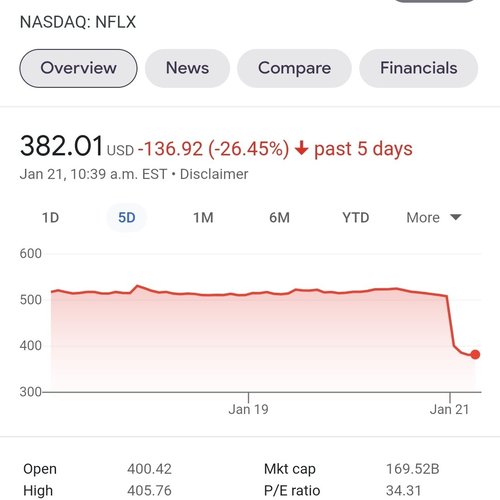
Netflix stock peaked just shy of $700 in late October 2021, and as of this writing the share price had just experienced an unprecedented pullback of 25 per cent. This seems to be driven by post-pandemic concerns of slower-than-anticipated subscriber growth, as well as by competition. The streaming marketplace is much more complex today than back in 2007 when Netflix began moving away from the DVD business and into the video-on-demand space.
Meanwhile, there is increasing evidence that the days of the traditional cable TV subscription are drawing to a close. Market trends analysis company eMarketer suggests that 2022 will mark the first year by the end of this year fewer than half of all Canadian households have a TV service subscription. Cord-cutting is no longer a niche phenomenon.
Against that backdrop, the move to increase Netflix fees is unlikely to meet with much resistance. Perhaps when that standard plan hits $20, plus taxes—surely within five years—there might be an outcry.
How about you? Has your family cut the TV subscription cord? Has the increasing cost of streaming subscriptions caused you to cut one or more such services? Will you be canceling your Netflix subscription?
Follow me on Facebook (facebook.com/PeterVogelCA) and on Twitter (@PeterVogel).
pvogel@outlook.com







