


2nd Sunday of Advent, Year B
First Reading: Is 40:1-5, 9-11
Second Reading: 2 Pet 3:8-15
Gospel Reading: Mk 1:1-8
This Sunday’s Gospel Reading announces the “good news of Jesus Christ,” and the First Reading describes it. However, the Gospel Reading continues with John’s “baptism of repentance for the forgiveness of sins” – which included confessing sins. If we do not repent, the Second Reading will terrify us.
As a matter of history, the world has been “virtually inundated by sin” since Adam and Eve’s Fall, says the Catechism of the Catholic Church. “If we say, ‘We are free of the guilt of sin,’ we deceive ourselves,” St. John says.
Through Christ, God has reconciled us with himself. To fulfill our part in this reconciliation, we must admit, personally, both objective guilt (what we have done is objectively wrong) and subjective guilt (we have done it, at least partly, through our own fault).
Those who claim the “right” to persist in evil – “in any sin at all,” reject redemption, said Pope St. John Paul II. In them, the Holy Spirit, who must “convince us of our sin” before we can be forgiven, encounters “an interior resistance” or “an impenetrability of conscience” called “hardness of heart” – “a state of spiritual ruin.”
If God offers us forgiveness, can we not just accept it mentally?
No. In the Lord’s Prayer, Jesus told us to ask for forgiveness: “When you pray, say … forgive us our trespasses.”
To understand, realize that mental acts can be social or solitary. For example, remembering and reasoning are solitary acts, while promising and forgiving are social acts. Mental acts that are social cannot exist without being expressed or made known to the other person involved. Linguists call them speech acts. For example, only by saying “I take you to be my husband” and “I take you to be my wife” can a man and a woman marry – even legally.
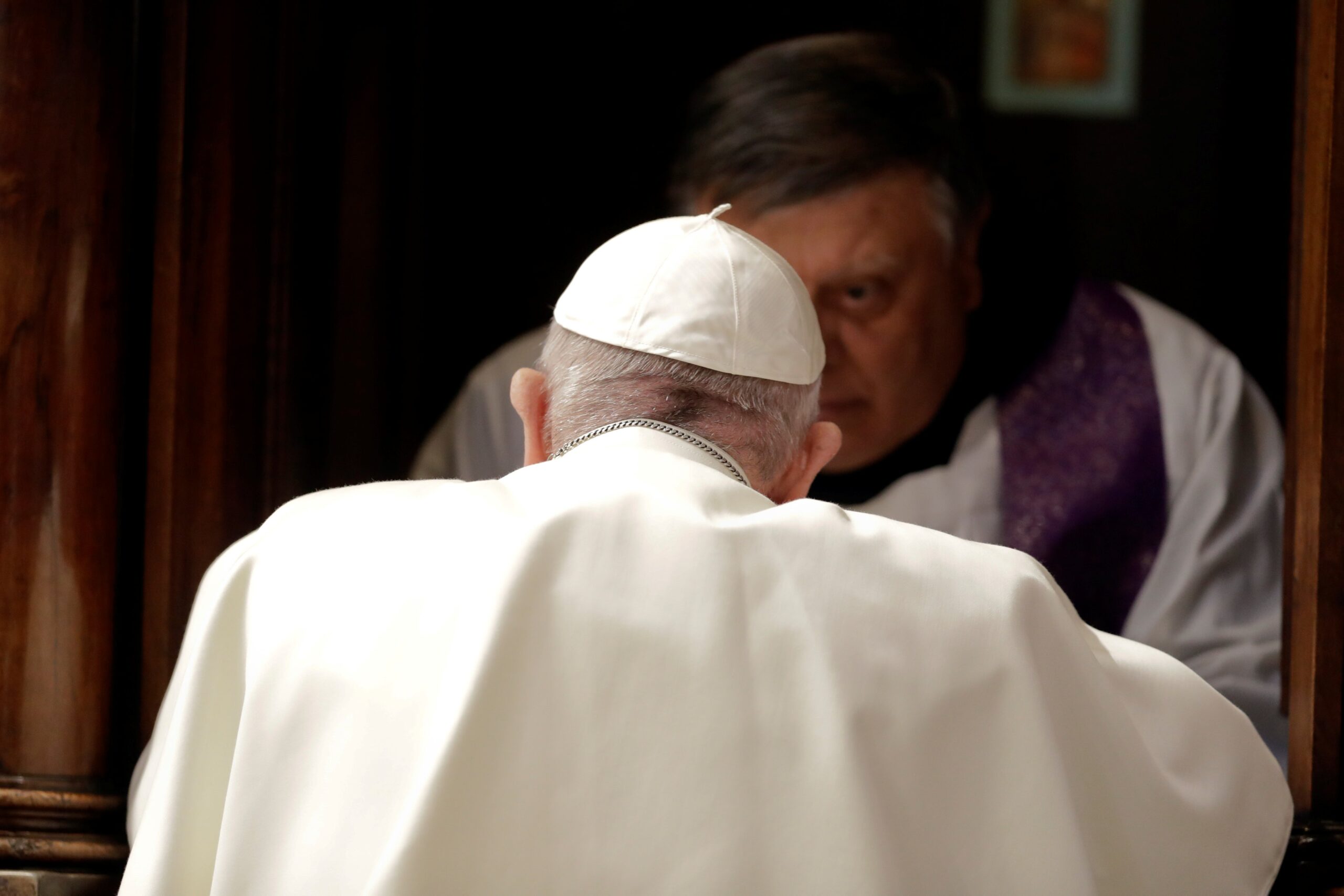
Similarly, the Church requires us to repent, confess our sins to a priest, and promise to change in words. Why?
The answer is that Christ gave “the ministry of reconciliation” to his Church when he told his apostles, “If you forgive men’s sins, they are forgiven them; if you hold them bound, they are held bound.” For the Church to exercise this power, the priest must know our sins, hear our sorrow, and be assured of our intention to change.
Moreover, so must we. As Samuel Johnson said, “We can hardly be confident of the state of our own minds, but as it stands attested by some external action; we are seldom sure that we sincerely meant what we omitted to do.” Accordingly, one of the twelve steps in Alcoholics Anonymous is to admit “to God, to ourselves, and to another human being the exact nature of our wrongs.”
Primarily, confession is difficult not because it reveals our sins to the priest (we know he will never disclose them), but because in stating them aloud, we place them “out there,” look at them squarely and objectively, and take responsibility for them. The very verbalization changes the character of our admission; to see this, try it when you are alone, where no one else can hear.
Verbal confession is humbling, but humility is appropriate in asking for forgiveness. Even psychologically, it frees us and facilitates our reconciliation with God and the Church.
Similarly, the priest must speak the words of absolution aloud. When my mother became Catholic, she said, “I have always believed that God is merciful, but now I know he’s forgiven me: I’ve heard it.”
Priests know how difficult confession can be, and Pope Francis has urged us to make it as easy as possible: an experience of “forgiveness and mercy,” not “a prosecuting court.”
We are tempted to shirk confession through pride, shame, discouragement, or reluctance to “avoid the occasions of sin,” but we can make these difficulties part of our reparation for sin.
This Advent, let us straighten Jesus’ way into our hearts by a good sacramental confession.
Father Hawkswell is again teaching The Catholic Faith in Plain English with new insights, in both print and YouTube form, at beholdvancouver.org/catholic-faith-course. He is also teaching the course in person on Sundays from 2 to 4 p.m. at the John Paul II Pastoral Centre, 4885 Saint John Paul II Way, 33rd Avenue and Willow Street, Vancouver, and Mondays from 10 a.m. to noon in St. Anthony’s Church Hall, 2347 Inglewood Avenue, West Vancouver. Next week’s topic is The Communion of the Saints in the Body of Christ. The course is entirely free of charge and no pre-registration is necessary.
Share your thoughts and contribute to the ongoing conversation by sending us a Letter to the Editor.







