

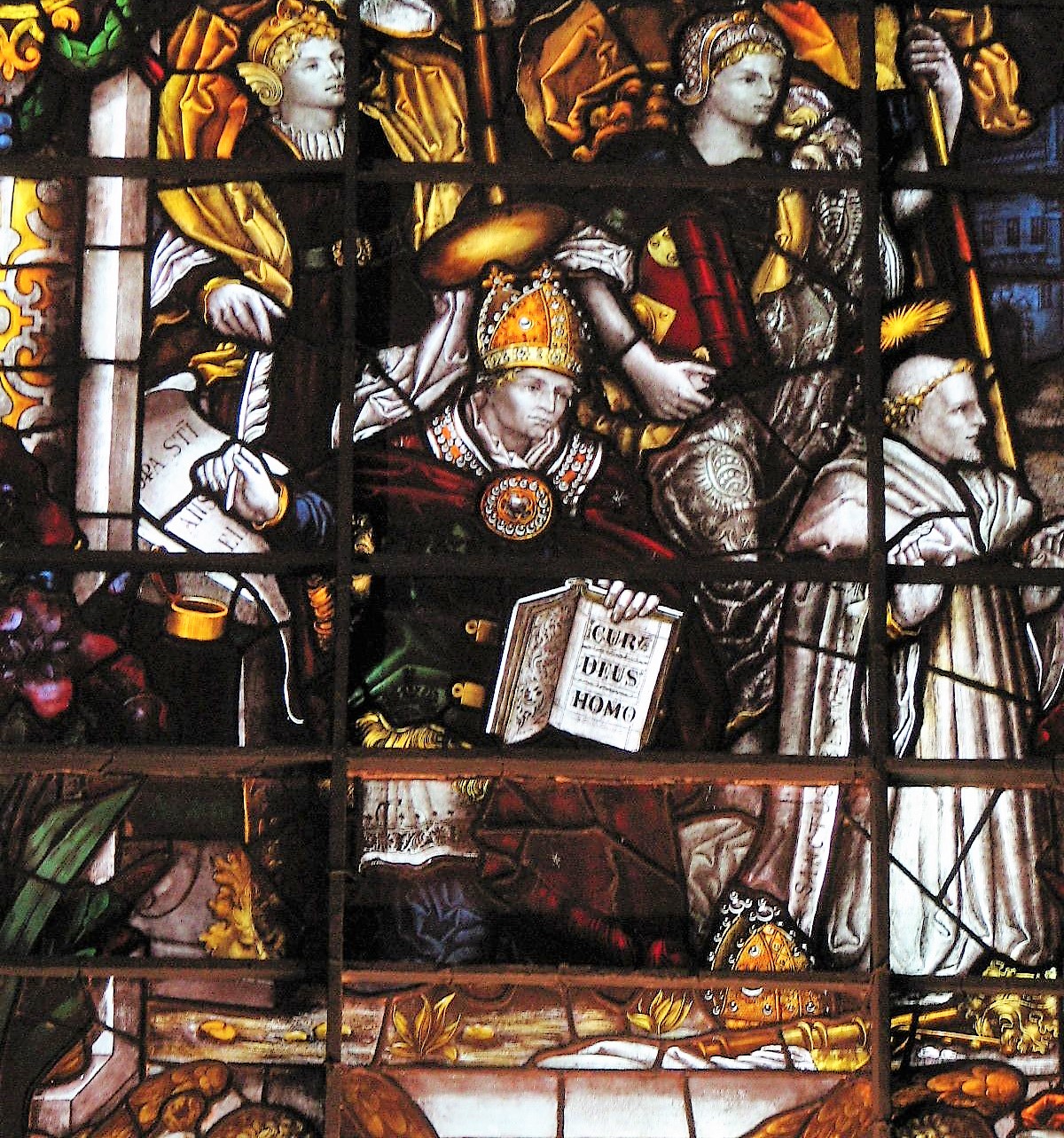

St. Anselm was born in Aosta in northern Italy in about 1033. Pope Benedict XVI said, “Anselm, who since childhood as his biographer recounts imagined that the good Lord dwelled among the towering, snow-capped peaks of the Alps, dreamed one night that he had been invited to this splendid kingdom by God himself, who had a long and affable conversation with him and then gave him to eat ‘a very white bread roll.’ This dream left him with the conviction that he was called to carry out a lofty mission.”
Anselm’s mother was very religious and she saw to the first human and religious formation of Anselm. At the age of 15, Anselm wanted to enter the monastery but was forbidden by his father. Anselm lost his fervour, left home, and went to different schools in France.
Anselm went to the Benedictine Abbey of Bec in Normandy, attracted by the fame of Lanfranc of Pavia, the Prior. Under Lanfranc’s guidance Anselm regained his fervour and eventually became a monk in 1060. Three years later, he was appointed prior, and in 1078 he was elected abbot. Under his supervision, the monastic school at Bec became a renowned centre of learning.
In 1093, Anselm became Archbishop of Canterbury. The saint immediately became involved in a difficult struggle for the Church’s freedom. Anselm defended the Church’s independence from undue interference by political authorities, especially King William Rufus and King Henry I. Anselm went into exile from 1097 to 1100, and from 1103 to 1107. Anselm returned to Canterbury after Henry finally agreed to respect the Church’s independence in appointing bishops.
Pope Benedict said, “This holy Archbishop, who roused such deep admiration around him wherever he went, dedicated the last years of his life to the moral formation of the clergy and to intellectual research into theological topics. He died on 21 April 1109, accompanied by the words of the Gospel proclaimed in Holy Mass on that day: ‘You are those who have continued with me in my trials; as my Father appointed a kingdom for me, so do I appoint for you that you may eat and drink at my table in my kingdom …’ (Lk 22:28–30). So it was that the dream of the mysterious banquet he had had as a small boy, at the very beginning of his spiritual journey, found fulfilment. Jesus, who had invited him to sit at his table, welcomed Anselm upon his death into the eternal Kingdom of the Father.”
St. Anselm is the founder of scholastic theology and is called the “Magnificent Doctor.” Pope Benedict XVI said, “He states clearly that whoever intends to study theology cannot rely on his intelligence alone but must cultivate at the same time a profound experience of faith. The theologian’s activity, according to St Anselm, thus develops in three stages: faith, a gift God freely offers, to be received with humility; experience, which consists in incarnating God’s word in one’s own daily life; and therefore true knowledge, which is never the fruit of ascetic reasoning but rather of contemplative intuition.”
St. John Paul II wrote, “Saint Anselm underscores the fact that the intellect must seek that which it loves: the more it loves, the more it desires to know.” St. Anselm prayed: “Lord, in hunger I began to seek you; I ask you that I may not cease to hunger for you. In hunger I have come to you; let me not go unfed.”
St. Anselm had a great love for Our Lady. He was the first to establish the Feast of the Immaculate Conception in the West. He wrote, “Mary, it is you whom my heart yearns to love, it is you whom my tongue ardently desires to praise.”
Share your thoughts. Send us a letter to the editor.
『優秀聖師』捍衛教會權利
聖安色莫約於1033年出生於義大利北部的奧斯塔。教宗本篤十六世說:『安色莫從小就想像著善良的上主住在阿爾卑斯山高聳的白雪皚皚的山峰之間,有一天晚上夢見天主親自邀請他來到這個輝煌的王國,天主與他進行了長時間和藹可親的交談,然後讓他吃「一個非常白的麵包捲」。這個夢想使他堅信,他被召喚去執行一項崇高的使命。』
安色莫的母親非常虔誠,她見證了安色莫的第一個人性和宗教形成。15歲時,安色莫想進入修院,但被父親禁止。安色莫失去他的了熱心,離開了家,去了法國的不同學校。
安色莫被帕維亞的蘭弗朗克副院長名聲所吸引,去了諾曼底的貝克本篤會修道院。在蘭弗朗克的指導下,安色莫重拾了熱心,最終在1060年成為一名隱修士。三年後,他被任命為副院長,並於1078年當選為修道院院牧。在他的監督下,貝克的修道院學校成為著名的學習中心。
在1093年,安色莫成為坎特伯雷總主教。聖人立即捲入了爭取教會自由的艱難鬥爭中。安色莫捍衛教會的獨立性,使其免受政治當局的不當干預,特別是威廉.魯弗斯國王和亨利一世國王。安色莫流亡於1097年到1100年,和從1103年到1107年。亨利最終同意尊重教會在任命主教方面的獨立性,安色莫便回到坎特伯雷后。
教宗本篤說:『這位神聖的總主教,無論走到哪裡,都引起了環繞他身旁的人如此深切的欽佩,他生命的最後幾年致力於神職人員的道德培養和對神學主題的學術研究。他於1109 年 4 月 21 日去世,伴隨著當天在彌撒聖祭中宣佈的福音話語:「在我的困難中,與我常常相偕的,就是你們。所以,我將王權給你們預備下,正如我父給我預備下了一樣;為使你們在我的國裏,一同在我的筳席上吃喝……」(路22:28-30)。就這樣,在他精神之旅的開始 ,他小時候的神秘宴會的夢,就得到了滿全。耶穌邀請他坐在他的餐桌旁,歡迎安色莫死後進入永恆的天父王國。』
聖安色莫是經院神學的創始人,被稱為「優秀聖師」。教宗本篤十六世稱:『他明確指出,任何打算學習神學的人都不能僅僅依靠他的智慧,而必須同時培養對信仰的深刻體驗。根據聖安色莫的說法,神學家的活動因此分三個階段發展:信德,是天主白白提供的禮物,要謙卑地接受;經驗,就是將天主的話具體化在自己的日常生活中;因此,真正的知識,從來都不是苦行推理的結果,而是默觀直覺的果實。』
聖若望保祿二世寫道:『聖安色莫強調,智力必須尋求它所愛的:它愛得越多,它渴望知道的就越多。』聖安色莫祈禱:『主啊,我在饑餓中開始尋找你;我請求你,我不能停止對你的饑餓。在饑餓中,我來到祢身邊;讓我不要不獲糧食。』
聖安色莫對聖母有著極大的愛。他是第一個在西方建立聖母無原罪始胎瞻禮的人。他寫道:『瑪利亞,你是我心中渴望愛的,你是我的舌頭熱切渴望讚美的。』







