

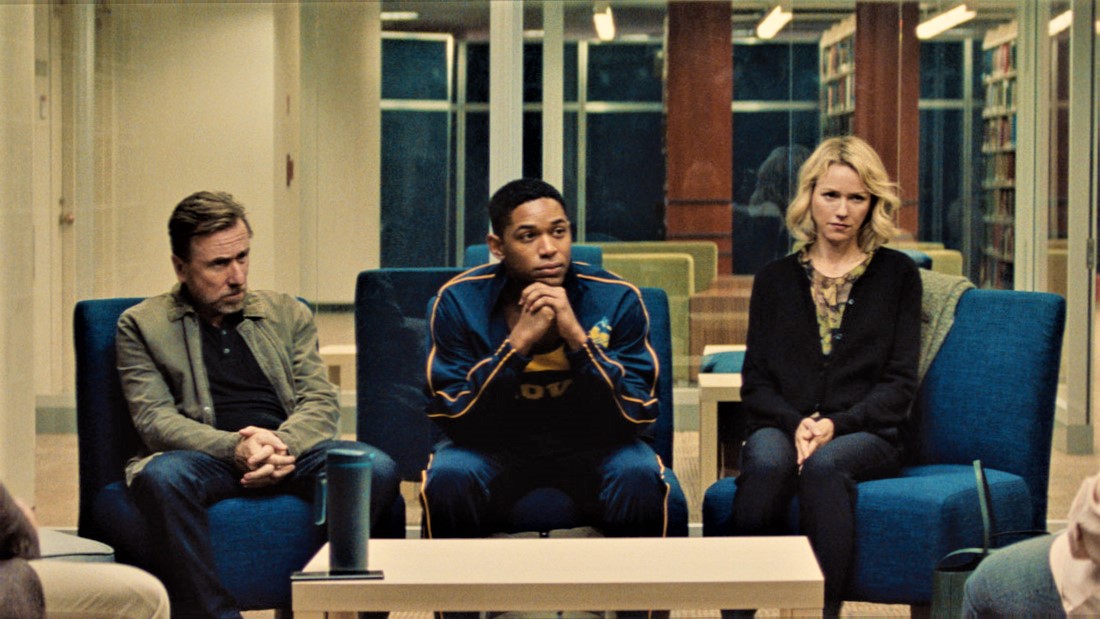

It is the general expectation that a movie dealing with real issues will not only offer a plot in which all conflicts are revolved, but also make a clear statement in regard to those issues. Such is most definitely not the case, however, with the brilliant movie Luce.
Based on the play by J. C. Lee, Luce tells the story of a young man who was adopted from Eritrea by a middle-class childless couple, Pete and Amy Edgar. As Luce, the valedictorian at his high school, graduates, his parents feel justifiably proud of his achievements, both athletic and scholastic. He has survived the trauma of the war and, though few details are given, he has managed to deal with the demons that beset him. Now he is a young man highly regarded by all. However, it soon becomes apparent that all may not be as wonderful as it appears.
Luce’s history teacher, Harriet Wilson, asks for a meeting with Amy regarding an essay Luce has written in which he seems to be applauding the violence advocated by Frantz Fanon, a Marxist revolutionary – a concern which is heightened by Wilson’s discovery of banned explosive fireworks in Luce’s locker.
From this point on, things become more and more complicated as a variety of issues are raised, including racism, sexual assault, parenting, educational ethics, the dangers of modern technology, and even police violence. Indeed, the film offers a cross-section of most of the cultural concerns of today’s society.
Where Luce is unusual is that it not only leaves all these issues unresolved, but also leaves the audience to decide whom to believe: the parents, who are determined to prove that they have done a good job in raising Luce; the teacher, who seems to both admire and resent Luce’s success; the principal, who wants his school to look good; Luce’s girlfriend, whose relationship with Luce is unclear; and above all, Luce himself, who seems to know more than he admits and who may or may not be all that he appears to be.
Some viewers may find the irresolution annoying, but the film is above all trying to point out that most of the issues in society and the leading participants in those issues are not always clear. People and issues can seldom be reduced to black or white, right or wrong.
Life itself is complicated, and Luce wants viewers to confront that complication, ideally to continue the discussion long after leaving the theatre. This is the film’s strength and greatness. Indeed, its only real weakness is not that it leaves many plot lines dangling, but that it ends with one of the main conflicts apparently resolved, though the apparent resolution is both illogical and as questionable as anything preceding it. It is one way to end the film, but everything else is left dangling.
However, this is a minor flaw in what otherwise is a challenging, thought-provoking, and timely work. It is so effective not only because of the clever script, which constantly takes the audience along new and tortuous roads, but because of Julius Onah’s delicate direction. He makes it possible always for the audience to both accept and question.
In this he is superbly aided by a brilliant cast. Naomi Watts and Tim Roth as the parents tellingly show a couple who begin to question not only their much-loved son, but even their decision to adopt. Octavia Spencer turns in yet another outstanding performance as the teacher who finds herself uncertain about her role as a teacher, but who is also dealing with other critical and complex personal matters.
The rest of the large supporting cast are just as convincing, but above all the film belongs to Kelvin Harrison Jr. as Luce. From his opening speech, he comes across as a young man who is not only brilliantly clever, but who knows it; who is charming, but who knows how to use charm for his own ends; who is polite, but who knows how to offend just enough to stay within the borders of politeness. It’s a stellar performance and is pivotal to the success of the film.
It is necessary to point out that the film does have moments which some may find unacceptable – nudity and objectionable language among them. However, at no point are these included wantonly or without dramatic reason, nor are they a major component of the film. It should also be noted that such factors are almost obligatory if a film is to deal convincingly with the realities of today’s society and are by no means redundant to that end.
It is the great strength of Luce that it confronts the audience with questions in a masterful way – and lets the audience determine its own conclusions. This is definitely a thinking person’s film, brilliantly executed.







