


Vancouver’s Elizabeth Bagshaw Clinic is scheduled to close June 30. Founded in 1989 to provide “reproductive, abortion, and sexual health services,” it was named after a doctor who became director of Hamilton’s Birth Control Clinic in 1932, then illegal.
Like Bagshaw, I myself broke the law in 1989 by helping to block access to Everywoman’s Health Centre, where abortions are performed. I reasoned that if I saw a car about to hit a child, I would do anything to save the child. The Church endorses such “Good Samaritan” acts, and so does Canada’s law, so I decided to treat abortion like any other killing. I ended up spending 24 days in jail.
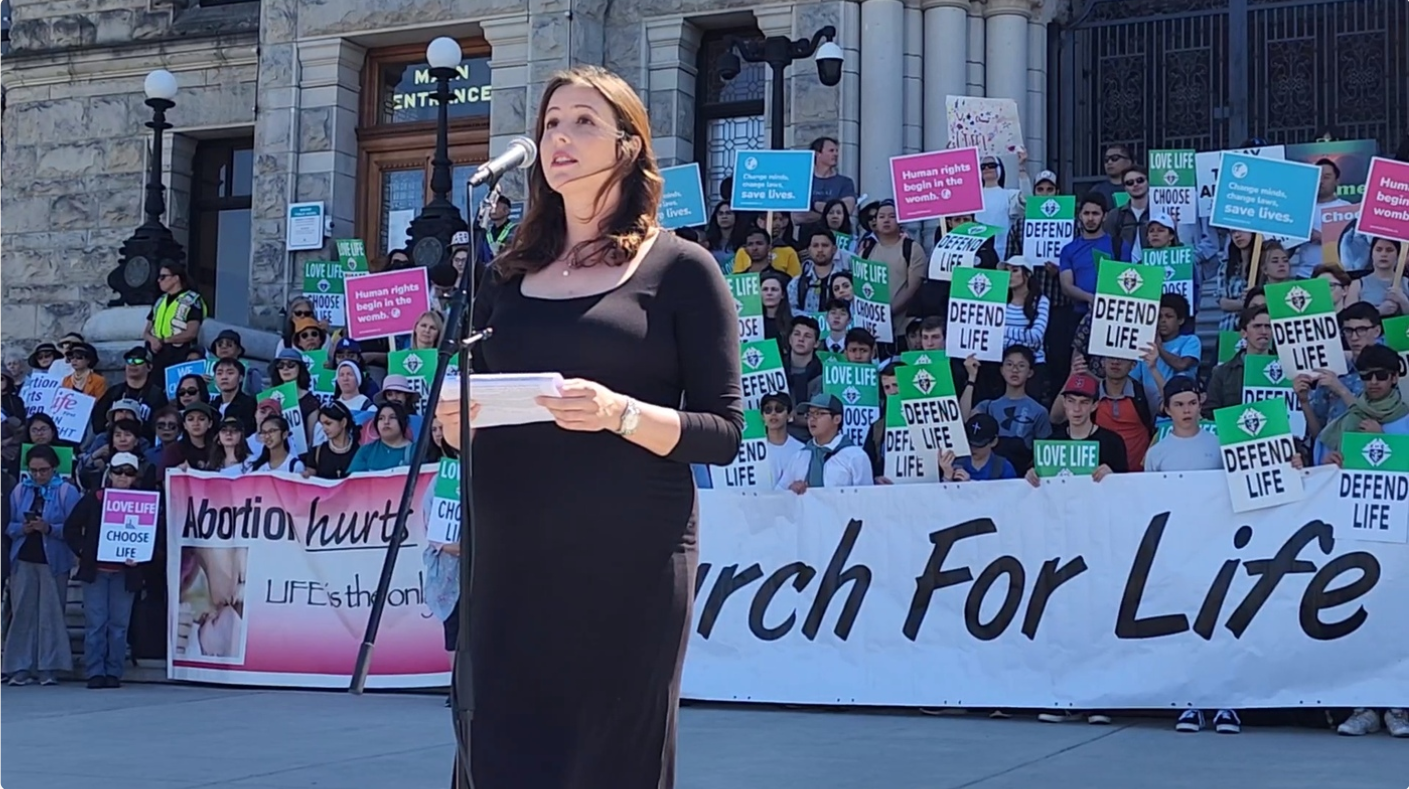
Our protest drew attention, but it did not close Everywoman’s. Since then, I have joined many legal protests and offered Mass repeatedly for the slaughtered babies, their parents, and their killers.
In 2019, I read Abby Johnson’s Unplanned. I was struck by the absence of the verbal abuse that disfigures both sides of the abortion debate. “How we love to vilify our opponents—from both sides!” she said. “We have far more in common with the ‘other’ side than we might imagine.”
Johnson became involved in abortion to help women in “crisis pregnancies.” When she finally saw what abortion was, she fled to the office of the prayerful, non- confrontational 40 Days for Life, confident that they would not reject even the director of an abortuary.
How should we fight abortion?
When I became editor of The B.C. Catholic in 1982, I resolved to teach and promote the truth rather than condemn evil. Let me apply that resolution now.
In sexual intercourse, which the Church calls “noble and honourable,” God invites a couple to imitate his own generosity and fertility. By his will, the act is both unitive and procreative, for it fosters the self-giving it symbolizes, enriches the couple with joy and gratitude, and enables them to share his creative power.
As the Irish bishops expressed in the title of their 1985 pastoral letter Love is for Life—a phrase that is, in effect, a pun—love is meant to be lifelong and also open to the gift of life. If we intentionally break this connection, we rupture our integrity, our inner unity.
Now every society has a set of assumptions, a way of seeing things, which is so widely accepted that it is hardly ever questioned, or even stated. In Western society, one such assumption is that couples should have, as far as possible, the freedom to obey any psychological or physical urge to sexual intercourse—including freedom from pregnancy. This assumption underlies our acceptance not only of abortion, but also of contraception, to which abortion is often just a backup.
No, says the Church. Sexual intercourse “is first of all fully human”: that is, “of the senses and of the spirit at the same time.” It is not just a “transport of instinct and sentiment,” but “also, and principally, an act of the free will.”
“The regulation of procreation” is part of our “human and Christian responsibility,” says the Catechism of the Catholic Church. For physical, economic, psychological, or social reasons—good and generous, not selfish—couples may wish to space their children’s births by freely deciding to engage in, or abstain from, sexual intercourse when they are fertile, observing the natural patterns God has built into their procreative functions.
Natural family planning (NFP), based on the virtue of temperance, fosters communication, tenderness, and authentic freedom. Contraception, based on a desire for “spontaneity,” makes sexual intercourse, at best, simply a “transport of instinct and sentiment,” and, at worst, a merely animal response to a sexual stimulus.
Both have the end (or purpose) of regulating procreation. However, the end does not justify the means. As Mary Healy says, NFP may mean refraining temporarily from the “language” of sexual intercourse, but contracepting means always lying: employing the “language” but denying its full meaning.
To fight the evils of contraception and abortion, we must inform minds and convert hearts, not just change laws or close abortuaries. We must live, and witness to, the “culture of life,” not just condemn the “culture of death”—especially in this Jubilee Year of hope.
It is more important to witness to God’s love and mercy than to demonstrate the horror of sin. I once had to counsel a family whose teenage daughter had become pregnant. To everyone’s surprise, I hugged the girl and congratulated her on the new life she was carrying. She burst into tears, crying that everyone else had simply scolded her.
“Has no one condemned you?” Jesus says. “Neither will I condemn you. Go, and sin no more.”
Your voice matters! Join the conversation by submitting a Letter to the Editor here.







