

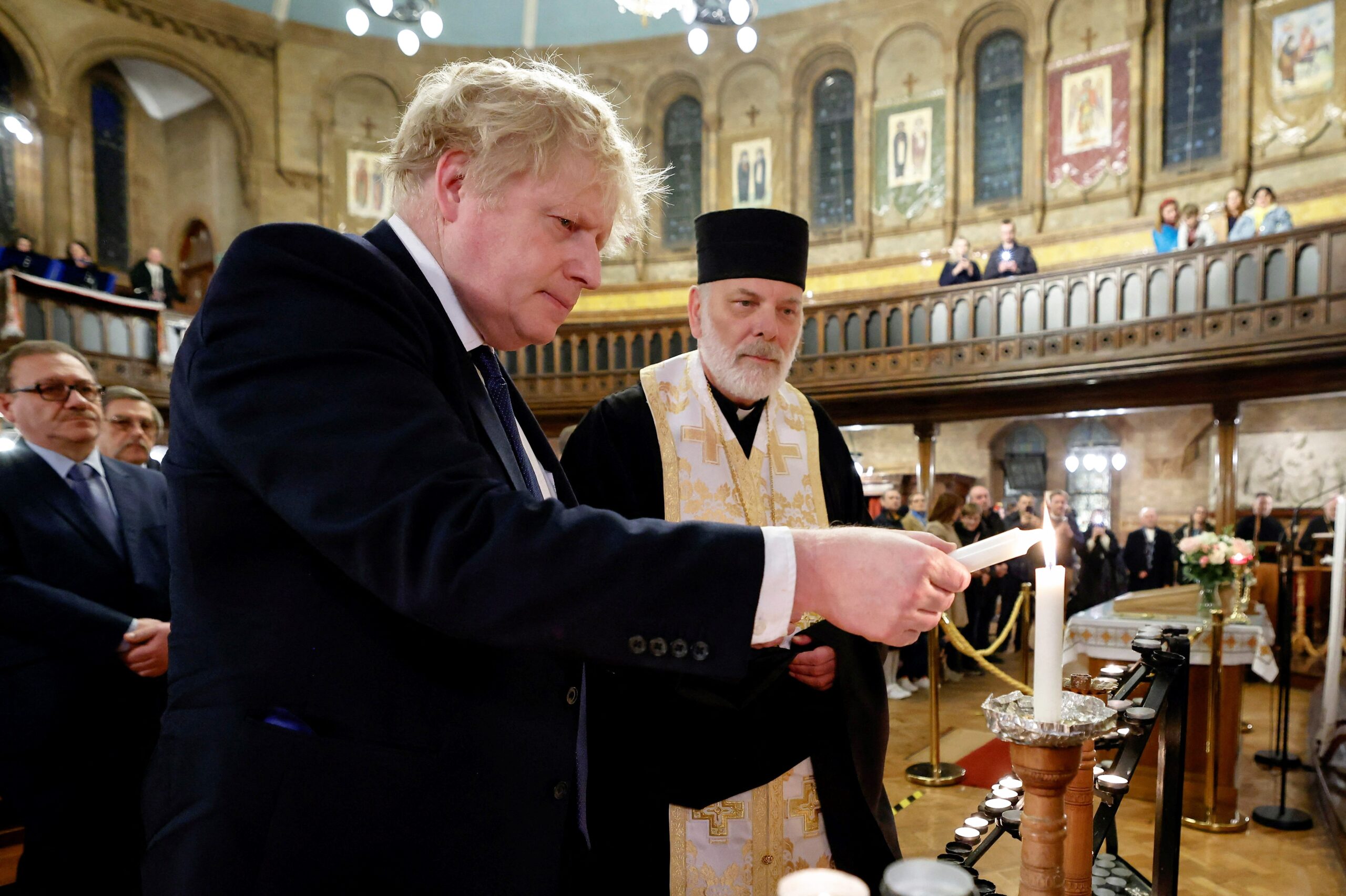

Recent footage of British Prime Minister Boris Johnson walking the streets of Kyiv with Ukrainian President Volodymyr Zelensky, greeting locals in the assailed capital and seeking to buoy spirits, serves as an occasion for reflecting on the bond between those who govern and those who are governed. A timely exercise, one might say, as we commemorate the death of he who told Pontius Pilate that the Roman prefect would have no power to begin with had it not been granted from above.
An initial observation is that Prime Minister Johnson has distinguished himself among major Western leaders in his gesture of support for the Ukrainian people. The United Kingdom is a major geopolitical actor. For its chief executive to make a clandestine 1,500-mile trip to a country under attack by another global power sends a forceful message. Even more so when that PM puts his own security at risk by accompanying his beset host on a walk around town, shaking hands with a shaken population, and looking the victims of war in the eye. (A stark contrast to the U.S. Vice President, whose solidarity tour took her as far as the Ukrainian-Polish border, with feet firmly planted in Poland).
In some ways, there is an echo in Johnson’s venture into the streets of Kyiv – and to a much greater extent, of course, Zelensky’s own resolve to remain with his countrymen as the missiles fly overhead – of the storied examples from history of rulers standing side-by-side with their subjects during extraordinary hardship: the Royal Family refusing to flee London during Germany’s bombing campaigns in the Second World War; or Blessed Karl of Austria (the centenary of whose death we observed on April 1) instituting food rationing at his palace and using his imperial carriages to distribute supplies to the poor.
Indeed, while increasingly rare in contemporary times, this model of sovereign-on-the-suffering-frontlines was actually quite familiar in centuries past. One thinks of St. Louis IX fighting at the forefront of the French army on crusade in the Holy Land in the late 1200s. Like many monarchs of the Middle Ages, St. Louis as a matter of routine, principle, and law granted audiences to commoners who would petition the king directly to remedy alleged grievances. And 16th-century England would not have batted an eye at Shakespeare’s depiction in Henry V of the king donning a disguise and mingling with his battle-weary soldiers so as to glean what they actually thought of their commander.
For many here in North America, the spectre of our leaders helping to carry our burdens shoulder-to-shoulder seems like a far cry from present experience. One wonders how many Canadians and Americans, after two years of intermittent COVID lockdowns and restrictions, feel in their bones that those on the giving end of policy measures which curtailed liberties and threatened (or deprived) livelihoods were open to enduring the same adversity and anguish as those on the receiving end.
And fresh in the minds of Canadians is the response by Prime Minister Justin Trudeau to the convoy of truckers who ensconced themselves in downtown Ottawa. Without question, we can and should debate the merits of the truckers’ actions. But what to make of the Prime Minister essentially branding them as racists and Nazi sympathizers, and refusing to acknowledge the potential basis for their discontent? Or his seeming dismissal of the concerns that prompted hundreds of thousands of Canadians to gather amidst frigid temperatures on highway overpasses to show support for the convoy?
In lieu of giving the time of day to anyone whose employment he put in jeopardy, Trudeau sought refuge in an undisclosed location outside the city, signalling fear and distrust of his own people. Hardly the stuff of courageous, compassionate leadership.
What does all of this have to do with Easter?
In this holiest of seasons, we celebrate the death and resurrection of the king (of kings) who was moved to pity by the lowliest of his subjects – the leper, the blind man, the woman caught in adultery. Jesus was not merely content to share in his people’s pain. In taking up the cross, he bore both our pain and our sins. Raised on the cross and then raised into heaven, it is not our king who is aloof from us. Rather, it is we – his purported followers – who are aloof from him. Aloof in our haughtiness, unworthiness, and sinfulness.
The grace of Easter flows from the blessed edict that by his wounds we are healed and by his kingship we are saved.
During this Paschal celebration, we pray for the humility to repeat the appeal of the petty thief, crucified on Christ’s right-hand side, that our king may remember us when he comes into his kingdom. And may the promise of paradise made by Jesus in return fill us with hope now and forever.
Patrick Owen Brown is a freelance writer and the host of Crown and Crozier, “the podcast on Church, State, and faithful citizenship.” He lives outside of Ottawa with his wife, children, and livestock.







