


Re Graham Osborne’s July 29 column “Receiving Holy Communion: tongue or hand?”
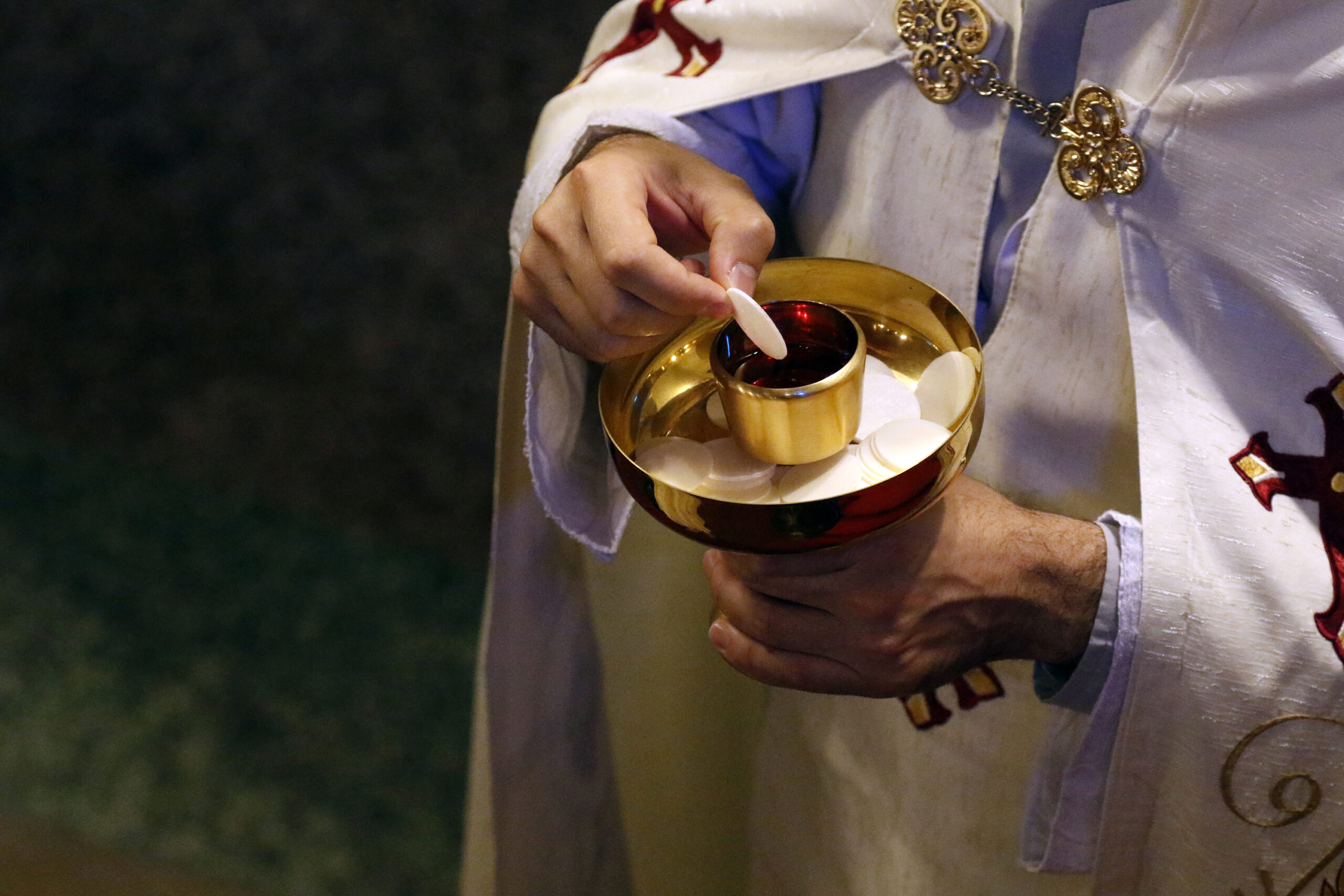
I would like to share the practice of the Pallottine Polish priests at St. Dominic’s Roman Catholic Church in Barbados. They use a chalice with a channel around the bottom holding the Precious Blood in the form of wine.
Then, when the recipient offers their tongue, the priest dips the host into the wine and places it on the tongue.
In this way the danger of abuse of the Eucharist in the hand is avoided and the great joy of receiving our Lord in both forms is magnified.
I understand that this might be a common practice in eastern Europe and I would dearly love to see a similar practice in North America.
Tony Archer
Sechelt
I agree with Margaret Webster’s July 29 letter that Pope Francis’ weekly Angelus address should be printed in The B.C. Catholic.
I disagree with the editor’s response. It really doesn’t matter if the Pope’s message is a week old by the time it is published. We are an international, global church, and not focused only on the Archdiocese of Vancouver.
We need the Pope’s message in readable form in The B.C. Catholic to remind us that the Church is indeed universal.
Margaret Wood
Victoria
Thank you for Paul Schratz’s July 15 column “Astronauts found God in space,” which was reprinted in The Record, the weekly newspaper of the Archdiocese of Louisville.
It was great to read of the public professions of religious faith by some of the 29 astronauts who visited the moon during the Apollo missions.
My gratitude to you for the research you did to dig up faith-related details not found in the secular media nor mentioned on TV programs that were aired on the golden anniversary of the occasion of the first manned landing on the surface of the moon on July 20, 1969.
Wishing you all the best in your continuing work.
Hal Frost
Sheffield, VT
In the Aug. 5 article “Evangelism is not as hard as you think,” the Alpha spokesperson’s quote that “We want to democratize evangelism again” is inappropriate for a Catholic. Democratize is not the right word, since democracy is “control of an organization or group by the majority of its members” or “the will of the people.”
Catholic Christianly is not and never will be a democracy. Truth is truth regardless of the will of the people. Protestants may disagree, and that might be why they have tens of thousands of denominations.
Byron Fisher
Delta
(Alpha’s call to “democratize” evangelism refers to putting responsibility for evangelizing into the hands of every Christian, rather than only priests and other leaders. – Editor)
In response to Robert C. Scott’s Aug. 5 letter, I feel very sad for him and other Catholics who feel like finding another denomination out of frustration over not getting answers to religious questions.
If your parish priest is busy, perhaps he would be happy to host a question time for parishioners after a weekday morning Mass. Make it a social! Or try asking the archdiocese if someone can be sent to the parish to answer questions.
There are also many Catholic books and websites on apologetics. I really like relevantradio.com to answer my questions and generally put my day into perspective. They also take questions! An excellent book to address the church scandals is Bishop Robert Barron’s Letter to A Suffering Church.
The importance of Holy Mass and the lack of reverence people have for it is what needs to be addressed when people are present at Mass.
In The Incredible Catholic Mass, published in 1704, Father Martin von Cochem wrote, “Doubtless it was due to Satan’s devices that, for a considerable period, this Divine Mystery was so seldom made the subject of sermons that so little was said or written respecting it – and thus Catholics became careless about hearing Mass, or heard it indevoutly. As a means of preventing this evil, the Council of Trent commanded those who had the care of souls frequently to preach about the Holy Mass.”
Once people realize the importance of Holy Mass, the churches will be filled and other denominations will realize what they are missing and come home to the true faith!
Lisa Lewko
Delta
No one should be surprised that two-thirds of Catholics do not believe in transubstantiation. The Aug. 12 online article “Poll results on Eucharist show need to teach ‘the basics’” suggests poor catechesis is the culprit. This is only partially true: Many Catholics, clergy included, do not act as though Communion is the Body of Christ. They do not show this truth.
It is possible to tell Catholics in the pews the Eucharist is Jesus, but if they see more people receiving Communion than going to confession, people receiving in the hand, chatting before and after Mass, leaving immediately after receiving, banal music, and nothing to suggest we have received Jesus Christ, why would anyone believe?
The maxim remains true: Lex orandi, lex credendi. As we pray, so we believe. A greater way to show and tell people that the Eucharist is Our Lord is to act like it is Our Lord.
Samuel Stagliano
Coquitlam







