

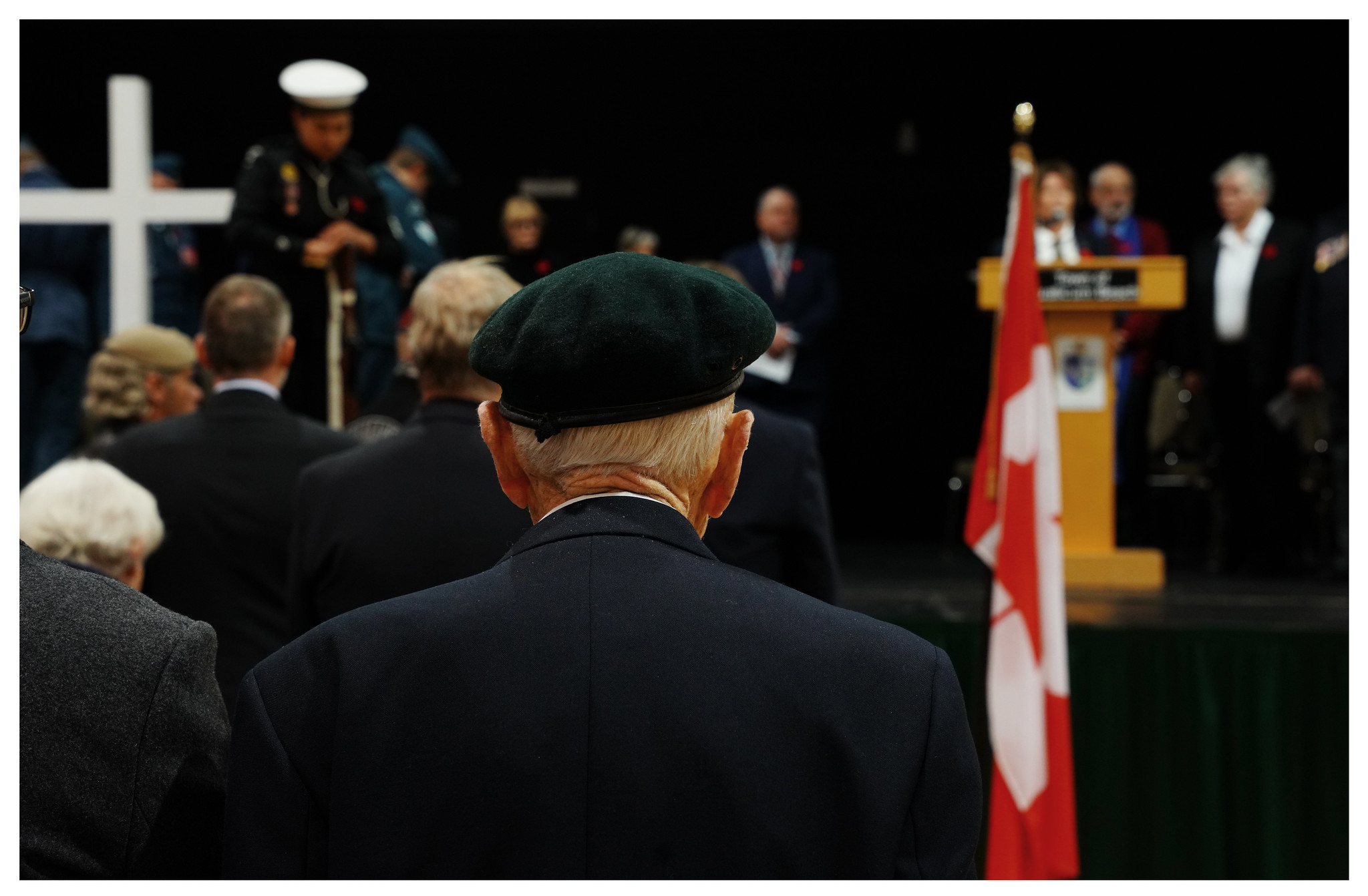

Would someone please explain why offering Medical Assistance in Dying (MAiD) to Canada’s veterans is worse than offering it to anyone else? It can only be if their lives are deemed to be of more value than other lives. This immediately raises the question of where on the scale of worthiness we each sit. And that in turn begs two further questions: how is that decided, and by whom?
In declaring that our truly honourable vets are near the top, we must state who is at the bottom. Initially, it was those dying in awful pain. Then it reached up to the handicapped and chronically sick for whom we find it too expensive to properly care. Then the lonely who feel unwanted and burdensome. And now the suicidal whom we choose to make no further effort to save. Shortly it will include the non-consenting, such as babies with birth defects, and doubtless then all the others with no voice, such as our demented parents and grandparents. Yet now, our Prime Minister emotionally cries out that the offering of MAiD to vets is “absolutely unacceptable.” Too late, Mr. Trudeau; the needle has moved on.
We adopted this scale of worthiness in 2016 when the Trudeau government failed to resist the decision of a few unelected judges. It found itself trying to fix the citizens’ places on the scale. But the needle kept shifting. Amid a cascade of changing criteria, it offered feeble “safeguards” to those whose only safeguard had ever been to do no harm. But did this give the doctors the moral right? Or the impeccable wisdom? Or prevent it from spiralling into death-on-demand? And does it preclude abuse by a future tyrant?
To this failure of forethought is added the failure of logic. MAiD is now a legitimate form of “health care” in this country, and in discussing treatment with the patient, all options must be brought up. Not to mention it to damaged veterans would have been an abrogation of fiduciary duty. So how is MAiD, offered in good faith and in response to Canadian law, unacceptable? Moreover, as ex-soldiers these particular patients had been willing to make the ultimate sacrifice for others: why should they not make the sacrifice now, for the betterment of their children and grandchildren, and all society?
None of it makes sense. Why? Because in truth there is no scale of worthiness. Every human life is of immeasurable and equal value. And remains so to the natural end of life. Without that moral principle to guide us, we are lost in a maze of our own making.
Dr. Richard R. J. Smyth, MBBS, LRCP, FRCS, FRCSC – retired
Adjunct Professor in Faculty of Science, Thompson Rivers University
Clinical Instructor in Otolaryngology – Head and Neck Surgery, UBC
West Vancouver
An important piece of news this week is that senior psychiatrists have told the government that it should delay allowing euthanasia (MAiD) for people with mental illnesses. The Canadian Catholic Bioethics Institute has been reporting on the move to extend euthanasia to cases of mental illness, a change scheduled to be implemented in March 2023, allowing for study and hearings by a special committee formed to devise safeguards for the procedure. The committee heard from many groups and individuals both for and against the extension, either by mail (e.g., by CCBI) or at hearings, if fortunate enough to be scheduled. While it was important and necessary to register those views, nothing seemed to have had much public impact until the publication of a declaration Dec. 1 by the Association of Chairs of Psychiatry in Canada calling for a delay.
Note that this powerful association is not against euthanasia but is rightly pointing out further dangers inherent in the legislation permitting the procedure for people with certain forms of mental illness. The statement refers to public concern about suicide, in turn frequently associated with mental illness and self-harm, and to society’s efforts to prevent it.
It is puzzling that, at the same time, society would condone assisted death for people suffering from similar mental illnesses. What is the distinction between suicide / assisted suicide? Why prevent one and allow the other? How will mental illnesses be assessed? What are the criteria? In fact, the association raises the same points that many other groups have already raised (CCBI, among others) but in all likelihood a professional, medical body may have more power and influence. We shall see.
After all, psychiatrists will be responsible for assessment of applicants for the procedure, and we should pay attention when they warn society of foreseeable problems in their task. For one thing, they question the concept of “irremediability.” The medical profession knows only too well how difficult it is in many cases to be reasonably certain that a patient will never be able to recover. Deciding on an application for MAiD for a person with mental illness, even if the doctor agrees with euthanasia in principle, is fraught with danger, most obviously for the person about to end his or her life but also for doctors and psychiatrists who express doubts about cooperating in termination of life as an “answer” to a psychiatric problem. Euthanasia is not treatment, which doctors are trained to give and where their professionalism truly lies.
This matter is far from being resolved and it will be interesting to see Parliament’s next steps. We hope they listen and prohibit euthanasia, if not completely, then in these types of cases. That would be a small step towards justice for the mentally ill.
Dr. Moira McQueen, LLB, MDiv. PhD
Executive Director
Canadian Catholic Bioethics Institute
Toronto
Send us a letter to the editor about this or any other article.







