


Re “Hospital put ‘do not resuscitate’ order on elderly woman, then urged husband to euthanize her,” B.C. Catholic, Feb. 6.
It was with some sadness that I read about Marilynn Leskun and the hospital’s efforts to put a do not resuscitate order on her, then urge her husband to euthanize her.
I remember her as a wonderful Grade 2 teacher at St. Patrick’s Elementary in Vancouver (1971-72). Here is a photo of Ms. Leskun and the Grade 1/2 class I was a member of.
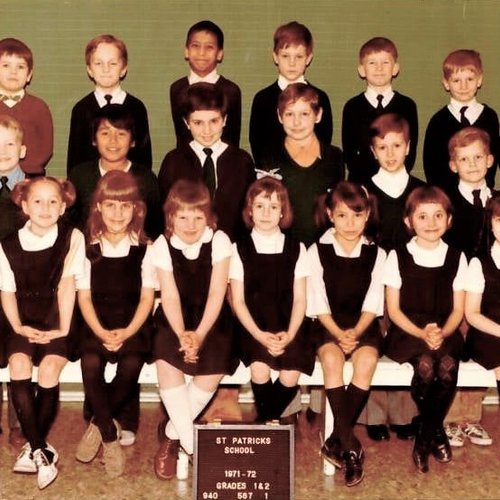
May Marilynn’s soul and all the souls of the faithful departed rest in peace, and thank you Richard for sharing your experience with Terry O’Neill.
John O’Flynn
West Vancouver
The story about Marilynn Leskun is very upsetting as it seems to indicate that a “do not resuscitate” (DNR) order is equivalent to a “do not care” order, which obviously is not the case as Mr. Leskun did not even realize that a DNR order was already in place.
The B.C. Catholic would do well to have an article about what the Church teaches about natural death in relation to a DNR order.
In my view it is not lawful for a doctor, likely because of his own and his staff’s discomfort, to order a DNR. Only the patient or a designated person can do that.
Furthermore it is my understanding that MAiD can only be brought into a conversation when the patient, not someone else, brings it up. This, by the way, makes discussion about providing MAiD for very ill babies and young people a thorny question. Can we order the life of another be snuffed out because we are uncomfortable with it?
Margaretha Smits
Vancouver
We offer our sincerest condolences to Mr. Leskun for the death of his wife Marilynn. According to the article, Marilynn suffered from dementia and was admitted to the hospital after falling from her wheelchair. Mr. Leskun claims that the hospital staff told him that they had written orders for a medically assisted death. In Canada, a request for medical assistance in dying (MAID) must be initiated by the individual; the person must have capacity to make that request.
In Mrs. Leskun’s case she was suffering from dementia and would not have had the capacity to make a request for MAID. To be clear, a clinician cannot order an assisted death. What they can do is explain to the patient or their substitute decision-maker their care options, including not to resuscitate (DNR order), palliative care, and MAID if the patient has the capacity to understand.
There are rigorous criteria and safeguards in place regarding MAID in Canada and the request must be initiated by the patient.
Sarah Dobec
Dying With Dignity Canada
Toronto
(The B.C. Catholic replied to Ms. Dobec, thanking her for her letter and saying it was good to see that despite our differences on the ending of people’s lives we can agree that coercion is wrong – Editor)
As I write this, I am filled with overwhelming gratitude for the power of prayer and the grace of God. Just under a month ago we were united in prayer for our baby Kenzo, one month old, who had contracted a severe case of respiratory syncytial virus (RSV) and bacterial pneumonia.
Kenzo was rushed to Royal Columbia Hospital emergency and transferred to acute care at B.C. Children’s Hospital. Rachelle watched helplessly as Kenzo’s lungs struggled to pull in a full breath. While in the pediatric intensive care unit we witnessed complete teams of medical staff attempt with futility to cure what ails our son. Kenzo’s little heart stopped twice, requiring medical intervention.

But with Kenzo’s sheer fighting spirit and the power of prayer, God delivered a miracle. Despite the dire prognosis given by the doctor, Kenzo began to improve. His breathing became easier and his coughing subsided. There are many months ahead of monitoring and follow-up, but he is now back home with his older brother, sister, and the family.
We attribute his recovery to the power of prayer and the grace of God. This is a powerful reminder of the
importance of coming together as a community to lift up those in need. When we come together in prayer, we are united in our faith and belief that God can and will work miracles in our lives.
Our family completely feels the love and support of our Fatima community, from the messages of concern and greeting cards to direct donations and prepared meals by staff at our daughter’s school, Our Lady of Fatima Elementary. All these gestures helped us to put more focus on Kenzo and our children’s needs during this difficult time.
But most importantly we experienced the power of the prayers sent by our community. It is through this unity that we are able to see God’s hand at work and to experience the joy and peace that comes from knowing that he is always with us, always watching over us, and always working for our good.
May we continue to come together in prayer, united in our faith and open to the power of God’s love and grace in our lives.
Rachelle Rayco and Kenneth Lukban
New Westminster
I enjoyed Peter Vogel’s Feb. 6 column “ChatGPT: Boom, bust, or boondoggle?”
The article written by ChatGPT provided good information, but it was a bit wordy and too formal. Style is something personal. I suppose that’s something AI can learn intuitively. I’m reminded of the movie HER [the 2013 film depicts a lonely writer who develops a relationship with an artificially intelligent virtual assistant].
I prefer Vogel’s writing style. Maybe he can ask ChatGPT to write for him and then edit it for style and local human perceptions.
Thelma Siglos
New Westminster







