


Sometimes we get to choose our Lenten penances. And sometimes we don’t. Five years ago, at this time, we were all plunged into a penance that was not of our choosing – lockdown. There have been other times in history when society has had to suffer together – world wars and the Great Depression come to mind.
Then there have been times when the penances have gotten a little more specific. Take, for example, the story of Venerable Father Emil Kapaun, a Kansas-born military chaplain who served in the Korean War.
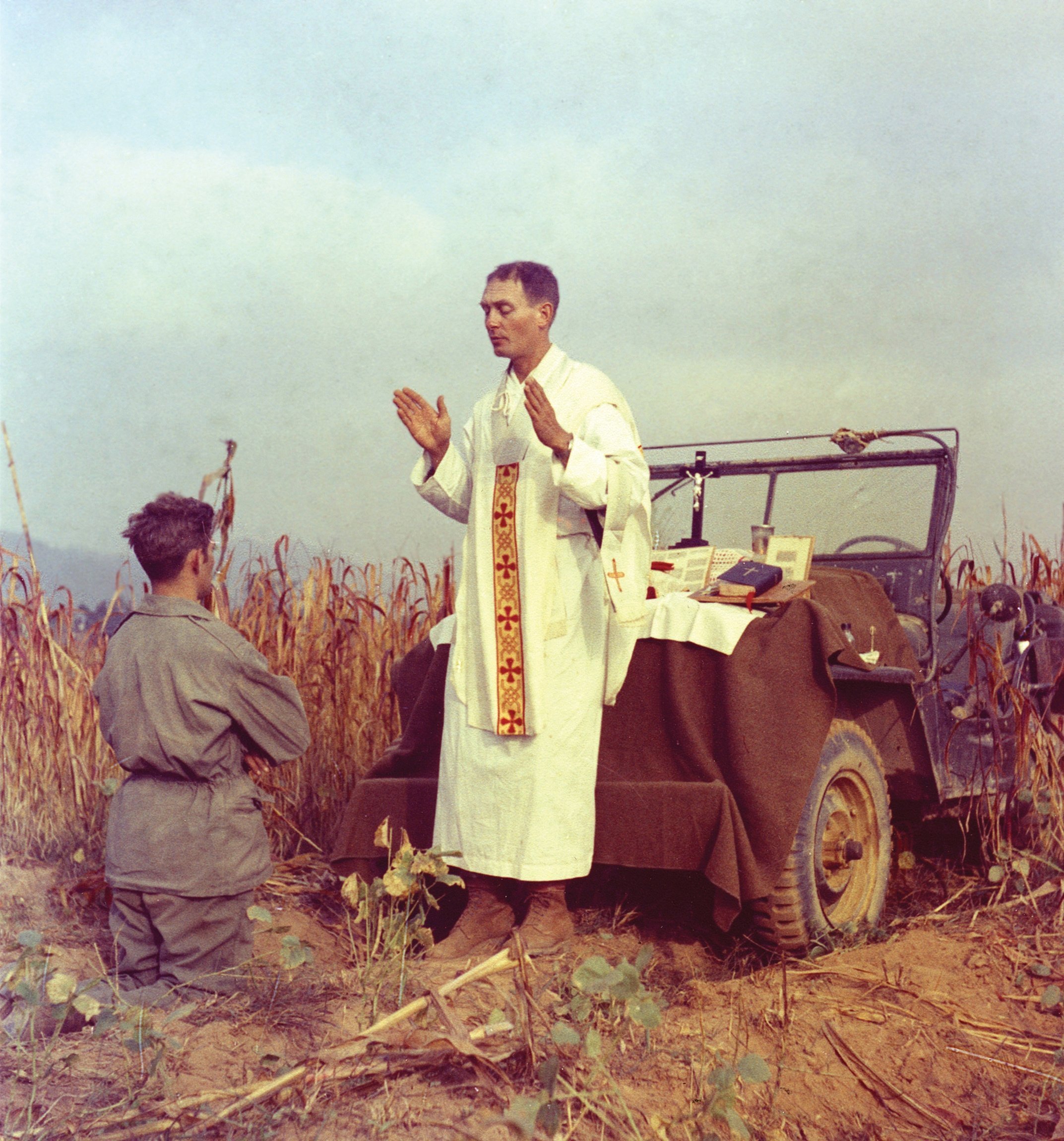
According to the story told on frkapaun.org, Father Kapaun went to great lengths to minister to the men who were serving in that conflict. He would use the hood of an Army jeep as an altar to celebrate Mass. When his unit was captured and marched to a POW camp, he risked his own life by breaking away from guards to pick up a wounded soldier who was left to die in a ditch.
In the YouTube series Kapaun’s Men, the Story of Fr. Kapaun: Virtue Series Week 1, the soldier, Herbert Miller, recalls that a Chinese guard was about to shoot him with the gun pressed against his forehead when Father Kapaun pushed the gun and guard out of the way, got Miller to his feet, and carried him a good part of the 50-mile trek to the prison camp. Father Kapaun showed by example what it means to be willing to lay down one’s life for a friend, even when that friend is a stranger.
Father Kapaun and his fellow soldiers arrived at the camp in October 1950 and faced a cruel winter, with meagre shelter, little clothing, sparse rations, and harsh punishments under the Chinese guards. Father Kapaun was a particular target of the guards, who knew that he was a man of deep faith and that his example and leadership were a lifeline for the other prisoners.
The young priest encouraged his friends, praying with them often, but more than that, he served them. He would even sneak out beyond the guarded area to gather rice and potatoes so the men could have real sustenance. He visited all the shelters each night to pray with the men, bless them, make sure they had something to eat, tend to their wounds, bring them clean clothing that he had washed himself, and even pick the lice off them.
One can’t help but wonder how Father Kapaun and the other prisoners thought about Lent in that winter of 1951. They most likely knew when it was Ash Wednesday because we know they celebrated Easter Mass at dawn on the outskirts of the prison camp on Easter Sunday, March 25.
How does one embrace the spirit of Lent when all manner of sacrifices and deprivations are being forced upon him? The answer, of course, is to think of Christ, who, through free choice and no fault of his own, suffered immensely for all of us.
What was the Easter Mass like for those who were experiencing so much pain? The fact that some 60 men attended speaks volumes about their chaplain’s leadership. One of those men even sought and received baptism at the sunrise service.
We know through the stories of those who survived the POW camp that during that Mass, Father Kapaun spoke mainly of Christ’s sufferings. The men were able to truly identify with Christ and what he endured for them. Their faith became personal. They were living out their own passion and learning to rely on the strength of Christ to get them through.
Less than two months after that Mass, when Father Kapaun became too weak to continue his ministry, his men didn’t want to let him go to the camp hospital, or “death house,” as it was commonly called. But Father Kapaun told the men to let him go, saying, “Don’t worry about me. I’m going where I always wanted to go, and when I get there, I’ll say a prayer for all of you.”
He was an example of faith to the end. The men watched as Father Kapaun, in typical Christlike fashion, blessed his captors and pleaded with God to “forgive them, for they know not what they do.” He died on May 23 at the age of 35.
Most of us aren’t facing the immense suffering found in a North Korean POW camp in 1951, but we are all in need of a renewal of our hearts this Lent. We can all benefit from the example of Father Kapaun, and many other saints throughout history, who have made the teachings and sufferings of Christ present to us in an intimate way.
Lazzuri writes from her home in Nova Scotia, where she lives with her husband, four of her six children, and her mom. She can be reached at clarelazzuri@gmail.com.
Your voice matters! Join the conversation by submitting a Letter to the Editor here.







