


Easter Sunday, Year A
First Reading: Acts 10:34a, 36-43
Second Reading: Col 3:1-4
Gospel Reading: Jn 20:1-18
“I go to my religion for comfort,” a woman told me; “I would never let it affect my real life.”
C.S. Lewis once prayed that he might so pass through eternal things that he did not lose sight of temporal things. It was a “slip of the tongue,” he said, but he wondered whether, perhaps, that was what he really wished!
As editor of The B.C. Catholic, I once asked my staff what our front-page story should be for the Easter edition. One of them replied, jokingly, “Why, Christ’s resurrection, of course!” We all laughed; but surely, had I been thinking of eternal things instead of temporal things, I would not have asked the question, nor laughed at the answer. (To do myself justice, I did make it my front-page story!)
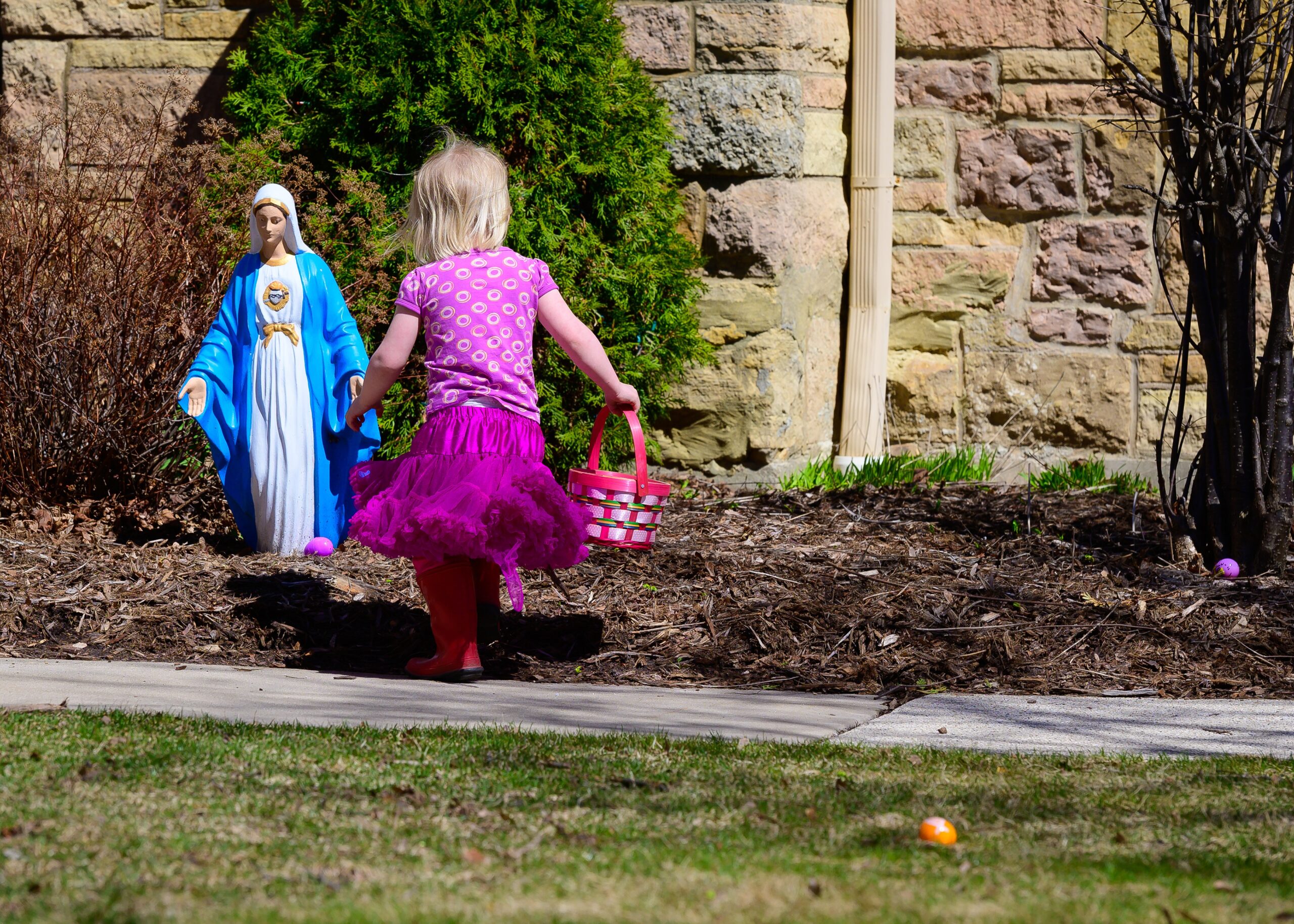
For those who go to religion only for comfort, who keep their eyes fixed on worldly things while paying lip service to religion, Easter is a non-event: a silly spring festival of bunny rabbits and chocolate eggs, a four-day weekend too valuable to waste on church.
For us who know better, Easter is the solemnity above all others, marking the central event of human history, reminding us that this world cannot satisfy us, but only prepare us for the fullness of a life that will last forever.
“They put him to death by hanging him on a tree,” St. Peter says; “but God raised him on the third day.” That is what will happen to us. When we die, our souls will leave our bodies, but we will not cease to exist; we will each be awarded our choice of heaven (immediately or after purgatory) or hell. However, at the end of the world, on the last day, God will reunite our souls and our bodies forever and we will be like Christ, risen from the dead to a glorious new life.
This, we claim, is our faith, but let us not deceive ourselves: we are just as slow to believe and understand as Peter, Mary Magdalene, or the disciples on the road to Emmaus. We may say we believe, but do we act as though we believe?
Do we really “seek the things that are above, where Christ is, seated at the right hand of God?” Do we behave as though the life which is “hidden with Christ in God” is our real life, the only life that will go on forever, the only life worth all the effort and concern we tend to give our earthly life; or do we try to make sure of temporal things before we take a chance on eternal things?
We are not wholly to blame for our unbelief. “O see, in guilt I was born, a sinner was I conceived,” we say with the psalmist. We have all contracted the disease of our first parents, which makes it difficult for us to see spiritual things as the eternal, diamond-hard realities they are and tempts us to substitute the ephemeral comforts of this world; we are all subject to the timidity that makes us, when God invites us out into the deep, cling to our life-line to the shore.
The truth is that what looks like a lifeline is really a deathline. As John the Baptist said, Christ must increase and we must decrease. We must turn away from the goal of happiness in this world and make God our goal instead, taking all our happiness from him as a by-product of our search for him, who is the only source of lasting happiness.
This is the message of Easter. If we do not hear and accept it, we lose everything. If we do, we gain Christ, and, with him, thrown in, even more happiness than we can imagine.
We have to make “the stone that the builders rejected” our “cornerstone.”
Father Hawkswell is again teaching The Catholic Faith in Plain English, with new insights in both print and YouTube form at beholdvancouver.org/catholic-faith-course. Father is also teaching the course in person on Sundays from 2 to 4 p.m. at the John Paul II Pastoral Centre (4885 Saint John Paul II Way, 33rd Avenue and Willow Street, Vancouver) and on Mondays from 10 a.m. to noon in St. Anthony’s Church Hall, 2347 Inglewood Avenue, West Vancouver. Next week’s topic is “Virtue.”







