
At some point in our secondary school English studies, most of us were taught there are essentially only three plots: a person versus him or herself, a person versus another, and a person versus society.
While some may disagree with this generalization, it does cover most plotlines, and nowhere is this more true than in movies. People often react to a film by saying that while it may be well made, it follows a predictable pattern. This accusation may be levelled at Just Mercy. In fact, it fits the bill in several ways.
Just Mercy tells the familiar story of an idealistic young lawyer who sets out to defend victims of injustice, realizing there is no more apt locale for this than Monroeville, Ala., where racism is rampant and innocent people are sentenced to death essentially because they are black.
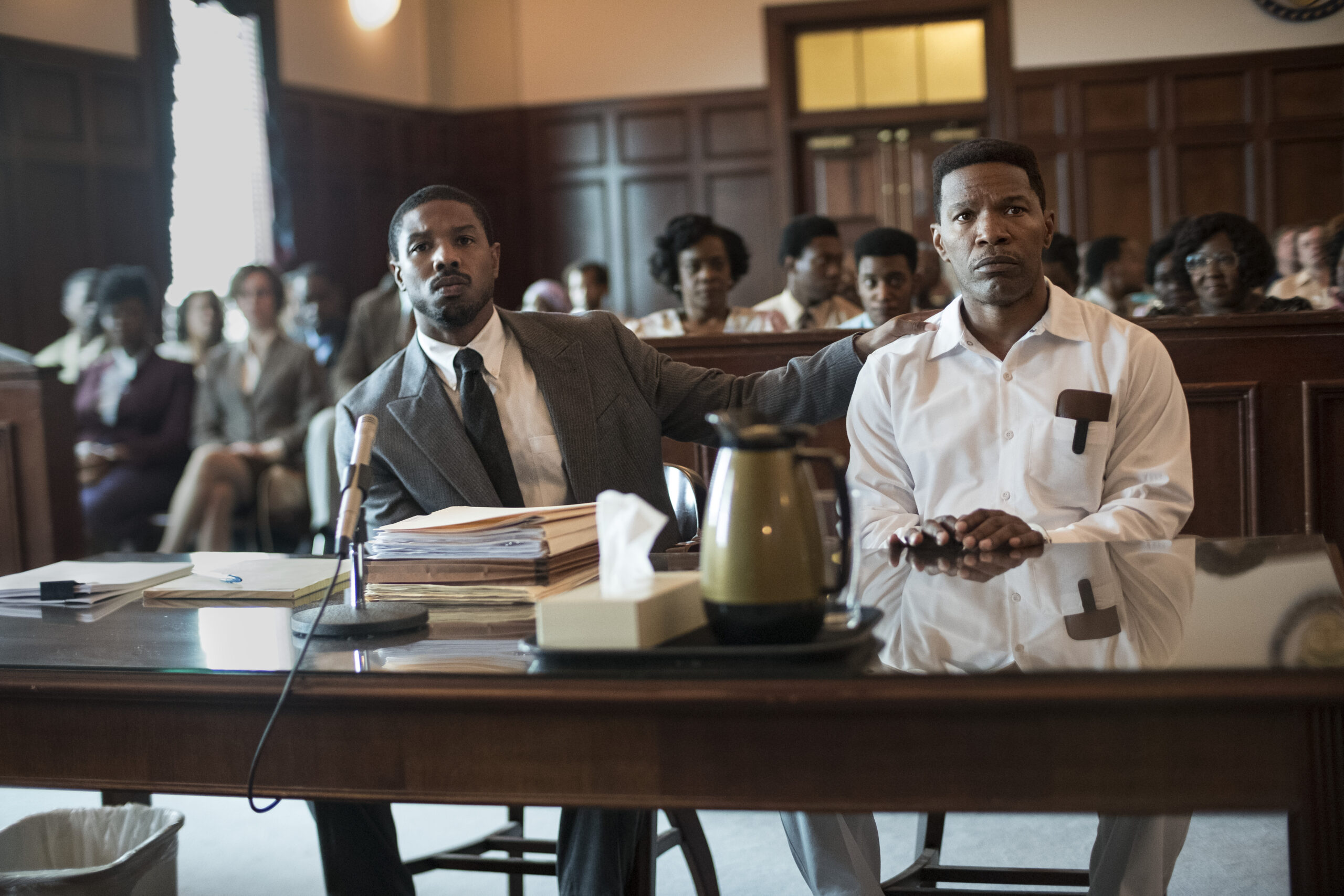
The irony of this is that Monroeville is the setting that inspired Harper Lee’s To Kill a Mockingbird, an honour of which the citizens are very proud. One wonders if they have ever read the book, as the film follows the essentially true story of Harvard law graduate Bryan Stevenson battling prejudice, bias, and injustice in his determination to prove the wrongful conviction of death row inmate Walter McMillian (Jamie Foxx).
Of course, a lawyer coming to the aid of an innocent man and trying to prove his conviction to be wrongful is a familiar plot line, which may cause the viewer to assume an inevitable outcome with little opportunity to build suspense.
However, writer/director Destin Daniel Cretton does not shy away from the dogged journey the lawyer has to undertake as he works for the Equal Justice Initiative. Some may find the plodding progress a little too lacking in excitement. However, the outstanding performances of the two leads and an admirable supporting cast portray the events with a controlled and quiet intensity that underscores the labourious process of the law, particularly when carried out in the midst of a hostile and threatening populace.
In fact, the film’s studied approach allows for development of other subplots, perhaps most tellingly in the exposure of the barbaric horrors of the execution chamber. Not since Dead Man Walking has the case been made more effectively.
Then, too, the film also makes viewers uncomfortably aware of the disadvantages many black people face daily in their communities – disadvantages which constantly threaten their entire lives.
As if these tropes were not enough, the film also tells the story of people persisting against their own doubts and misgivings in order to maintain the right.
Ultimately the film reaches a dramatic climax, which pays off by travelling less predictable ground with a series of unexpected twists and turns – all the more surprising in that they are factually correct.
It is true that some liberties have been taken with Stevenson’s life in that incidents from other circumstances have been included – something that is excusable in that they further highlight the main theme of the plight of the black people and their disadvantaged lives.
Just Mercy, despite being a riff on familiar plot lines, is engrossing, moving, and provocative. In fact, my main reaction to much of the film was a feeling of intense anger that such events are possible.
Certainly, many viewers will experience a similar reaction to the blatant racism displayed in the film (and reiterated in the climax). However, that very reaction should give us pause. Sadly, such racism is not confined to the Deep South – though some might like to believe otherwise.
One of the strengths of the film is that it does an admirable job of exposing racism, in all its blind and illogical hatred, based on skin colour and ethnicity. One can only hope that in the war against such prejudice, a film like Just Mercy will contribute to the cause of those determined to stamp out such inhuman and un-Christian attitudes wherever they exist. Just Mercy is a film which conveys lessons we all need to take to heart.