
The arts in general, and theatre in particular, have long been a source of controversy. On one hand there are those who feel that artists should above all pleasantly entertain, while the more avant-garde group has advocated for artists who challenge, disturb, and shock the public.
Indeed, this resulted in a lively, though today largely forgotten, debate about the kind of works that were being presented in London’s West End theatres in the 1950s. One of the most popular dramatists of the time, Terrence Rattigan, even posited a fictional “Aunt Edna” whose taste for so-called drawing-room comedies and dramas was the mainstay of box office success.
At the same time, something of a theatrical revolution was taking place. Plays such as Beckett’s Waiting for Godot and the “kitchen sink” dramas of the “Angry Young Men” were being lauded for offering challenging and disturbing commentaries on society as a whole, and particularly the lives of people like middle-class, smugly contented “Aunt Edna.”
To this day, this battle for box-office success continues and is reflected not only in live theatre, but also in movies. Which, ultimately, is going to win over audiences? Are people going to patronize “safe” works, whether they be comedies or tragedies, or are they going to seek out more challenging work? Do they want to attend Tar and the disturbing concerns it arouses with regard to sexual predators, even when well-made and widely praised? Or do they want to attend an action-hero movie and its comforting suggestion that, no matter how the world develops, good will ultimately triumph against the forces of evil? Or do they want something even more comfortingly familiar?
Certainly, among the most recent movie releases, for those who opt for comforting, safe entertainment, nothing could be better suited than Juniper. It is the sort of film that Rattigan’s Aunt Edna” would embrace.
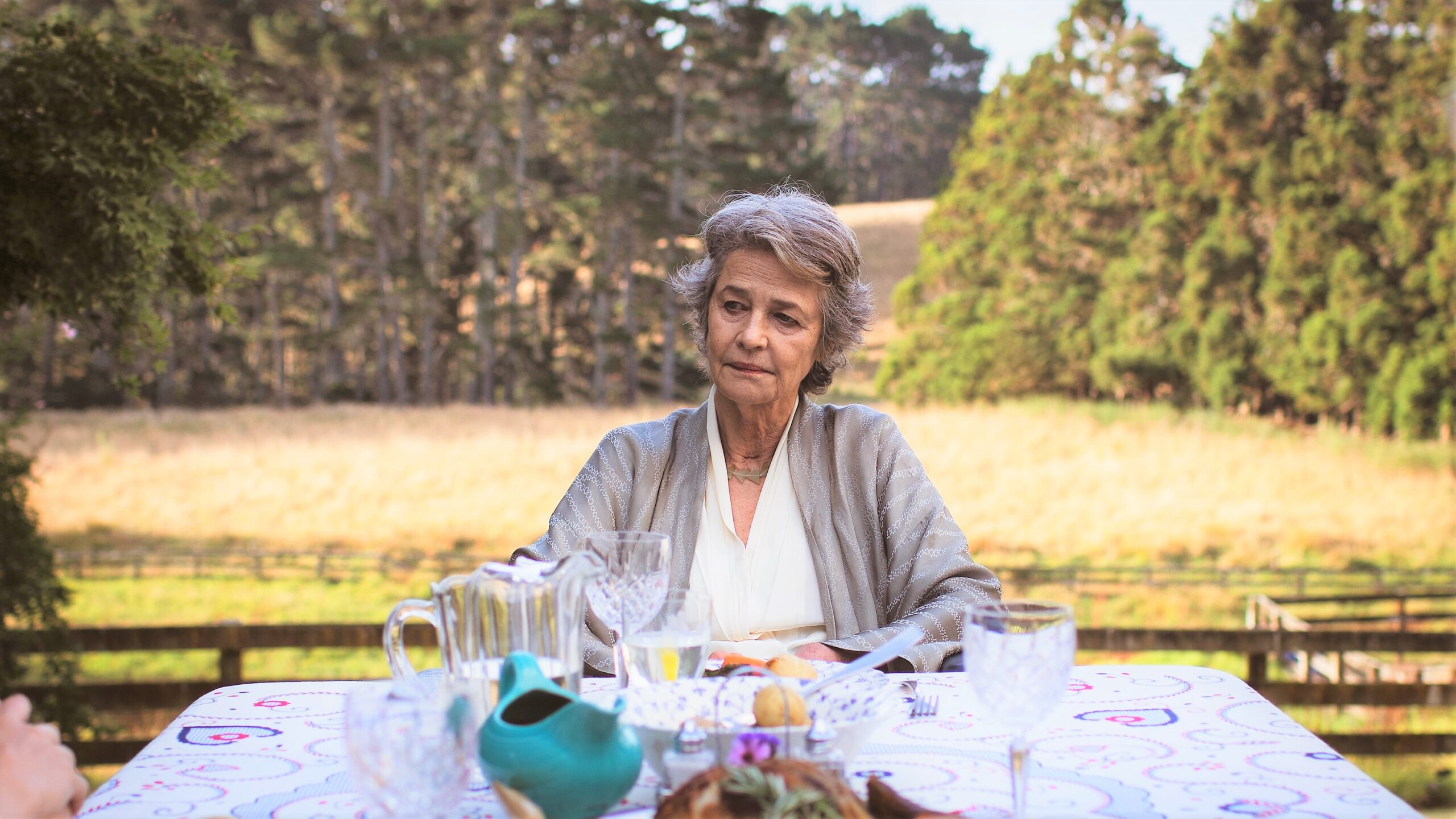
Its story of a curmudgeonly grandmother inviting herself to her estranged son’s home to recuperate while a broken leg heals is the sort of dramatic situation that anyone can see as possible. Throw in a rebellious grandson who also resents his grandmother’s invasion of his home and one has the perfect set-up for an entertaining family drama.
What follows is certainly diverting as the grandson, who ultimately is left to take part in the nursing responsibilities, first spars with his grandmother. She is non-conformist enough to be a massive consumer of alcohol, the occasional marijuana user, and with a decidedly non-traditional view of sex. Perhaps because of this, or perhaps one instinctively knows where this kind of drama is likely to go, one recognizes that somehow the unlikely pair will come to a mutual regard and all the familial tensions will end. It is predictable, entertaining, non-disturbing, and, above all, safe.
The plot, it is true, defies logic. Why would an estranged mother go all the way from England to New Zealand to impose herself on an estranged son when she can afford a full-time nurse? Why would a wildly rebellious grandson even begin to accept the responsibility of looking after a grandmother whom he has been raised to hate? These are the sorts of questions that one may consider, even when being diverted by what is happening on screen.
This is not to say that the film does not have considerable merit. Like so many of Rattigan’s works, for example The Browning Version and The Deep Blue Sea, designed to appeal to Aunt Edna, it is literate, well-constructed, and involves well-delineated and oddly likeable, generally believable characters. Writer-director Matthew J. Saville’s work is cinematically commendable. Above all, it has Charlotte Rampling at her most acidic and winning best in the role of the grandmother – a performance which ultimately makes Juniper a real pleasure to experience.
It is true that Juniper has a script replete with objectionable language, while its sexual content is even more objectionable to the Aunt Ednas and others of this world. However, that has sadly become a norm for most entertainment today. And since Juniper is available for buying or renting on a number of sites, it is easily accessible.
In other words, for all the Aunt Ednas out there it is the sort of film, despite its negatives, that will provide appealing, safe entertainment. And afterwards they can spend a pleasant time discussing what the enigmatic (and unexplained) title means. (Hint: juniper berries are used in the making of gin.)