
29th Sunday in Ordinary Time, Year C
First Reading: Ex 17:8-13
Second Reading: 2 Tim 3:14–4:2
Gospel Reading: Lk 18:1-8
“Be persistent,” Paul tells Timothy in this Sunday’s Second Reading: “convince, rebuke, and encourage, with the utmost patience in teaching.”
In fact, all this Sunday’s Readings enjoin persistence and patience, particularly in petitionary prayer. “Praying” includes praise, adoration, contrition, and thanksgiving, but it usually means asking.
Jesus told us to ask (“Give us this day our daily bread”). Of course, God knows what we need, but he waits for our request because our dignity as his children lies in our freedom, says the Catechism of the Catholic Church. In asking, we are not just being selfish, but recognizing and admitting our dependence on him.
We can petition God about every need: not only those that “influence the march of history,” as the Catechism says, but also our everyday wants. The rightness of prayer in the events of the moment is one of the “secrets of the Kingdom” that is revealed to little ones.
However, we should pray first for the coming of God’s reign (“Thy kingdom come”) and second for what we need in order to “co-operate with its coming” (“Give us this day our daily bread”).
“Do not worry about your livelihood: what you are to eat or drink or use for clothing,” Jesus said. “Your heavenly Father knows all that you need. Seek first his kingship over you, his way of holiness, and all these things will be given you besides.”
Jesus told us to ask for things in his name. To do this, we must have the “attitude” of Jesus, who “seeks only what pleases the Father” (“Thy will be done”).
If our will is perfectly united to his, we can pray with the boldness of a son requesting good things from a father who denies him nothing. Jesus described this kind of prayer when he said, “I assure you, if you had faith the size of a mustard seed, you would be able to say to this mountain, ‘Move from here to there,’ and it would move. Nothing would be impossible for you.”
We can hear Jesus’ “filial boldness” in his prayer before he raised Lazarus. “Father, I thank you for having heard me. I know that you always hear me, but I have said this for the sake of the crowd.”
“Before the gift is given,” Jesus “commits himself to the one who, in giving, gives himself,” says the Catechism: “the giver is more precious than the gift.”
If we consult only our own will, we will ask, through selfishness or ignorance, for things which are not good for us or for others. God cannot grant such requests, for he “desires our well-being, our life.”
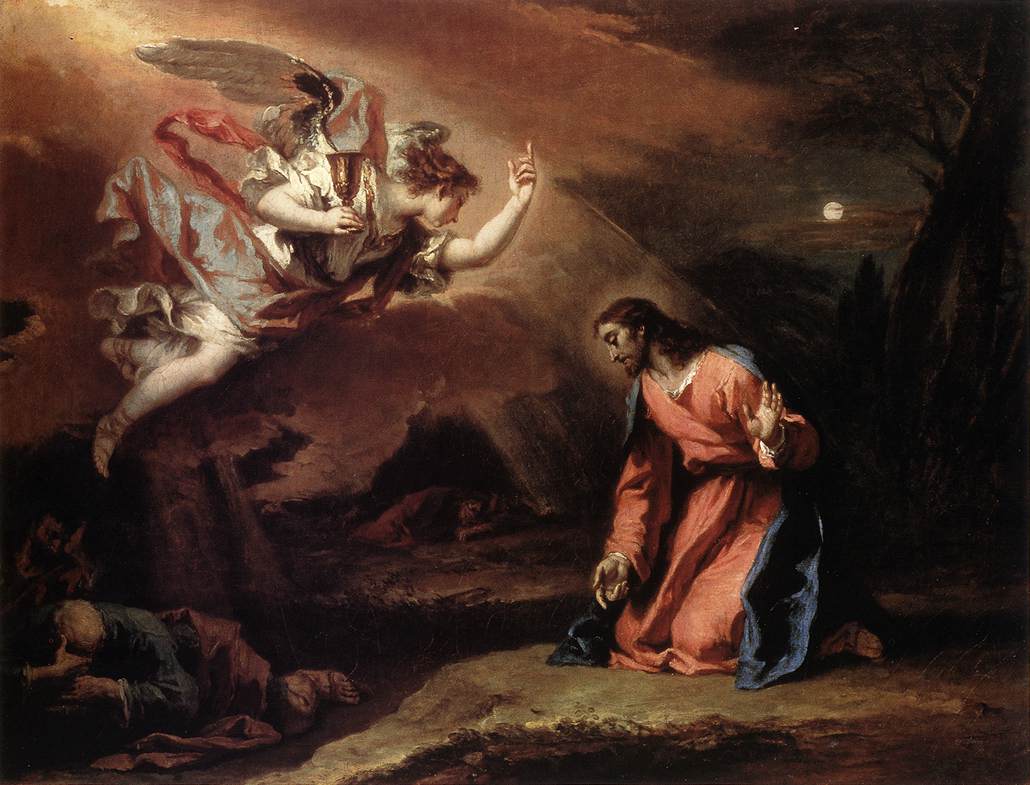
We should not stop asking, but we should add, “If it is your will.” This is how Jesus prayed the night before he died: “My Father, if it is possible, let this cup pass me by. Still, let it be as you would have it, not as I.”
Here there is no “filial boldness.” In “becoming sin,” Jesus has become separated from his Father. He seems no longer sure of God’s will: he says, “If it is possible.” He seems to be submitting to God’s will rather than actively doing it.
In his agony, Jesus prayed like this three times. In the Gospel Reading, he tells us to pray like this with urgency and patience, without losing heart.
It is more important to ask than to get what we ask for, the Catechism explains, for by asking “we express awareness of our relationship with God,” the giver, who, in giving, gives the far more precious gift of himself. God wants us to exercise our desire in prayer, so “that we may be able to receive what he is prepared to give.”
In fact, he wants to do “something even greater” than what we are asking for. To this end, while we “cling to him in prayer,” he transforms our “praying heart.”
Father Hawkswell teaches “The Catholic Faith in Plain English” free of charge every week: Sundays, 2–4 p.m. at the John Paul II Pastoral Centre (33rd and Willow, Vancouver); Mondays, 11 a.m.–1 p.m. at St. Anthony’s Parish (2347 Inglewood, West Vancouver) and 7–9 p.m. at the John Paul II Pastoral Centre; and Tuesdays, 7–9 p.m. in St. Clare’s Parish Hall (2888 Delahaye Drive, Coquitlam).