
Merry Christmas! As the Catholic season is still under way, I hope you’re not already sick and tired of everything red, green, holy, and festive. (It really is hard to keep the seasons straight when the pagan world has its tree up the first week of November and in the dump Dec. 26.)
A friend of mine posted that is was disappointing to go shopping and see nothing that celebrated the truth of Christmas – no nativities or religious cards. Someone responded that not everyone is Christian, so if you want religion, go to a Christian store, lay off, and let us celebrate Christmas without your interference. (That’s not a direct quote, but I think it captures the sentiment).
My friend sagely responded that, uhh, (the uhh is my addition) Christmas is religious. If she were to lay claim to Hanukkah while eating bacon and refusing Judaism and the menorah, people would think it a bit odd.
But I digress.
So, what’s a Catholic to do? How does a parent pass on a faith that is contradictory to almost everything thing that surrounds them? How do they not only “keep” Christ in Christmas, but keep him in every breath?
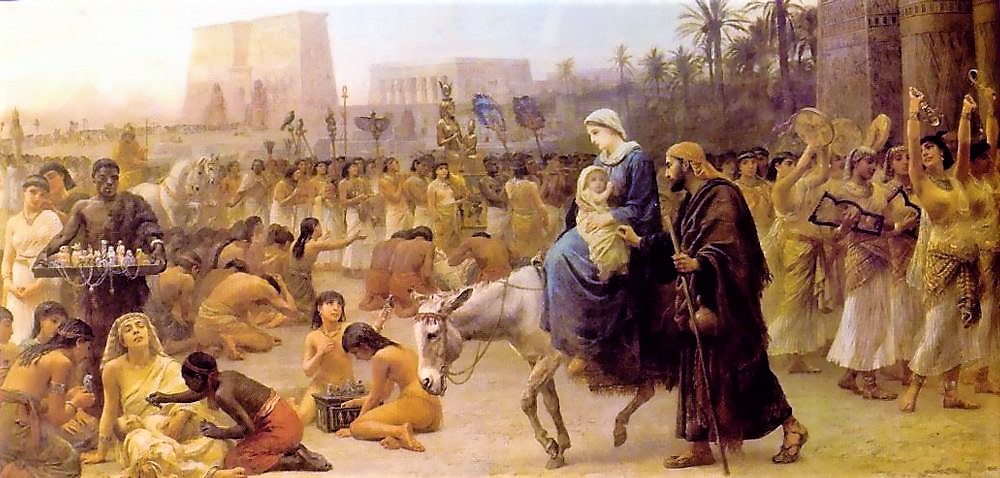
When Joseph was told in a dream to take his wife and new child out of Jerusalem, he was led into pagan Egypt. I cannot even begin to imagine what that all meant. For Jews, Egypt was the land of enslavement. It was a land of false gods, idolatry, and a whole lot of unclean.
Yet Joseph was taking the Immaculate Conception and the Son of God into its borders. There were no temples or Jewish priests. How did the Holy Family maintain the fullness of their faith in a world diametrically opposed to all that they believed?
How did Our Lord, as a child, learn the prayers of the temple, the stories of his people, and the obligations of the law?
I think the answer lies in what is called the domestic church. The document Lumen Gentium reminds families, “parents should, by their word and example, be the first preachers of the faith to their children; they should encourage them in the vocation which is proper to each of them, fostering with special care vocation to a sacred state.”
It was Mary and Joseph who made their home a sanctuary in the midst of a sinful world. It was they who told Our Lord the story of David and Goliath, Jacob and Isaac, and the flood.
They taught him the chants and prayers and celebrated the seasons of their faith.
The Catholic traditions we maintain within our homes are what lead our children toward sanctity and an appreciation of the Eucharist and blessings they receive at Mass. It is the prayers in the morning, and at their bedsides, the stories of Scripture and of the saints, meditations and chants, that will fill their little hearts and minds before the world has a chance to interfere.
The Holy Family spent only a short time, perhaps less than two years, in Egypt. We raise our children in a post-Christian world, and there isn’t much change in sight. But the church within our homes can be led and anointed by the Holy Spirit.
Each home will have its own traditions and devotions, but every domestic church must be centred around prayer and the virtues of faith, hope, and love.
It should be a home with a culture of celebration, tradition, sacraments, sacramentals, and devotion that sets it apart, like a shining candle in a dark night.
Joseph followed the promptings of the Holy Spirit and saved his family. If we follow that example, we might do the same.