

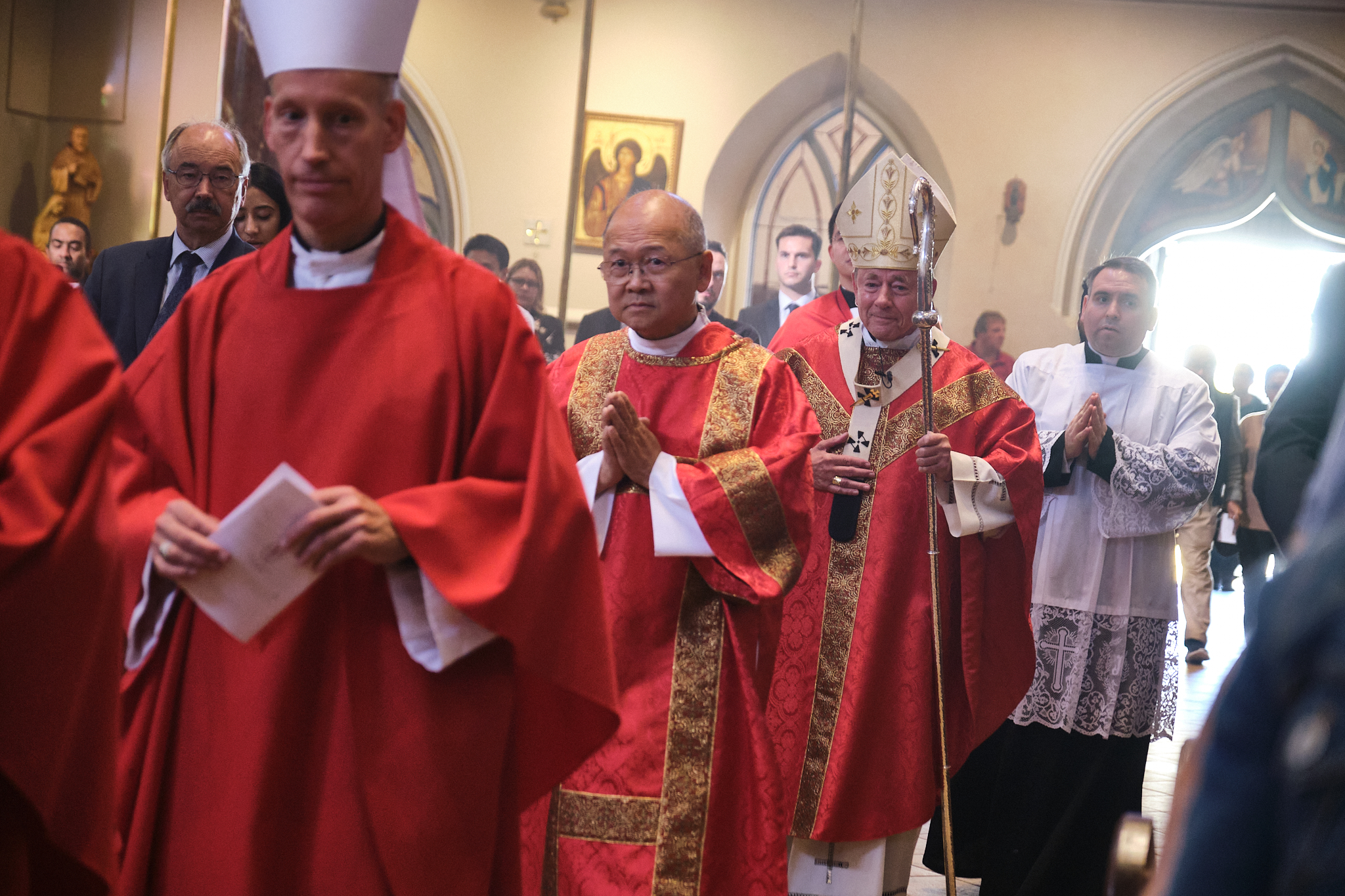

Second in a series of articles about the Holy Mass.
Holy Mass begins with the Introductory Rites. According to the General Instruction of the Roman Missal, “The rites that precede the Liturgy of the Word, namely, the Entrance, the Greeting, the Penitential Act, the Kyrie, the Gloria in excelsis (Glory to God in the highest), and Collect, have the character of a beginning, an introduction, and a preparation. Their purpose is to ensure that the faithful, who come together as one, establish communion and dispose themselves properly to listen to the Word of God and to celebrate the Eucharist worthily.”
During the entrance hymn or antiphon, the priest approaches the altar and venerates it. The altar is the figure of Christ, who, by commending himself to the Father for our salvation, “showed himself the Priest, the Altar, and the Lamb of sacrifice.” (Preface V of Easter) Pope Francis said, “The whole community [gathers] around the altar, which is Christ, not to look at each other but to look at Christ because Christ is at the centre of the community; he is not distant from it.”
The priest and the people make the Sign of the Cross. Pope Francis said that when we make the Sign of the Cross, we “affirm that the liturgical prayer is the encounter with God in Jesus Christ, who became flesh, died on the Cross, and rose in glory for us.”
The priest then greets the people with the expression: “The Lord be with you” or something similar. Theologian Edward Sri said, “Throughout salvation history, these sacred words – ‘the Lord is with you’ – are spoken when God calls people to difficult missions that stretch them well beyond their ‘comfort zones.’ They are pushed to the point that they can no longer rely on their talents, strengths, and abilities, and as a result, they begin to realize, at a more profound level, how much they really need God. It is then that the Lord says He will give them the one thing they will need the most: His presence with them through their many trials and sacrifices.”
In the Penitential Act, we acknowledge our own sinfulness by using the first-person singular accompanied by the gesture of striking our breast. After the Kyrie (Lord have mercy) comes the Gloria. According to the General Instruction of the Roman Missal, “The Gloria in excelsis (Glory to God in the highest) is a most ancient and venerable hymn by which the Church, gathered in the Holy Spirit, glorifies and entreats God the Father and the Lamb.” Pius Parsch, a liturgical theologian, wrote, “We come to Mass conscious of two things: that we stand greatly in need of redemption and that we have actually been saved. Let us put in the prayerful Kyrie our yearning for salvation. In the joyful Gloria, let us sing out confidently of our redemption, celebrating thus in every Mass both Advent and Christmas.”
Edward Sri called the Gloria a mosaic of biblical titles for God. In the first part of the Gloria, we address God the Father with the titles: “Heavenly King” and “Almighty Father.” The second part of the Gloria recalls the story of Jesus – the mysteries of the Incarnation (“Only Begotten Son,” “Son of the Father”), Redemption (“Lamb of God,” “you take away the sins of the world”), and Glorification (“you are seated at the right hand of the Father”). In the third part of the Gloria, we acknowledge the divinity of Jesus Christ by addressing him with three divine titles – “Holy One,” “Lord,” and “Most High.”
The Introductory Rites conclude with the Opening Prayer or “collect.” This prayer gathers together the intentions of the people participating in the Mass. There is a brief silence after the invitation: “Let us pray.” According to the General Instruction, “Sacred silence also, as part of the celebration, is to be observed at the designated times. Its nature, however, depends on the moment when it occurs in the different parts of the celebration. For in the Penitential Act and again after the invitation to pray, individuals recollect themselves, whereas after a reading or after the homily, all meditate briefly on what they have heard; then after Communion, they praise God in their hearts and pray to him.”
Share your thoughts and contribute to the ongoing conversation by sending us a Letter to the Editor.
「進堂禮」幫助我們準備「聖道禮儀」和「聖祭禮儀」
這是有關彌撒聖祭的一系列文章中的第二篇。
彌撒聖祭以「進堂禮」作開始。根據彌撒經書指示:「聖道禮儀前,我們有一系列的儀式,包括進堂禮、致候禮、悔罪禮、求主垂憐、光榮頌及集禱經。這些都是作開始、引領和準備,目的是讓聚在一起的信眾,能一心一德去交流,正確地自我棄絕來恭聽天主的聖言,堪當地領受聖體。」
詠唱或誦讀進堂時,主祭神父緩緩步入聖堂,向祭台致敬。祭台象徵基督,向聖父顯示祂對人類的救贖:「祂為拯救我們把自己奉獻給祢,亦同時充當了司祭、祭台和羔羊。(復活節頌謝詞五)」教宗方濟各說:「整個教會團體(集結)環繞在祭台,是為凝望基督,不是為其他,因為基督是團體的中心,祂並非遙遠之外。」
神父帶領信眾劃十字聖號。教宗方濟各解釋:「十字聖號確認我們的禮儀祈禱,是在主耶穌內與天主相遇;耶穌為了我們,成了血肉,死聖架上,在光榮中復活。」
神父向信眾致候:「願主與你們同在」或類似的方式。愛德華.斯里說:「整個救贖旅程,『願主與你們同在』這句神聖的祝願,令天主使那些在苦海使命中的人,伸延了他們的安慰。這些人在心力交粹之時,他們在心深處,明白真的需要天主。天主將要賞給他們最需要的:就是祂親臨他們的試煉及犧牲旅程中。」
「悔罪禮」是個人宣認己罪,以捶胸表達悲憤的悔意。隨著是向天主祈求憐憫的「求主垂憐經」。之後,我們誦唸或詠唱「光榮頌」。「光榮頌」一首極其古舊的敬禮聖詠:教會在聖神內向天主聖父及「羔羊」讚頌和祈求。一位禮儀神學家、庇約.帕曹寫道:「我們參與彌撒,要意識到兩點:我們極須要天主的救贖 ── 祂已救贖了。我們呼號天主的垂憐,以得救援。歡欣詠唱『光榮頌』,顯示確信已存在的救贖;因此在每台彌撒中都慶祝將臨和聖誕。」
庇約.帕曹形容「光榮頌」猶如彰顯天主的聖經鑲嵌畫。前部份尊稱天主為「天上的君王」及「全能的天主聖父」。第二部份提醒我們「道成肉身」的耶穌(「獨生子」、「聖父之子」),和祂的救贖(「天主的羔羊」、「除免世罪者」),與及祂的光榮(「坐在聖父之右者」)。第三部份是我們宣認耶穌的天主性,稱祂為「至聖的」、「主」和「至高無尚的」。
「進堂禮」以「開啟經」或「集禱經」結束。這經文是收集在場信眾的意願:神父首先邀請信眾說「請大家祈禱」,然後作短暫的靜默。短暫的靜默是包含在整個祭禮內。彌撒經書指出:「短暫的靜默,是神聖的,讓我們辨識祭禮時某種不同的時刻。譬如,『悔罪禮』後神父邀請信眾祈禱,那短暫的靜默,幫助我們收斂心神,進入另一祈禱意向;讀經或講道後的短暫靜默,讓我們簡速地默想我們聽到的聖言和教導。領聖體後,我們靜默下來,心中與耶穌交談、向天主祈求、表達讚頌之意。」
Share your thoughts and contribute to the ongoing conversation by sending us a Letter to the Editor.







