

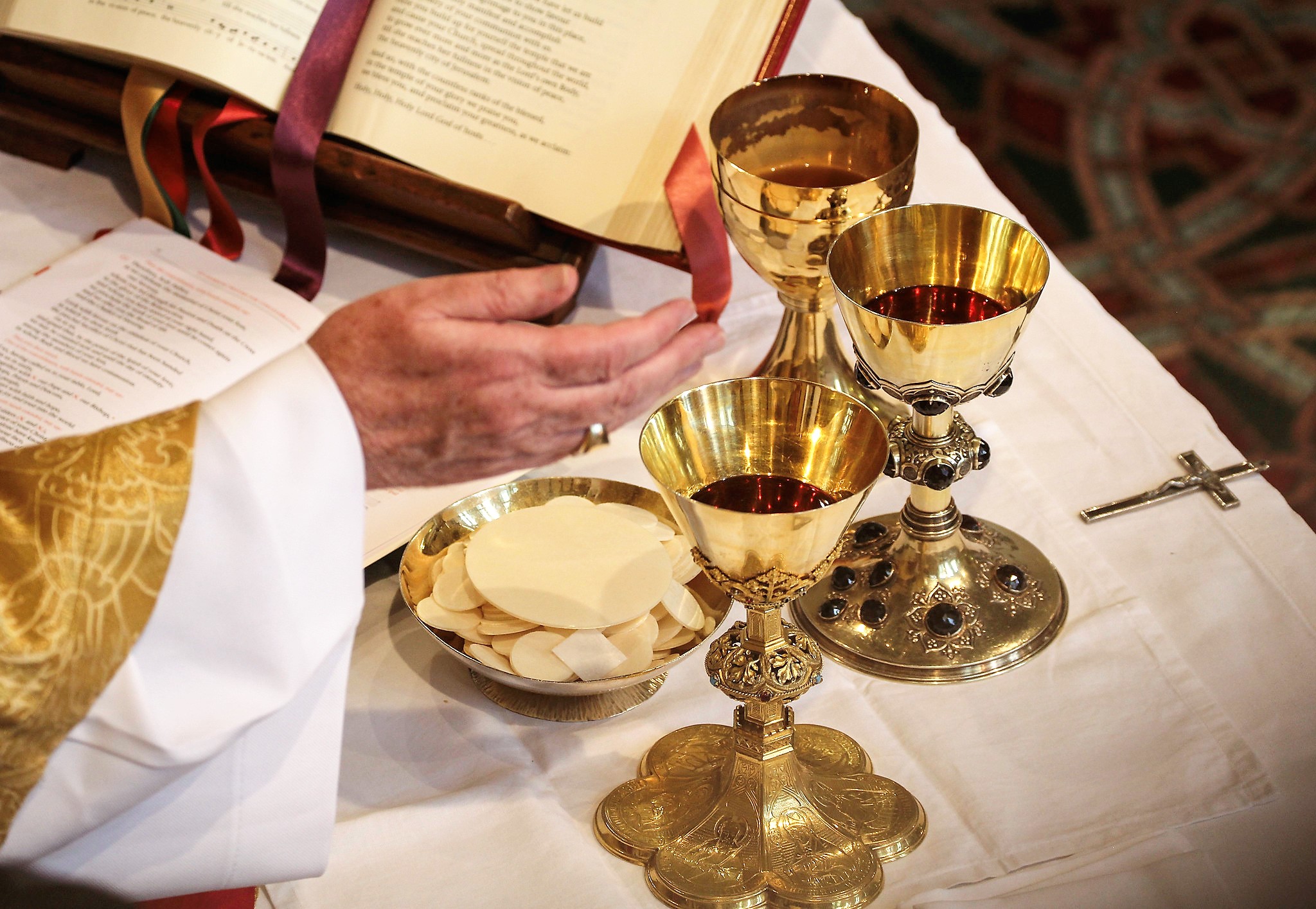

At the moment of consecration during the Eucharist, the bread and wine cease to exist. “If you do not believe this, you are a heretic,” a faithful and feisty priest once told me. “You have lost the faith, or you never had it to begin with.”
We do not eat bread, nor do we drink wine at Holy Communion. We are not in expectation of the coming of Christ; he has come, and we are, at that moment, in his presence, preparing to eat his body, his blood, his soul, and his divinity. This is one of the primary, fundamental teachings of our Church, and yet according to studies only a small minority believe it.
July is the month of the Precious Blood of Christ. “The Precious Blood exercises a constant warfare against evil and raises a mighty bulwark against the inroads of sin,” writes Father Max Walz, CPPS, in his book Glories of the Precious Blood. “It is to us a source of light and warmth and strength in our daily trials and combats. In death, when all lights go out, the Precious Blood offers the anxious soul its only light and hope and courage.”
Christ’s Precious Blood was shed for us in atonement, in that sacrificial event of Calvary. But the same blood is given to us each and every time we receive Holy Communion. That very same blood that poured down the cross is truly given to us, in reality, when we approach the altar rail. It is beyond words to describe the power of that reality.
And yet, so many of us are receiving it without concern or love. We are receiving it without belief. Imagine wearing a ring from your spouse that you assumed was glass and tin, even though he vowed to you it was diamonds and gold. It would mean that you doubted the words of your spouse, it would mean that you believed he lied, you did not trust him, but still, for some reason, wore it. It would be making a mockery of him, yourself, and the marriage to which you vowed yourself.
I suppose it is difficult to believe in the mysteries of our faith because we live in a time that believes in the transcendent knowledge of a god called science, instead of the inexplicable love of God whose work science can only begin to describe. The word “reality” is used when something can be seen and calculated. Faith in the Eucharist requires not seeing but still knowing there is no way to calculate its worth.
When Scott and I took the kids to France on pilgrimage to Lourdes, one of our favourite places was the Chartres Cathedral. I was blown away by the faith of the people who built it almost 800 years ago.
As I raised my eyes to the ceiling and discovered in every corner some work of stone carved to glorify God, I knew that I stood in a physical catechism. The statues, symbols, and pillars filled every wall and door. I remember standing outside and taking a final glance into a little corner, hidden behind some other monument, and finding by accident more carvings meant to glorify God. They were completely hidden unless you sought them out.
I remember thinking to myself that only a people fully alive in faith would spend the time, sweat, and gold to create tributes that were so hidden from view. They were truly worked for God’s glory, and not man’s acclamation. Whether or not I saw them, whether or not I could confirm that they were there in physical reality, with or without my knowledge, belief, or acknowledgement, they existed and gave praise to God. It was a faith-changing thought.
The idea that hidden things exist regardless of my approval gave me a lot to ponder. I am not in an existential bubble, where the only true things are those before me. God exists. Our Lord exists. He, in his glorified physical body, takes up physical space right now, with or without my faith.
The prayers of a priest during Mass are efficacious. They bring about God’s very living presence, whether or not I hear them, believe them, repeat them, or understand the language or meaning of the words used. There is no form of participation by me that is necessary that makes that truth more real.
I’ve read that the sacred body of our redeemer, covered with his Precious Blood, is a proof that God wishes not to condemn us but to save us for all eternity. Christ the Bridegroom holds out to us his beloved true gold and true gemstones.
The Blood of Christ is a sign of deep love. It is veiled, but it is true, and it is offered to each of us, if we have the humility to believe and seek out hidden things.
We welcome letters to the editor about articles in The B.C. Catholic.







