

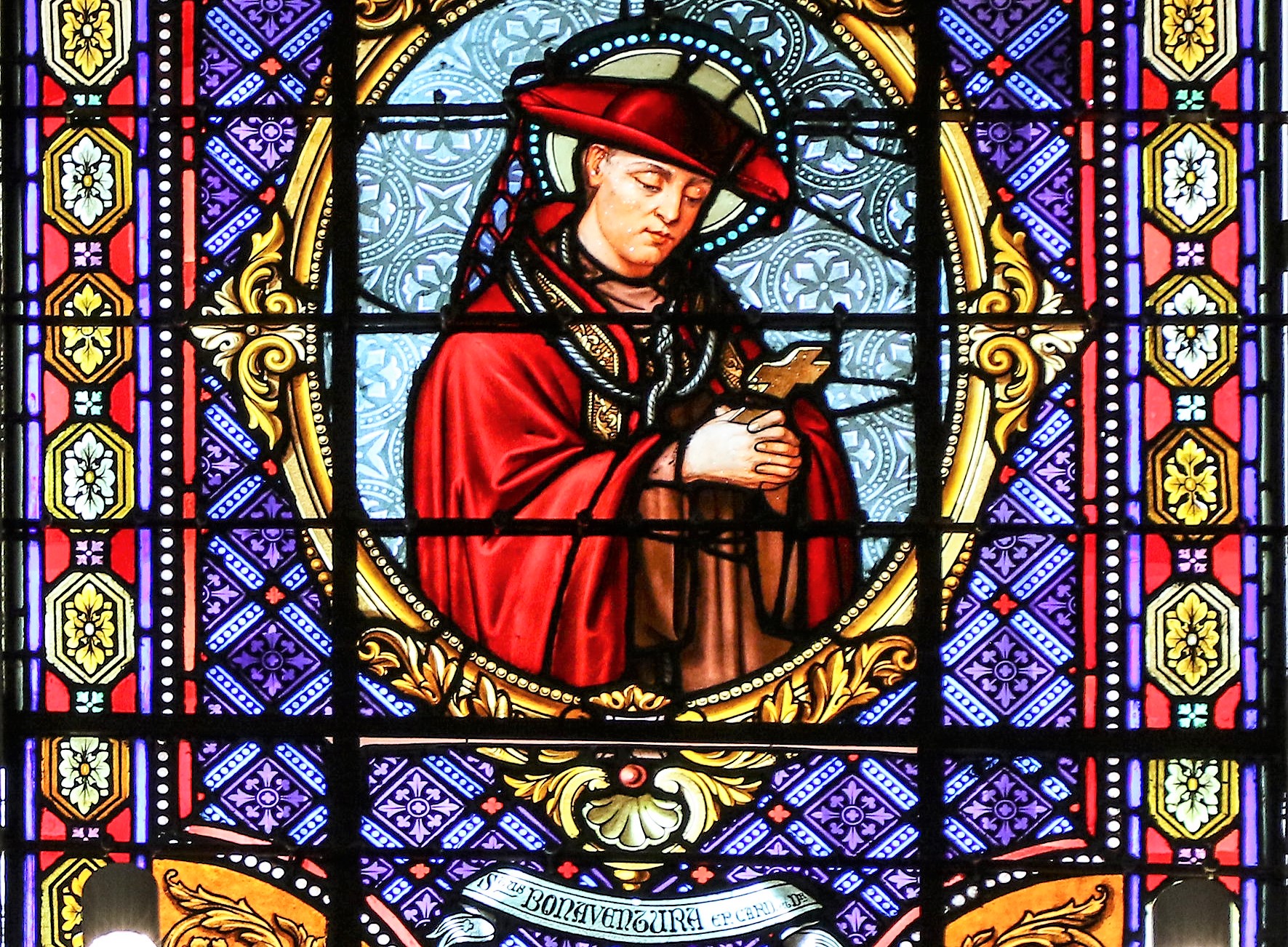

St. Bonaventure, whose original name was Giovanni di Fidanza, was born around 1217 and spent part of his childhood seriously ill. Through the prayers of his mother, who sought the intercession of St. Francis of Assisi, Giovanni recovered.
Giovanni went to Paris for studies and at the age of 25 joined the Franciscan community there. Many years later he wrote, “I confess before God that the reason which made me love the life of blessed Francis most is that it resembled the birth and early development of the Church. The Church began with simple fishermen, and was subsequently enriched by very distinguished and wise teachers; the religion of Blessed Francis was not established by the prudence of men but by Christ.”
About 1243, Giovanni received the Franciscan habit and took the name Bonaventure. He studied Sacred Scripture, the Sentences of Peter Lombard, and other important theological authors at the Faculty of Theology of the University of Paris. The title of Bonaventure’s dissertation was “Questions on the knowledge of Christ.” The thinking and theology of Bonaventure were very Christocentric.
In Paris there was strong opposition against the Mendicant Orders. The right of the friars to teach at the university was contested and some even questioned the authenticity of their consecrated life.
St. Bonaventure and his friend, St. Thomas Aquinas, defended the Mendicant Orders, and Bonaventure wrote the book Evangelical Perfection. Pope Benedict XVI commented: “In this work he shows how the Mendicant Orders, especially the Friars Minor, in practising the vows of poverty, chastity and obedience, were following the recommendations of the Gospel itself. Over and above these historical circumstances the teaching that Bonaventure provides in this work of his and in his life remains every timely: the Church is made more luminous and beautiful by the fidelity to their vocation of those sons and daughters of hers who not only put the evangelical precepts into practice but, by the grace of God, are called to observe their counsels and thereby, with their poor, chaste and obedient way of life, to witness to the Gospel as a source of joy and perfection.”
In 1257, Bonaventure was elected Minister General of the Franciscans. Benedict XVI said, “He fulfilled this office for 17 years with wisdom and dedication, visiting the provinces, writing to his brethren, and at times intervening with some severity to eliminate abuses. When Bonaventure began this service, the Order of Friars Minor had experienced an extraordinary expansion: there were more than 30,000 Friars scattered throughout the West with missionaries in North Africa, the Middle East, and even in Peking. It was necessary to consolidate this expansion and especially, to give it unity of action and of spirit in full fidelity to Francis’ charism.”
Hence, Bonaventure wrote The Life of St. Francis, a biography that presented the authentic charism of Francis, his life, and his teaching.
In May 1273, Pope Gregory X named Bonaventure Cardinal Bishop of Albano. The Pope also asked him to prepare the Second Council of Lyon (May 7–July 17, 1274).
Bonaventure died on July 15, 1274, two days before the council ended. Pope Gregory X administrated the sacrament of the anointing of the sick to Bonaventure before death and the council as a body attended his funeral. A papal notary composed a eulogy which stated: “A good, affable, devout and compassionate man, full of virtue, beloved of God and human beings alike … God in fact had bestowed upon him such grace that all who saw him were pervaded by a love that their hearts could not conceal.”
St. Bonaventure was declared a doctor of the Church in 1588 and is called the “Seraphic Doctor” for his zealous theology.
Father Augustine Kalberer, the Westminster Abbey author of Lives of the Saints, wrote, “Love of God, prayer, and contemplation were his great preoccupations. ‘Prayer,’ he wrote, ‘is the source and origin of every upward progress that has God for goal.’ And again, ‘Contemplation demands the greatest simplicity, and the greatest simplicity demands the greatest poverty.’”
The saint once said, “The fear of God forbids a man to give his heart to transitory things, which are the true seeds of sin.”
Share your thoughts by sending us a letter to the editor.
『熾熱天使聖師』為修會辯護
聖文德出生於1217年左右。他原名為喬瓦尼·菲丹澤。喬瓦尼為年輕的孩子時,曾罹重病,他的母親請亞西西的方濟各代禱。藉著這禱告喬瓦尼痊癒了。
喬瓦尼前往巴黎學習,並在25歲時加入了那裡的方濟各修院。多年後,他寫道:『我在天主面前承認,使我最愛方濟各生活的原因是,它類似於教會的誕生和早期發展。教會從簡單的漁夫開始,後來由非常傑出和明智的老師使她豐盛;聖方濟各的宗教不是由人的謹慎建立的,而是由基督建立的。』
大約在1243年,喬瓦尼接受了方濟各會的會衣,並取名為『文德』。他在巴黎大學神學院學習聖經、伯鐸隆巴德的著作和其他重要的神學作者。文德論文的題目是『關於基督知識的問題。』文德的思想和神學非常以基督為中心。
在巴黎,有人強烈反對托鉢修會。會士在大學任教的權柄受到質疑,有些人甚至質疑他們獻身生活的真實性。聖文德和他的朋友聖多馬斯·阿奎那為托鉢修會辯護。文德寫了一書『福音的完美。』教宗本篤十六世評論說:『在這部作品中,他展示了托鉢修會,特別是方濟各會,在實踐貧窮、貞潔和服從的聖愿時,如何遵循福音本身的規勸。除了這些歷史環境之外,文德在他和他一生的這項工作中提供的教導仍然很及時:教會因忠於她的兒女的聖召而變得更加光明和美麗,他們不僅將福音的戒律付諸實踐,而且因著天主的恩典,被呼召遵守福音的規勸,從而以他們貧窮、貞潔和順服的生活方式,見證福音作為喜樂和完美的源泉。』
1257年,文德當選為方濟各會會長。本篤十六世說:『他以智慧和奉獻精神履行了17年的這一職責,訪問各省,寫信給他的弟兄們,有時以某種嚴厲的方式進行干預以消除濫權行為。當文德開始這項服務時,方濟各會經歷了一次非凡的擴張:有三萬多名修士分散在西方各地,傳教士分佈在北非、中東,甚至北京。有必要鞏固這種擴張,特別是要使其行動和精神的統一,完全忠於『方濟各的神恩』。因此,文德寫了『聖方濟各的傳記』,展示了方濟各的真實神恩、他的生活和他的教導。
1273年5月,教宗額我略十世任命文德為阿爾巴諾的樞機主教。教宗還要求他準備第二次里昂大公會議(1274年5月7日至7月17日)。文德於 1274 年 7 月 15 日去世,即會議結束前兩天。教宗額我略十世為文德主持傅油聖事,大公會議的與會者參加了他的葬禮。一位教宗公證人撰寫了悼詞,其中寫道:『一個善良、和藹可親、虔誠和富有同情心的人,充滿美德,深受天主和人類的愛戴……事實上,天主賜予他如此恩典,以至於所有看到他的人都充滿了他們內心無法掩飾的愛』。
聖文德於1588年被宣佈為聖師。他被稱為『熾熱天使聖師』。奧斯定·卡爾貝勒神父寫道:『對天主的愛、祈禱和默觀是他最關心的問題。他寫道:「祈禱是每一個以天主為目標的向上前進的源泉和起源。他又寫道:「默觀需要最大的簡撲,而最大的簡撲需要最大的神貧。」』聖人曾經說過:『敬畏天主禁止一個人將他的心獻給短暫的事情,這些是罪惡的真正種子。』







