

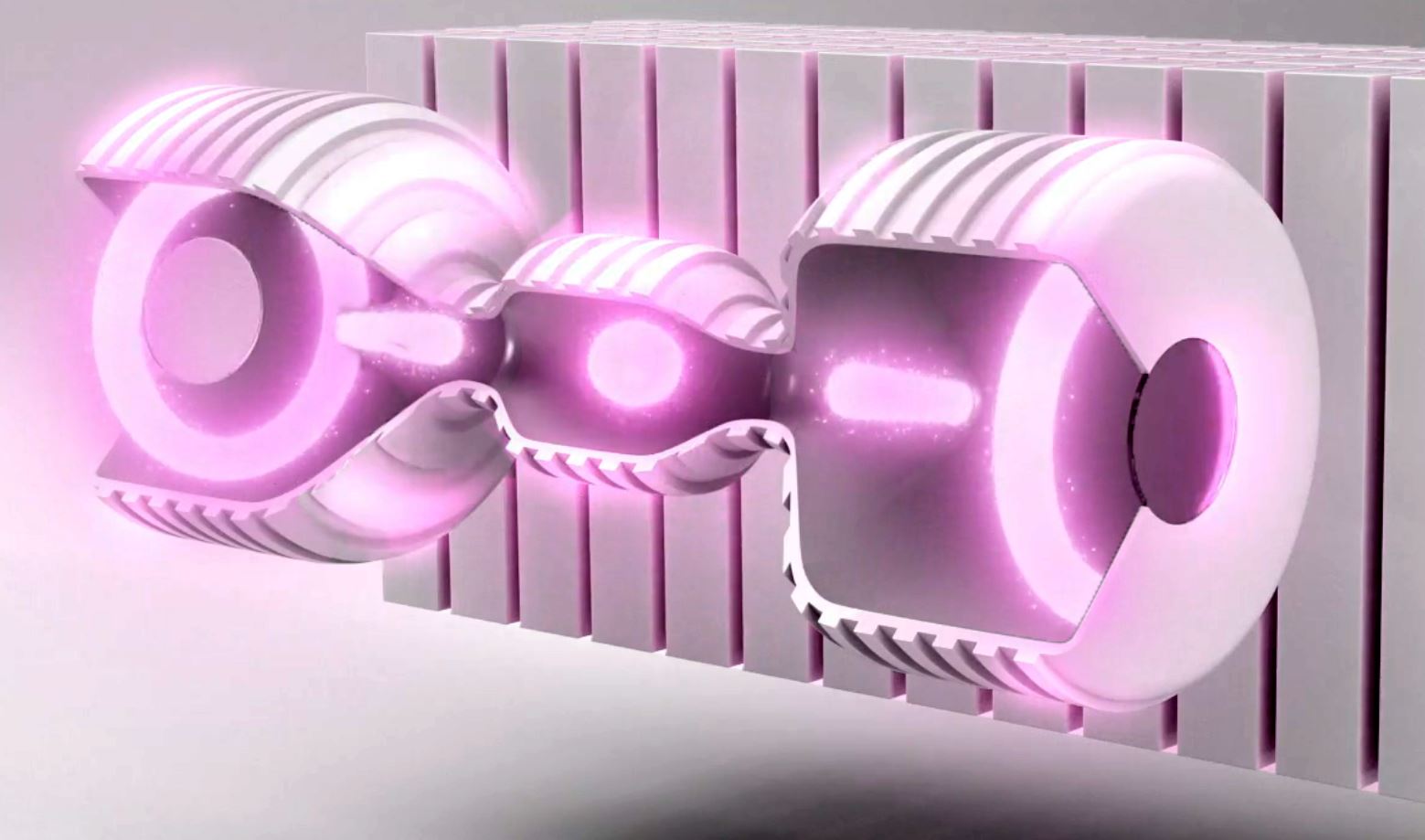

Limitless energy.
Limitless clean energy.
A game-changing development.
There was no shortage of hyperbole when it came to processing the news last year that, supposedly, physicists had run a fusion experiment that resulted in more energy being released than – again, supposedly – had been supplied on the input side.
Sadly, critical analysis of the Lawrence Livermore Labs event was in short supply and the hyperbole won the day.
To be sure, the press release emphasized that the total amount of energy released was only enough to boil a few kettles of water, but it really was lacking in a dose of good old-fashioned skepticism.
Fusion energy, released when atomic nuclei fuse, or combine, is important to man’s long-term presence on this planet. However, viable fusion energy in a practical sense appears to be only marginally closer to reality than it was a year or two ago. In fact, we could argue that it is no closer, as the method used for this announcement – inertial confinement – seems to me to be a dead-end off-ramp on the several freeways leading to possible real-world fusion energy plants.
Confining a frozen pellet of deuterium-tritium the size of a pencil eraser with 192 lasers and then imploding it to fusion ignition is not going to lead to a fusion energy plant. The pellets would have to be reloaded in minutes if not seconds. The high-energy neutron flux would also need to be managed, and the energy released would need to be harnessed.
This experiment was not fusion in the form that happens in the sun. Solar fusion depends on hydrogen nuclei, protons if you will, fusing to eventually produce helium nuclei. The Livermore Labs experiment involved the fusion of deuterium, which is widely available, and tritium, which is a much more rare isotopic form of hydrogen.
We simply don’t have the means to efficiently fuse hydrogen nuclei. The energies required are many times bigger than what we can produce today. So, this “limitless energy” announcement really needs to be parsed critically.
That said, there is no shortage of interest from billionaires and others in a variety of approaches to tackling the fusion viability question. Here in Metro Vancouver we have General Fusion, backed in part by Amazon founder Jeff Bezos. General Fusion has changed trajectories several times over the years it has worked in this space. Most recently it has announced it will pause a proposed test facility near Oxford in the UK and focus on a unit at its Richmond campus to demonstrate its magnetized target fusion energy technology.
General Fusion has been working toward a viable fusion energy system for more than two decades. Its Burnaby plant was recently relocated to Vancouver International Airport property on Sea Island, where it has some 200 employees.
Biggest of all, and with a budget that really seems to have no upper limit, is ITER, the International Thermonuclear Experimental Reactor in southern France. Backed by a multinational, primarily European, consortium of nations including Russia, ITER is one of the world’s largest-ever engineering undertakings. The reactor is being constructed on a 42-hectare platform, itself part of a 136-hectare site. Canada was part of the early planning for ITER, dropped out in 2003, but more recently signed on to supply tritium for the project.
There are however serious questions about whether ITER will ever produce a single joule of energy let alone become a functioning fusion energy generating facility. Fusion production through magnetically confined plasma in a toroid or tokamak design – basically a large hollow doughnut-shaped container – is very difficult. In November 2022, it was discovered that there were engineering defects in two key ITER components, the vacuum vessel sectors comprising the tokamak, and the thermal shields. Costs to repair these are as yet unquantified.
Not that the potential failure of ITER is necessarily a bad thing. Progress in science and engineering, particularly what might be termed a quantum leap in progress should a working fusion-generating facility eventually emerge, nearly always comes from knowledge learned through failure. ITER may prove to be a financial boondoggle, and some say it already is, but it has already produced major advances in engineering that will surely find uses elsewhere.
Recently another player has emerged. This one is a bit of a mystery in that it first made a splash as a virtual unknown when it signed a contract with Microsoft. Helion Energy, based in Everett, Wash., and backed by none other than OpenAI/ChatGPT head Sam Altman announced in May that it would deliver fusion-generated electricity to Microsoft by 2028.
Should Helion be able to deliver on its Microsoft contract in just five years it would be at complete odds with a general consensus that fusion energy, at least commercially viable fusion energy, is still decades away. The contract between the two companies states that Helion will produce a 50-megawatt electricity supply for Microsoft. (By way of comparison B.C.’s Site C dam and powerhouse on the Peace River will operate at about 1,100 megawatts when it starts in 2026). Helion itself says its goal is to produce a gigawatt supply, or one billion watts.
Coming as we have recently through the hottest July on record, new ways of generating electricity that don’t contribute to climate change can’t come fast enough. We already are seeing renewed interest in carbon-neutral nuclear fission. Electricity from nuclear fusion will be similarly carbon-neutral, with the added benefit of not having to manage highly radioactive spent fuel rods.
Might this be the decade when we see commercial quantities of electricity generated from a nuclear fusion plant? As a planet, we’ve made major strides in renewables such as wind and photovoltaics (solar). Smaller-scale fission plants appear poised for a comeback. That leaves energy from fusion waiting for its moment.
Follow me on Facebook (facebook.com/PeterVogelCA), or on Twitter (@PeterVogel)
We welcome letters to the editor about articles in The B.C. Catholic.







