

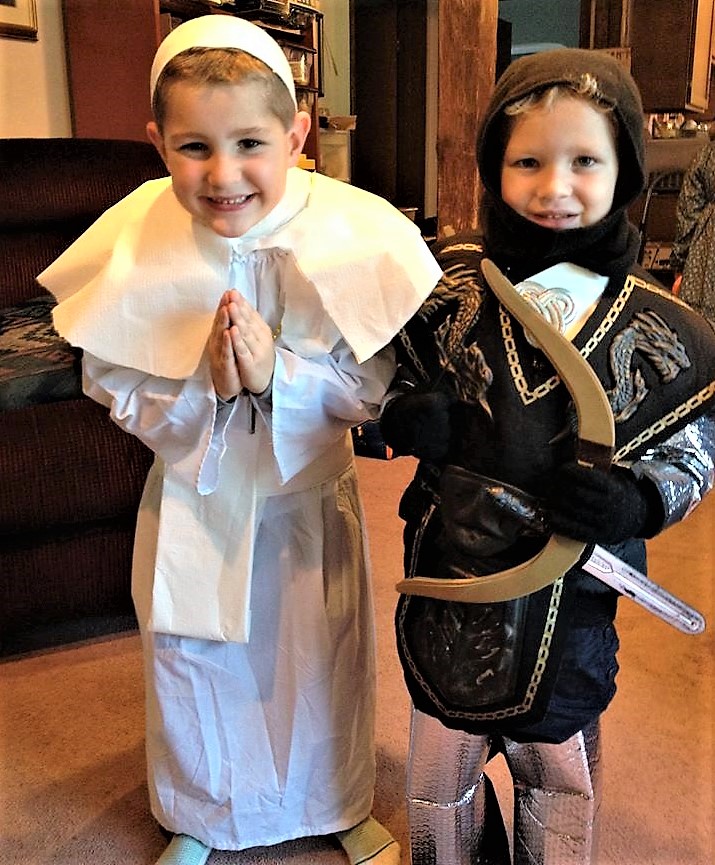

One of my favourite Halloween costumes was a few years ago when my son, Tom, who was seven at the time, dressed as Saint John Paul II. I think the best part about it was that it was his idea (JPII wasn’t even Pope in his lifetime).
When we knocked on the door at one house, a man answered and said, “Oh, your holiness! Can I get a blessing?” Without missing a beat, Tom extended his hand over the man and solemnly made the sign of the cross over him. At the time, I remember wondering if that scene was bordering on sacrilegious, but I think it actually might have been the opposite – an act of evangelization.
We’ve taken a few saints trick-or-treating over the years. St. Juan Diego raised confusion at some doors. When my son, Joe, would tell people who he was, they would say, “Who?” and he would point to his sombrero and explain about the young Mexican man who was privileged to witness and spread the news of the apparition of Our Lady of Guadalupe. Again, a little evangelization on a chilly fall night never hurt anyone.
My husband and I don’t tell our children they have to dress up as saints for Halloween. But we do tell them what they can’t dress up as – no devils, zombies, vampires, bloody/violent characters, etc. In recent years, our youngest sons have gone as historical figures (George Washington was a big conversation starter in the neighbourhood).
The bottom line is our kids have learned over the years all about the Catholic roots of this popular holiday. And, after many years participating in All Saints’ parties (in addition to Halloween), where whole families dressed up as saints or biblical characters, our kids have gotten the gist that Halloween is actually Catholic-centred.
I know there are some Catholics who do not participate in Halloween because they think it is associated with evil and darkness. Unfortunately, there are people out there who do choose to turn Halloween into a dark, macabre day. But, really, Halloween, originally known as All Hallows’ Eve, is simply the eve of a Catholic holy day – All Saints’ Day – on Nov. 1. Once a holy day of obligation, meaning all Catholics were expected to attend Mass, All Saints’ Day celebrates all the holy souls of the Church, who are rejoicing in heaven. This important day also reminds us of our own call to holiness and our ultimate heavenly destination.
All Saints’ Day is, of course, immediately followed by All Souls’ Day, on Nov. 2. This day is devoted to prayer for the dead, particularly the holy souls in purgatory, who rely on our intercession to shorten the distance between them and their heavenly home.
The Gospel reading for the liturgy for All Saints’ is St. Matthew’s version of the beatitudes. The Church teaches that the beatitudes are actually the Christian’s recipe for how to become a saint. Jesus tells us what we need to do to be “blessed” or, some versions say, “happy.” In his homily from the All Saints’ Mass in 2000, Pope John Paul said one could also replace “blessed” with “canonized” or “saintly.”
The Pontiff said, “The saints took these words of Jesus seriously. They believed that they would find ‘happiness’ by putting them into practice in their lives. And they realized their truth in everyday experience: despite their trials, moments of darkness and failures, they already tasted here below the deep joy of communion with Christ. In him they discovered the initial seed, already present in time, of the future glory of God’s kingdom.”
Participating in Halloween can be part of our faith journey as Catholics. We are all striving to be something – saints. No one can be a full-blown perfect saint on earth, but we can do saintly things and try to live saintly lives. Better than putting on a costume for just one night, we can imitate, by the way we live, the saints the Church gives us in the liturgical calendar almost every day, until we actually become saints in heaven.
And, just like we should do in everyday life, we can use Halloween as a time to evangelize. You could suggest a saint costume to your child, or you could carve a holy image in your jack-o’-lantern (search saint-o-lanterns on Catholiccuisine.blogspot.com for ideas). You might even choose to pass out holy cards with the candy.
Halloween can also remind us that our earthly journey is finite. As Christians we have to think about death. To avoid death is to avoid Christ. Our earthly journey is our All Hallows’ Eve, pointing towards the tomorrow of our eternal All Saints’ Day. Halloween, and subsequently All Saints’ and All Souls’ Days, can be perfect teaching moments for parents to explain the importance of death in the Christian journey, not as something to fear but as the gateway to eternal life.
So, this year, don’t forget that beyond the bags of treats, costumes, parties, and commercialization of Halloween, there is a deeper, Catholic meaning. Let’s not let the opportunity slide by to show the holy side of Halloween to our kids, and the world.
Lazzuri writes from her home in Nova Scotia, where she lives with her husband, six children, and her mom. She can be reached at clarelazzuri@gmail.com







