

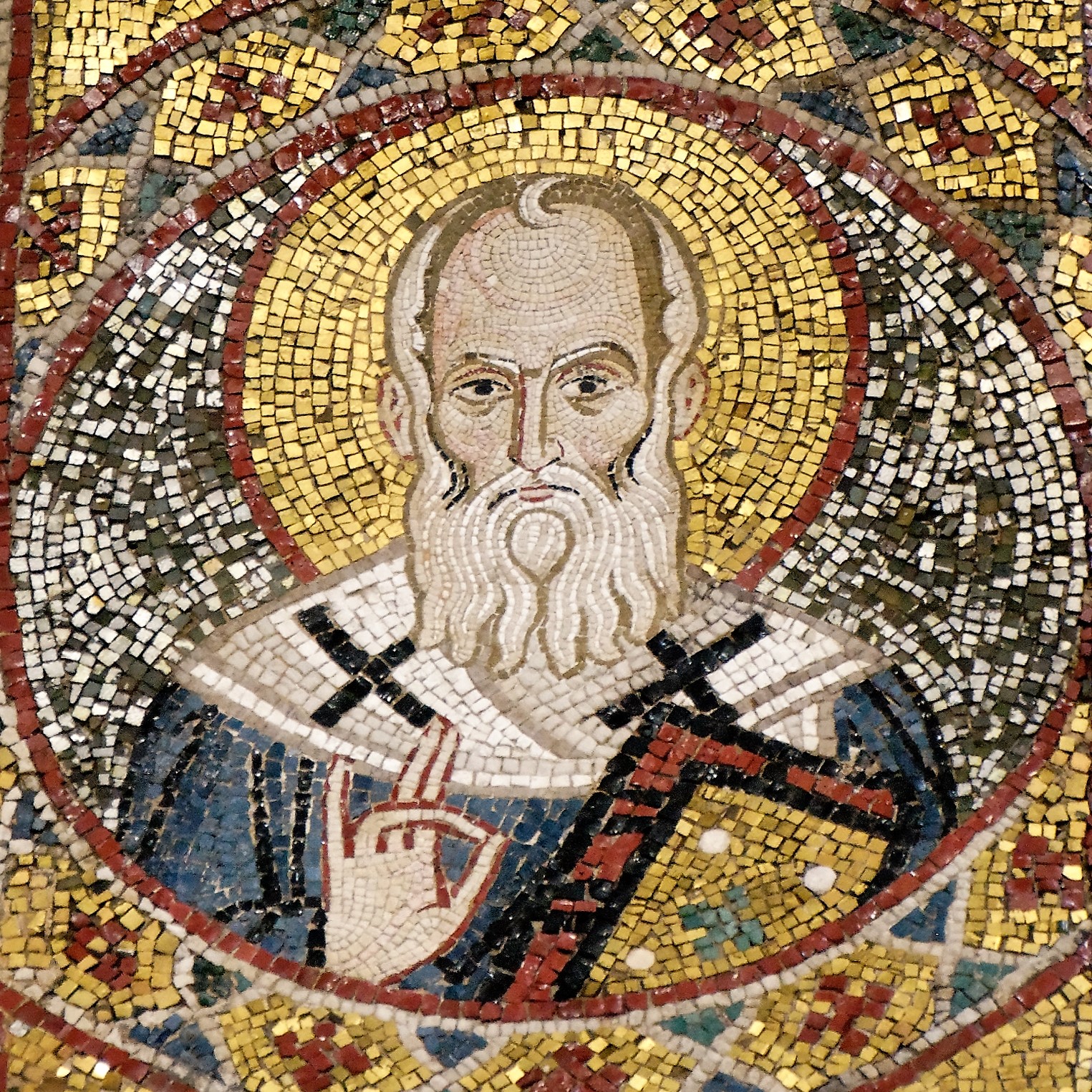

St. Gregory of Nazianzus (329-389) was a close friend of St. Basil the Great and was a contemplative forced into action.
Gregory wrote about his friendship with Basil: “Not only did I feel full of veneration for my great Basil because of the seriousness of his morals and the maturity and wisdom of his speeches, but he induced others who did not yet know him to be like him … The same eagerness for knowledge motivated us … This was our competition: not who was first but who allowed the other to be first. It seemed as if we had one soul in two bodies.”
Gregory wrote about his inclination for contemplative life: “Nothing seems to me greater than this: to silence one’s senses, to emerge from the flesh of the world, to withdraw into oneself, no longer to be concerned with human things other than what is strictly necessary; to converse with oneself and with God, to lead a life that transcends the visible; to bear in one’s soul divine images, ever pure, not mingled with earthly or erroneous forms; truly to be a perfect mirror of God and of divine things, and to become so more and more, taking light from light … to enjoy, in the present hope, the future good, and to converse with angels; to have already left the earth even while continuing to dwell on it, borne aloft by the spirit.”
Despite his preference for a quiet life, Gregory was ordained a priest by his own father, St. Gregory Nazianzen the Elder. Pope Benedict XVI pointed out that Gregory “received priestly ordination with a certain reluctance, for he knew that he would later have to be a bishop, to look after others and their affairs, hence, could no longer be absorbed in pure meditation.”
Gregory was consecrated bishop by St. Basil in 372. After the death of the Arian emperor Valens, Gregory was transferred to Constantinople, where Arians had dominated for over 30 years. In Constantinople, Gregory opened a small chapel in the house of a friend. He comforted himself by reflecting that if his adversaries were the stronger party, he had the better cause. Though they had the churches and the people, he had God and the angels on his side. It was at the small chapel that Gregory delivered the famous sermons on the Trinity to his little flock.
Pope Benedict XVI described the ministry of Gregory in Constantinople: “In about 379, Gregory was called to Constantinople, the capital, to head the small Catholic community faithful to the Council of Nicaea and to belief in the Trinity. The majority adhered instead to Arianism, which was ‘politically correct’ and viewed by emperors as politically useful. Thus, he found himself in a condition of minority, surrounded by hostility. He delivered five Theological Orations in the little Church of the Anastasis precisely in order to defend the Trinitarian faith and to make it intelligible.”
Gregory is especially remembered for his clear and explicit teaching about the Trinity. His Theological Orations won him the title of “theologian” which he shared with St. John the Apostle.
Gregory was a lover of peace. When the legitimacy of his transfer to Constantinople was contested, he resigned to avoid disturbance and bloodshed. Gregory then led a life of retirement, enjoyed his garden, and wrote religious poems.
Pope Benedict XVI said, “Gregory gave great prominence to Christ’s full humanity: to redeem man in the totality of his body, soul and spirit, Christ assumed all the elements of human nature, otherwise man would not have been saved.”
國瑞宣講天主聖三
聖國瑞.納祥(公元329-389年)是聖大西略的好友,是一個被迫要活躍行動的黙觀者。
提到與大西略的友誼,國瑞寫道:「我十分敬重偉大的西略,不止是他嚴謹的道德,和他那滿有成熟與智慧的演說,而是他促使那些不認識他的人來相似他 …。我們有相同求知的動機 …。我們根本就是在競賽 ── 並非互相比拼優劣,而是讓誰優勝。我們似乎是同一個靈魂,居住在兩個不同的身體。」
有關醉心於沉默的生活,國瑞解釋說:「對我來說,沒有什麼可比擬你靜下感官,出離肉身的世界,退避到自己內;除非必要,便不問世事。與自己和與天主對話,渡超越可見的生活;在自己的靈魂上帶著純潔而不與塵俗或錯誤形式混和的神聖肖像;真正成為天主和聖善事物的一面完美鏡子,不斷進展,從光中得到光明…;在現今的希望中享受將來的美善,並與天使交談;雖寓於人世,卻被精神高舉,猶如已有離開世界。」
儘管嚮往寧靜的生活,國瑞還是從自己的父親、聖長國瑞手中領受鐸品。教宗本篤十六世指出:「國瑞不大情願領受鐸品,因為他明白他將會繼而成為主教,需要看顧其他人,和處理他們的事務,不能專注於純默觀。」
公元372年,聖大西略親手把國瑞晉升為主教。在信奉亞略主義的瓦倫斯王逝世後,國瑞被調到早被亞略主義橫行了三十年的君士坦丁堡。在君士坦丁堡的一個朋友家中,國瑞開設了一個小聖堂,並安慰他的自己想:雖然敵人們是更強大,但自己的使命是更好的;縱然敵人們有教堂和人羣,但有天主和天神們站在他那邊。就是在那小聖堂裡,國瑞向他小小的羊群,作出了有關「天主三位一體」箸名的講道。
2007年8月8日的公開接見時,教宗本篤十六世敘述國瑞在君士坦丁堡的使命:「約在公元379年,國瑞被召叫到首都君士坦丁堡,帶領著忠於尼西亞大公會議和對『天主聖三』的信仰的小小天主教團體。君士坦丁堡大部份卻投向亞略主義,當時是「政治正確」,亦為被君主視為有用的政治工具。因此,國瑞的只屬極小數,被敵對重重包圍。就在亞納史蒂斯的小堂裡,發表了五篇神學講辭,為保家衛對『天主聖三』的信仰,並使這信仰受到理解。」
國瑞為人樂道的,是他清晰的「聖三」道理。他的神學演辭,使他與聖若望宗徒共享「神學家」尊銜。
國瑞喜愛和平。他在君士坦丁堡的任命受到質疑時,為避免紛亂和流血衝突,他辭去牧職,渡退隱生活,享受整理花園之樂,寫宗教詩篇。
教宗本篤十六世說:「國瑞顯出基督完全人性的重要: 為救贖整個人—–肉身、靈魂和心神,基督取了人性的所有元素,否則人不能被救贖。」







