
I have a few prints of Vincent van Gogh paintings in my house. I won’t say that he’s my favourite artist. I’ll even admit that, while I often find it lovely to look at, I have issues with Impressionism (I think he’s technically post-impressionism, but whatever). But, maybe because of his sad life and sadder death, I have a sense of relief when I see his beautiful pieces. They assure me that, even in his struggles, he was capable of recognizing something beautiful. So, I have a few on my wall.
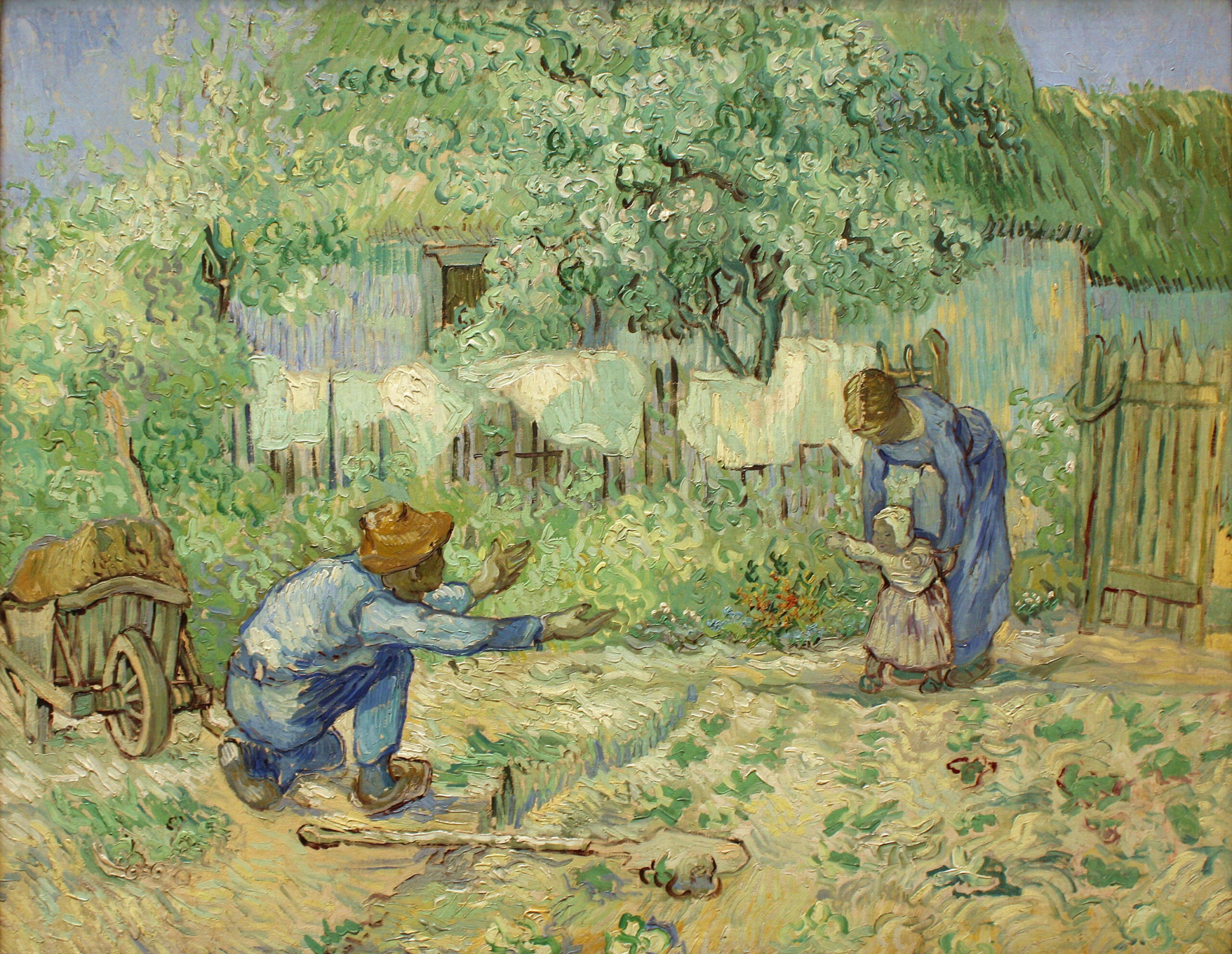
Van Gogh has a painting called “First Steps,” which shows a man in his garden. His house, with a thatched roof, is in the background. A large tree in bloom fills the centre, and below it, a fence is nearly covered with white sheets, set out to dry and blowing in the wind. There is every sign of busy work, but in a peaceful setting.
The man’s wheelbarrow is behind him, full of something. It’s impressionistic, so it’s kind of blurry. But let’s say fertilizer, or hay for mulching. He is harvesting from the rows of vegetables that grow in front of him, all that he has planted to feed his family.
But in the painting we see that he has just placed his shovel down on the ground. He has stopped his work. In fact, the shovel has not been placed, but dropped down, smothering some of the plants, as though he dropped it in a sudden moment. His head is lifted and his arms are outstretched.
The gate has been opened, and a beautiful woman, a mother, is bringing their child. The little one is balancing with the mother’s help, but she has freed both of her arms and is reaching forward to the arms of her father, on the other side of the garden. The child is about to take her first steps, through a garden and into his arms.
I don’t know what was going on in van Gogh’s mind as he painted, but I think it is interesting to note that the only bit of colour, other than green, muted blue, and earthy beige, is one singular red blossom on a small tree in the centre of the painting. The child must pass by this fruit to reach daddy.
To me, deliberate or not, this painting is a sign of truth: God waits for us to let go and reach out for him. The red fruit of destruction, hanging in a tree in the centre of the garden, is still there to tempt us and distract us and lead us to perdition, but the Father waits. He pauses the planting while he waits, but they are still growing: things that are delightful to look at and good for food. It is true that God calls out to us, that he longs to have us walking towards him, looking into his face, trusting him to catch us, to wait for us, to hold us.
In the Bible, God started life in a garden and he planted that garden himself. Our Lord resurrected in a garden. It is the work of God, the gardener, to give life to things, and to feed us.
I see a sign of goodness: the help of the mother, leading her child to the father. The goodness of the harvest. The goodness of the father’s patience, always with his arms outspread, not only to welcome, but also to catch if (and likely when) the child slips. It is the goodness of God that saves us. It is his goodness that led him to offer himself for our sake.
I see a sign of beauty here, too: salvation, heaven, love, life growing, a mother, a father, and a child celebrating all that has been given to them. They have three reminders before them of the presence of God: truth, goodness, and beauty.
The child in the painting, looking at her father, is so little, so untried, but she is alive and full of joy. She is full of strength, because she knows she is loved, and she knows that she can do all things through her father who gives her strength.
Your voice matters! Join the conversation by submitting a Letter to the Editor here.