

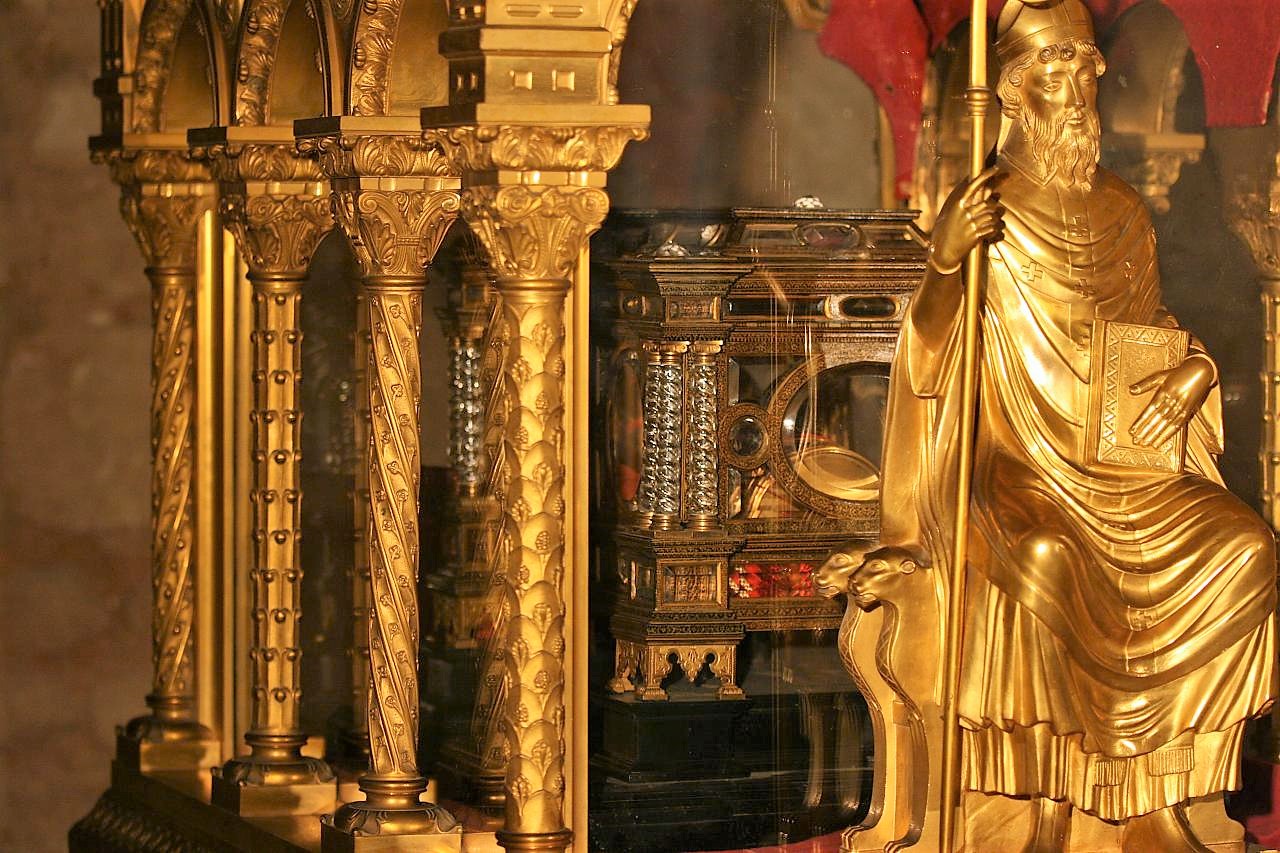

St. Hilary of Poitiers was the principal opponent of Arianism in the West. Born in Poitiers, France, about 315, he grew up in a non-Christian environment and spent time searching for the meaning of life.
He wrote, “While, therefore, I was giving serious thought to these and many other similar problems, I chanced upon those books which according to Jewish tradition were written by Moses and the Prophets. In them I found the testimony of God the Creator about Himself expressed in the following manner: ‘I AM WHO AM,’ and again: ‘Thus shalt thou say to the children of Israel: He who is, hath sent me to you.’ I was filled with admiration at such a clear definition of God, which spoke of the incomprehensible nature in language most suitable to our human understanding. It is known that there is nothing more characteristic of God than to be, because that itself which is does not belong to those things which will one day end or to those which had a beginning.” (Hilary of Poitiers, On the Trinity 1, 5)
Moved mainly by the idea of God he discovered in the Holy Scriptures, Hilary embraced the Catholic faith and soon converted his wife and daughter.
Hilary received holy orders and was chosen Bishop of Poitiers in about 353. As bishop, Hilary wrote his first work, Commentary on St Matthew’s Gospel. Commenting on “You are the light of the world” (Mt 5:14) Hilary wrote, “It is in the nature of light to emit radiance wherever it moves. Once it has been introduced into a house, darkness is dispelled by its overwhelming brightness. In like manner, the world is reckoned outside of the knowledge of God, enshrouded by the darkness of ignorance. Through the apostles, the light of understanding is brought into it, and illuminated by the knowledge of God. Wherever the tiny particles of light have gone, darkness is dissipated.”
Pope Benedict XVI said in a General Audience in 2007, “In 356, Hilary took part as a Bishop in the Synod of Béziers in the South of France, the ‘synod of false apostles,’ as he himself called it since the assembly was in the control of Philo-Arian Bishops who denied the divinity of Jesus Christ. ‘These false apostles’ asked the Emperor Constantius to have the Bishop of Poitiers sentenced to exile. Thus, in the summer of 356, Hilary was forced to leave Gaul.”
Hilary was banished to Phrygia in present-day Turkey. Author Father Joseph Tylenda wrote, “During his four years (356–60) in exile, he became familiar with Greek theology and wrote two of his most important books. On the Trinity was directed against Arian teaching, and On Synods, which continued his combat against the Arian heresy, also included a history of the Eastern Church up to his time.”
Pope Benedict XVI pointed out that Hilary “developed his entire Trinitarian theology based on the formula of baptism given to us by the Lord himself: ‘In the name of the Father and of the Son and of the Holy Spirit.’”
In 361, Hilary returned home from exile and immediately resumed pastoral activity, striving to undo the havoc caused by the Arians in Gaul and northern Italy.
In the last years of his life, Hilary composed the Treatises on the Psalms, writing, “There is no doubt that all the things that are said in the Psalms should be understood in accordance with Gospel proclamation, so that, whatever the voice with which the prophetic spirit has spoken, all may be referred nevertheless to the knowledge of the coming of Our Lord Jesus Christ, the Incarnation, Passion and Kingdom, and to the power and glory of our resurrection.”
Hilary died in Poitiers on Jan. 13, 367, and was declared a doctor of the Church by Pope Pius IX in 1851.
對天主的意念使怡樂皈依
聖怡樂.普瓦捷是西方抵抗亞略主義的主力。公元315年,他出生於法國的普瓦捷。
怡樂長大於非基督宗教的環境,他嘗試尋找生命的意義;他寫道:「我認真思考這問題及其它類似的疑問。我嘗試閱讀那些根據猶太人傳統是由梅瑟及先知們所寫的書本,我發現造物主天主親自自我介紹說:『我是自有者。』又說:『你要這樣對以色列子民說:那自有者打發我到你們這裡來。』我十分欽佩這個有關天主清晰的定義,讓那不可理解的天主,藉人可理解的言詞得以明白。存在是天主的主要特徵,因為永存的祂並不屬於有始有終的東西。」
從聖經認識天主後,怡樂便擁抱著天主教信仰,亦帶動妻女皈依聖教。
怡樂領受鐸品,並約在公元353年任普瓦捷主教。他第一部寫作,是瑪竇福音注釋,談到「你們是世界的光(5:14)」。他闡釋說:「光的本質就是所到之處發放光芒。當被帶進屋內時,光完全把黑暗驅走。如是者,世界不認識天主,就被無知的黑暗掩蓋。藉著宗徒們,把明達之光帶進世界,以對天主的認識來照亮它。那些有一小點的光,黑暗便被驅散。」
教宗本篤十六世在2007年10月10日公開接見羣眾時,說:「356年,怡樂到法國南部參加貝濟耶會議,形容那會議是『偽宗徒會議』,被反基督天主性的菲洛亞略主教們操控。那些偽宗徒慫恿君士坦都斯王放逐普瓦捷主教。356年夏季,怡樂被逼離開高盧。」
怡樂被流放到今日土耳其的腓尼基。若瑟.泰利達神父寫道:「怡樂四年(356-360年)的流放生涯,卻讓他熟悉了希臘神學,並寫了他其中兩本重要著作:『關乎天主聖三』直接抗拒亞略主義;『關乎會議』則繼續與亞略異端開戰,該著作包括東方教會的歷史。」
教宗本篤十六世指怡樂「從耶穌給予的受洗禱詞『因父、及子、及聖神之名』,發展他整個天主聖三的神學。」
361年怡樂結束放逐返普瓦捷,馬上回復他的牧民工作,並努力消除亞略異端在高盧及北意大利做成的禍害。
怡樂在晚年編箸了「聖詠集論述」。他寫著:「無可置疑,我們要按福音的傳佈,來了解聖詠集的內容,因此任何藉先知精神所發之言都預示著對救主耶穌基督的來臨、祂的降誕、苦難、天國、我們復活德能和光榮的知識。」
367年1月13日,怡樂死在普瓦捷。1851年,教宗庇約九世敕封怡樂為「教會聖師」。







