

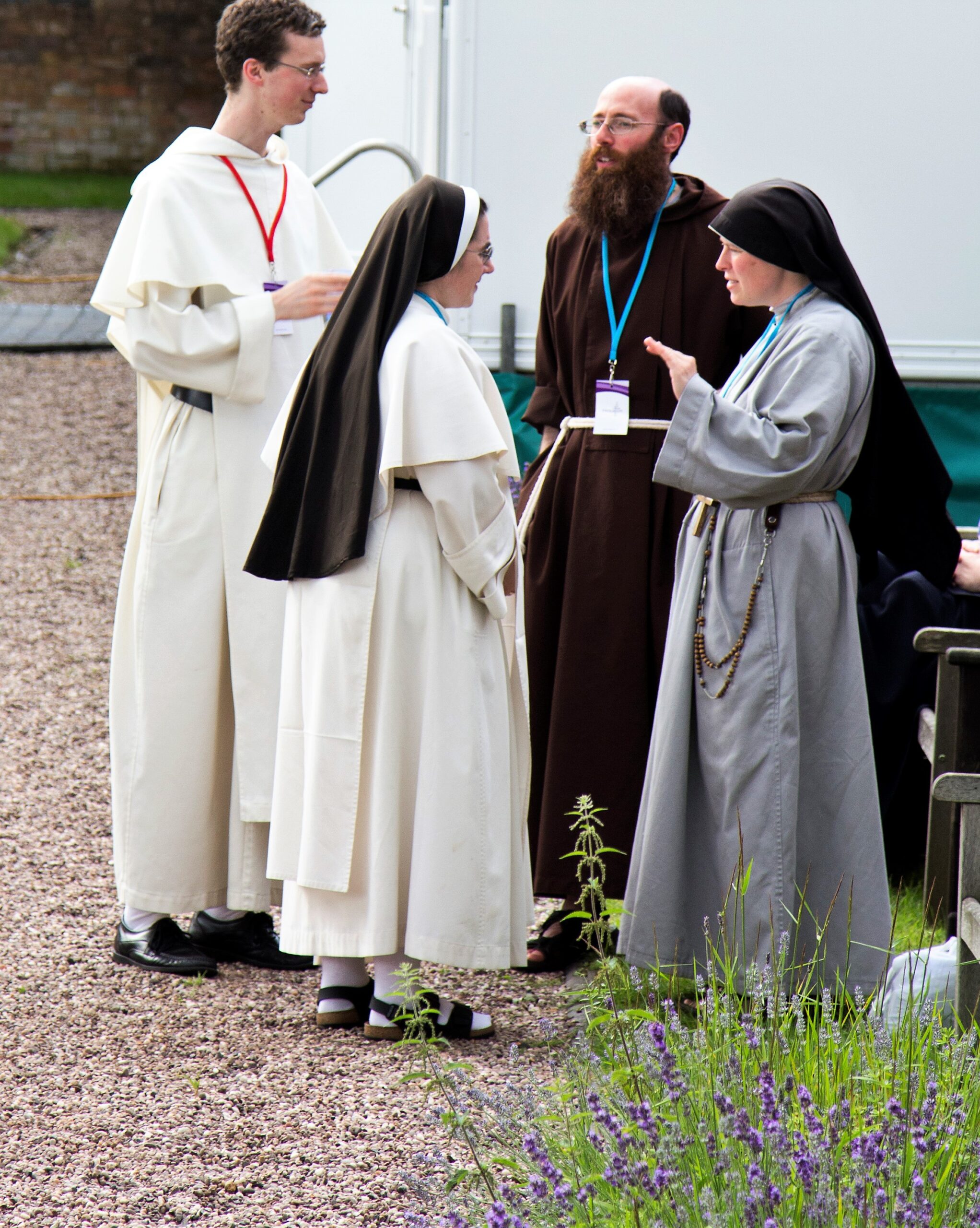

In the 13th century, the Catholic Church experienced the birth of the Mendicant Orders. Pope Benedict XVI explained: “They were given this name because of their characteristic feature of ‘begging,’ in other words humbly turning to the people for financial support in order to live their vow of poverty and carry out their evangelizing mission. The best known and most important of the Mendicant Orders that came into being in this period are the Friars Minor and the Friars Preachers, known as Franciscans and Dominicans.”
According to Benedict XVI, the Mendicant Orders responded to the different challenges and needs in the Catholic Church in the 13th century. A first challenge was the expansion of different groups and movements that of the faithful who desired reform but set themselves outside ecclesial communion. The Holy Father said, “Both Franciscans and Dominicans, following in their Founders’ footsteps, showed on the contrary that it was possible to live evangelical poverty, the truth of the Gospel as such, without being separated from the Church.”
Another need of the time was religious instruction. Benedict XVI said, “Many of the lay faithful who dwelled in the rapidly expanding cities, wanted to live an intensely spiritual Christian life. They therefore sought to deepen their knowledge of the faith and to be guided in the demanding but exciting path of holiness. The Mendicant Orders were felicitously able to meet this need too: the proclamation of the Gospel in simplicity and with its depth and grandeur was an aim, perhaps the principal aim, of this movement.”
From the 13th to the 15th centuries the Church was blessed with great saints and preachers from the Mendicant Orders who attracted large crowds. St. Anthony of Padua (1195-1231) was a very popular Franciscan preacher.
Regarding St. Anthony, Father Augustine Kalberer wrote, “Other saints took to the squares and streets when churches became too small; Anthony had need of the open fields.”
The Dominican St. Vincent Ferrer (1350-1419) was one of the most influential and popular preachers of all times. He preached powerfully on the Four Last Things and brought many people to the Catholic Faith.
St. Bernardine of Siena (1380-1444) was a Franciscan preacher. Father Kalberer wrote, “Schism, reform, and the Council of Basel kept the church in continual ferment over constitutional issues; but Bernardine’s sermons dealt with topics of immediate concern to his hearers: repentance, the Passion, virtues, and the prevalent vices such as gambling, usury, discord, and ostentation… With great fervour he fostered devotion to the Holy Name, to the Madonna, and to St. Joseph.”
Commenting on the preachers of the Mendicant Orders, Benedict XVI said, “The preachers addressed topics close to people’s lives, especially the practice of the theological and moral virtues, with practical examples that were easy to understand. They also taught ways to cultivate a life of prayer and devotion. For example, the Franciscans spread far and wide the devotion to the humanity of Christ, with the commitment to imitate the Lord.” Popular Marian devotions such as the Angelus, the Rosary, and the Brown Scapular, came to us from the Mendicant Orders.
Universities came into being at the end of the 12th century. The friars of the Mendicant Orders entered the most famous universities of the time as students and professors. Benedict XVI said, “The greatest thinkers, St Thomas Aquinas and St Bonaventure, were Mendicants who worked precisely with this dynamism of the new evangelization which also renewed the courage of thought, of the dialogue between reason and faith.”
The founder of the Friars Minor was St. Francis of Assisi. Benedict XVI said, “Francis was a great Saint and a joyful man. His simplicity, his humility, his faith, his love for Christ, his goodness towards every man and every woman, brought him gladness in every circumstance. Indeed, there subsists an intimate and indissoluble relationship between holiness and joy. A French writer once wrote that there is only one sorrow in the world: not to be saints, that is, not to be near to God. Looking at the testimony of St Francis, we understand that this is the secret of true happiness: to become saints, close to God!”
Share your thoughts. Send us a letter to the editor.
會士回應時代的需要
在13世紀,天主教會經歷了「行乞修會」的誕生。教宗本篤十六世說:『他們之所以被賦予這個名字,是因為他們的特點是「乞討」,換句話說,他們謙卑地向人們尋求經濟支援,以踐行他們的神貧愿並履行他們的福傳使命。』在這一時期形成的最著名和最重要的行乞修會是方濟會和道明會。
根據本篤十六世,「行乞修會」回應了13世紀天主教會的不同挑戰和需求。第一個挑戰是不同團體和運動的擴張,這些團體和運動是那些渴望改革但將自己置於教會共融之外的信徒。這位教宗說:『方濟各會和道明會都追隨他們創始人的腳步,表明了相反地,在不與教會分離的情況下,過著福音勸諭的神貧,活出福音的真理。』
當時的另一個需求是宗教教育。本篤十六世說:『許多居住在迅速擴張的城市中的平信徒想要過一種強烈的屬靈基督徒生活。因此,他們尋求加深對信仰的瞭解,並在要求高但令人興奮的成聖道路上接受引導。「行乞修會」也恰好能夠滿足這一需要:以簡單、深入和宏偉的方式宣講福音是這一運動的一個目標,也許是主要目標。』
從13世紀到15世紀,教會擁有來自「行乞修會」的偉大聖人和宣道者,他們吸引了大量人群。帕多瓦的聖安多尼(1195-1231)是一位非常受歡迎的方濟各會宣道者。有關聖安多尼,奧斯定·卡爾貝勒神父寫道:『當教堂變得太小時,其他聖人走上廣場和街道;安多尼需要開闊的田野。』道明會的聖味增爵、斐勒略(1350-1419)是有史以來最有影響力的流行宣道者之一。他有力地宣講了萬民四末,並把許多人帶到了天主教信仰中。錫耶納的聖納定(1380-1444)是方濟各會宣道者。卡爾貝勒神父寫道:『分裂、改革和巴塞爾會議使教會在憲法問題上不斷發酵; 但納定的講道涉及他的聽眾直接關心的話題:悔改、耶穌苦難、美德和流行的惡習,如賭博、高利貸、不和和炫耀…他以極大的熱情培育了對耶穌聖名、聖母和聖若瑟的敬禮。』
在評論「行乞修會」的宣道者時,本篤十六世說:『宣道者用易於理解的實際例子來討論接近人們生活的話題,特別是向天主的和倫理的德行的實踐。他們還教導如何培養祈禱和敬禮的生活。例如,方濟會廣泛傳播對基督人性的敬禮,並承諾效法我主。』流行對聖母的敬禮,如三鍾經、玫瑰經和聖母聖衣,都來自「行乞修會」。
大學誕生於12世紀末成立。「行乞修會」的會士以學生和教授的身份進入當時最著名的大學。本篤十六世說:『最偉大的思想家,聖多瑪斯、阿奎那和聖文德,是「行乞修會」修士,他們正是與新福傳的這種活力一起工作的,這也更新了思想的勇氣,理性與信仰之間的對話。』
方濟會的創始人是阿西西的聖方濟各。本篤十六世說:『方濟各是一位偉大的聖人,也是一個快樂的人。他的單純,他的謙卑,他的信德,他對基督的愛,他對每個男女的良善,在任何情況下都給他帶來快樂。事實上,聖德和喜樂之間存在著一種親密和不可分割的關係。一位法國作家曾經寫道,世界上只有一種悲傷:不做聖人,就是不親近天主。看看聖方濟各的見證,我們明白這是真正幸福的秘訣:成為聖人,親近天主!』







