

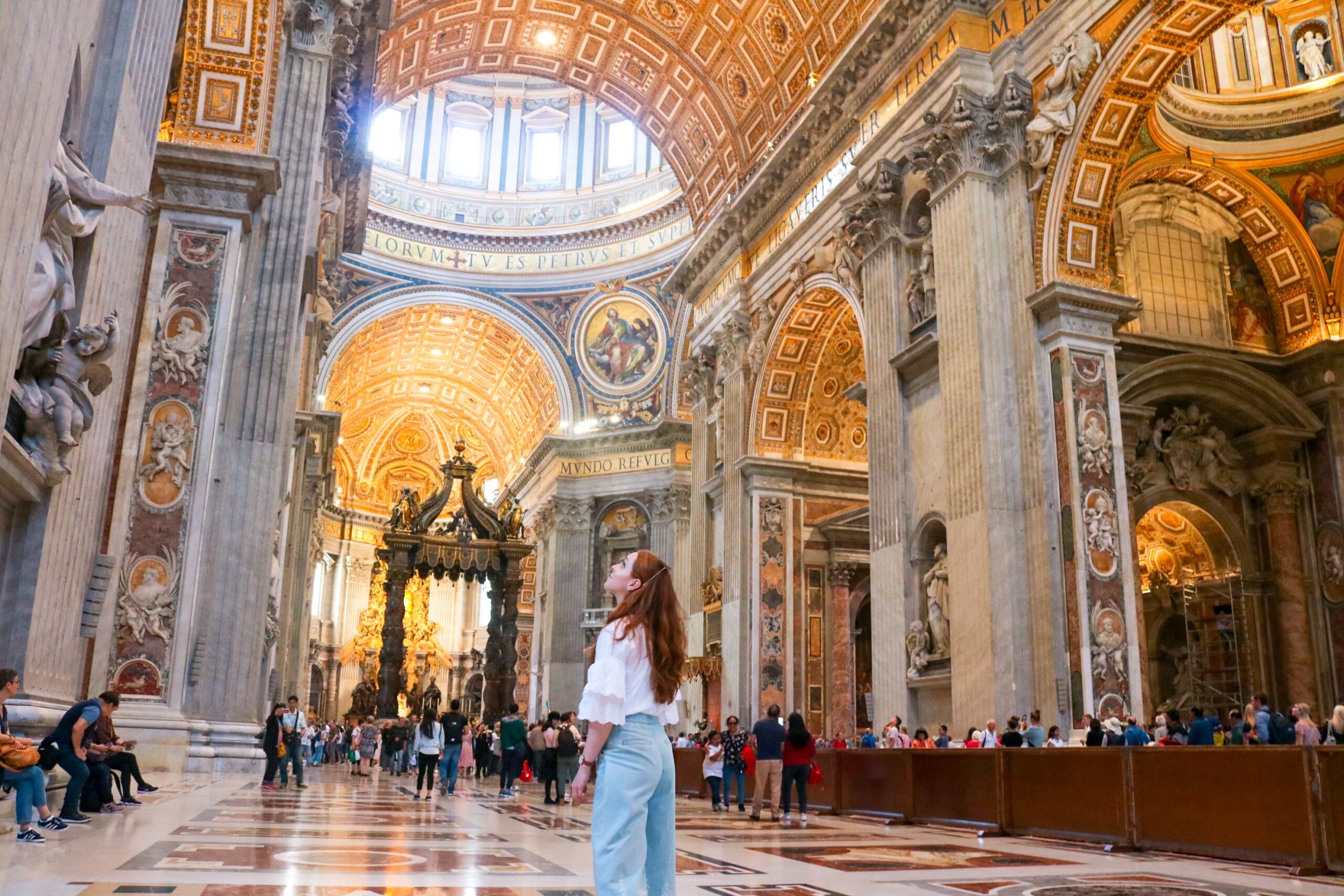

My husband Scott was talking with a visiting philosopher about the meaning of beauty. The man told him that he took a daily walk around an institution – new, with modern buildings – and the only thing he was able to find and call beautiful was the old, crumbling chimney of a forgotten building on the outskirts of the property.
It’s strange to think that millions of dollars were spent on the new buildings, paying not only for the supplies and labour, but also for a designer who, presumably, was trained to create beautiful things.
The philosopher was also trained, not necessarily to design beautiful things, but to find them. And the chimney was the only thing in sight.
The Church document Via Pulchritudinis: Pathway for Evangelization says, “The way of beauty can open the pathway for the search for God.” St. Augustine wrote that it was the beauty of creation that answered his questions of God. And Cardinal Joseph Ratzinger, the future Pope Emeritus Benedict XVI, wrote, “Beauty can be the most effective means to bring man to Jesus Christ.”
Even Dr. Jordan Peterson advises people to take one room in their homes and make it as beautiful as they possibly can. And I suppose that if beauty can lead man to contemplation, and ultimately to God, it is wise advice.
I would say that the idea of beauty leading to God is confirmed by the world’s destruction of it. After 14 years of the most basic art appreciation with my children, I can say with some small amount of conviction that beauty has long since become a lost ideal. Keep in mind that beauty is not always pretty. Beauty “prevents [man] from being content with just daily life. It causes him to suffer.” Beauty is Christ stripped and bleeding on the cross. And therefore the demons tremble before it and seek its destruction.
Humans have come to a place where we allow our children to mutilate their own bodies, created in God’s image. How much greater a triumph could the demons seek? We replace living plants with plastic greenery, conversations with digital acronyms, and homemade pies with vacuum-sealed glucose.
In the sacrifice of the Mass, I am often concerned that the mysterious beauty of the liturgy is being replaced with pop songs and cold, incense-less sanctuaries. “For someone who has no experience of the beauty of the liturgy, the smells and bells and sights and sounds tell them that something remarkable is going on,” Cardinal Ratzinger wrote.
I have experienced this personally, when a friend with no knowledge whatsoever of Christianity – not even the most basic stories of the Bible – visited a Latin Mass with me and said that, for some reason, she felt like weeping. How often do we feel like weeping? Are we looking for beauty? Are we finding it?
As a mother, I feel an on-going battle. How do Scott and I direct our children to seek and find what the world works to destroy? How do I instill in them a heart willing to suffer for beauty, for silence, for God? This is the work of grace, but it is also the vocational work of a parent. We take deliberate steps, I would say, to see that our children eat well, understand arithmetic, say some basic prayers, and control their impulses. What effort goes into beauty, into truth?
Gwyneth Thompson-Briggs is a Catholic who has taken the Church’s call as a visual artist, to respond “to the call of beauty.” She writes that parents often ask for her advice when they notice their children have a particular artistic talent. I would say her thoughts are worth contemplating, regardless of artistic talent.
Briggs recommends giving, according to one’s budget, quality clothes, books, and toys, and to discard the cheap, ugly “vulgar pop-culture” items. She says small children need to have their attention spans lengthened by eliminating screen time (and limiting your own). Children should be taken outdoors into beautiful landscapes and older neighbourhoods. For the aspiring artist (for all children then) virtue must be instilled: humility, fortitude, perseverance.
I would add, more generally, that listening to “classical” music, polyphony, and chant, and looking at (and attempting to copy) beautiful works of art have always been considered organic ways to train the heart and mind to recognize beauty, and therefore, God.
“Every expression of true beauty can be acknowledged as a path leading to an encounter with the Lord Jesus.” – Pope Francis







