


16th Sunday of Ordinary Time, Year C
First reading: Gen 18:1-10a
Second reading: Col 1:24-28
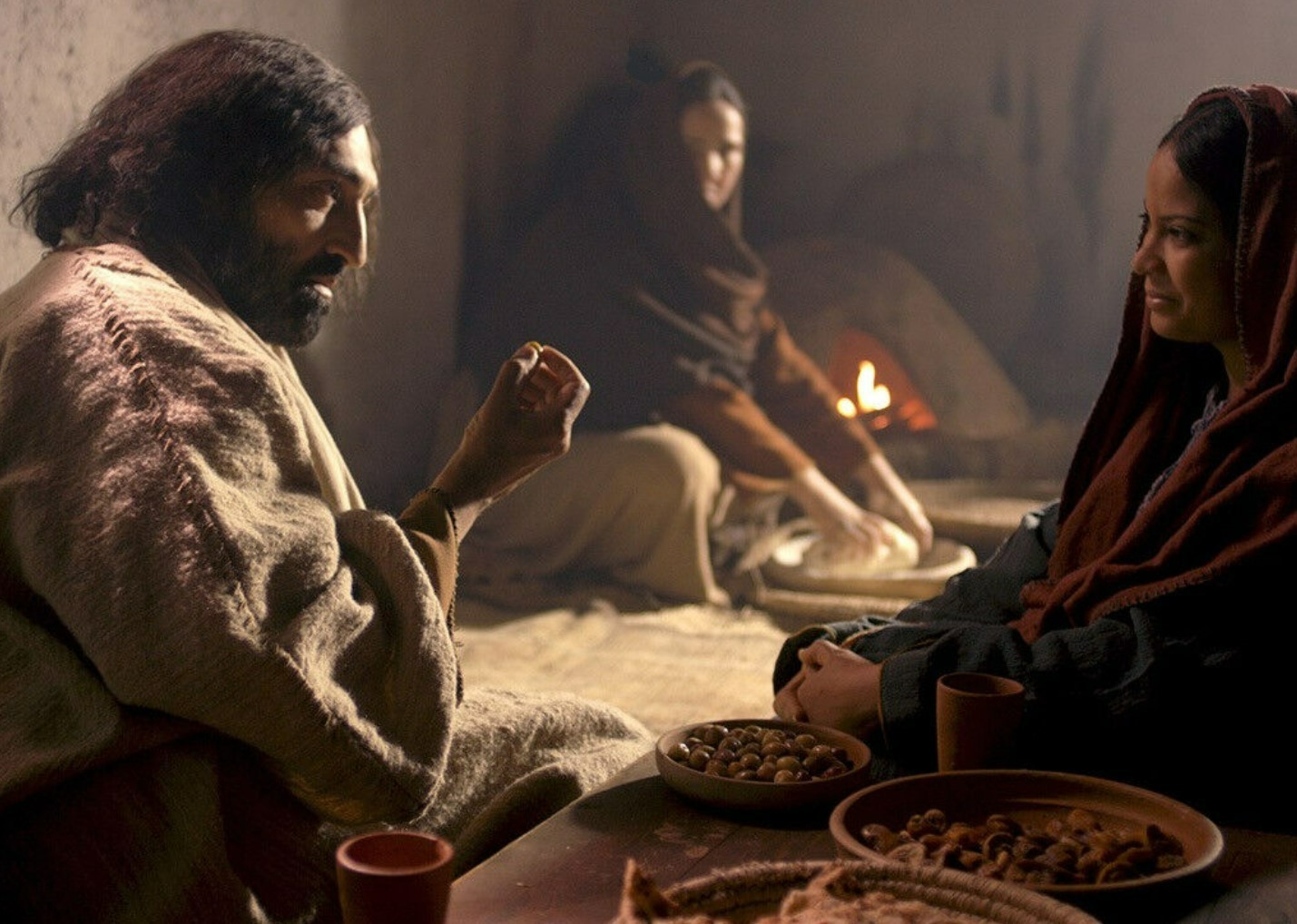
Gospel reading: Lk 10:38-42
This Sunday, St. Paul uses the phrase “in Christ,” which he used over 70 times in his 11 letters.
What does he mean by it?
The Catechism of the Catholic Church says that God the Son became man so that we might become “sharers of the divine nature” (51), “so that he, made man, might make men gods” and even “so that we might become God” (460).
God the Son possesses supernatural life by nature. When he became man, he assumed, or took on, human life. He was conceived inside a woman, starting as an embryo and a fetus, being born as a baby, and growing up to be a man: a real man, with his own birth date and name; with real ancestors, a real heredity, and a unique DNA; having a certain height and weight and hair of a certain colour; speaking a certain language and following certain traditions.
Now, for the first time, there was one man who possessed what God had always intended for all humans: both supernatural and natural life. In his natural life, Christ freely accepted death, which separated his human body from his human soul. However, three days later, he rose from the dead because in him, human life was united to supernatural life, which could not die.
What did this mean for the rest of us?
We think of humans as all separate, but that is because we can see only the present. If we could see the past, it would look different, for every human being has grown out of an ovum from his mother and a sperm from his father. If we could see humanity (including Christ) as God sees it, it would look like a single growing thing, like a very complicated tree.
Consequently, if one man is what the Catechism calls a “god,” it affects the whole tree, making a difference to everyone: not just people who lived after him, but also people who lived before him, like his ancestor Abraham.
Thanks to Christ, the transformation from natural life to supernatural life, from a created thing into a son of God, has been accomplished for us. If we will only lay ourselves open to Christ, he will effect that transformation in us. One of our own race has supernatural life: if we want, we can “catch” it from him.
“I am the vine, you are the branches,” Christ said. “Live on in me, as I do in you.”
St. Paul used the image of a body. At our baptism, we become members of Christ’s mystical body, “that is, the Church,” as he says in the second reading.
As members of that body, alive with its supernatural life, we can truly cooperate with Christ in the salvation of the world. There is only one Saviour, but we are the organs of his body in doing what remains to be done to spread the life of the body to every human being. “In our flesh we complete what is lacking in Christ’s afflictions for the sake of his body, the Church,” St. Paul says.
Our supernatural life is infinitely more important than our natural life. This Sunday, we see Martha “distracted by her many tasks,” while Mary sits “at the Lord’s feet” and listens to him. When Martha protests, Jesus says that “Mary has chosen the better part.”
C.S. Lewis says that the real problem of the Christian life “comes the very moment we wake up each morning. All our wishes and hopes for the day rush at us like wild animals. The first job each morning consists simply in shoving them all back; in listening to that other voice, taking that other point of view, letting that other larger, stronger, quieter life come flowing in.”
So we must go on all day, he says, “standing back from all our natural fussings and frettings; coming in out of the wind.”
Father Hawkswell has now finished teaching The Catholic Faith in Plain English. The whole course is available in written form and YouTube form at beholdvancouver.org/catholic-faith-course and will remain available until the end of August. Father will teach the whole course again, with new insights, starting in September.







