

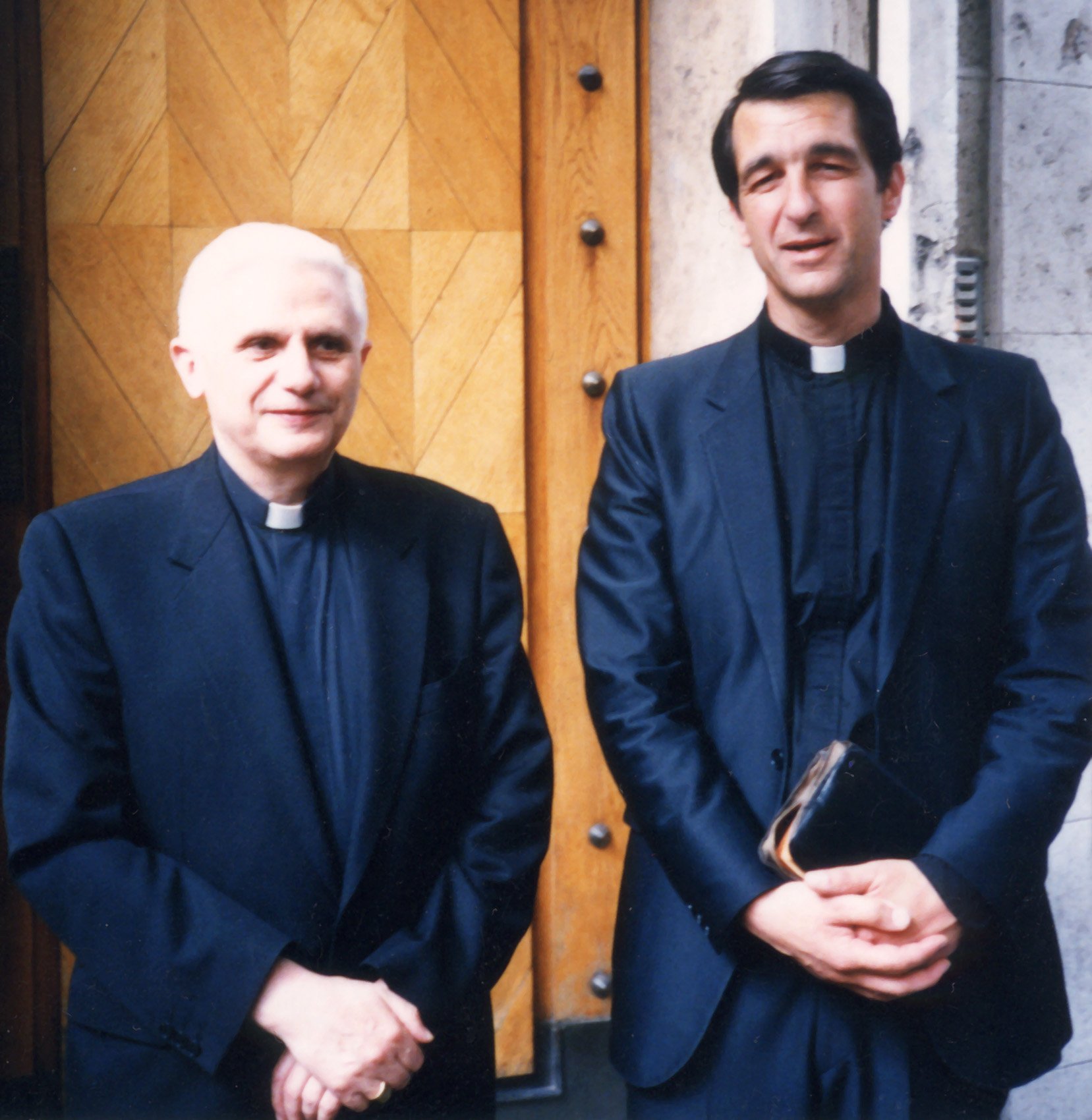

I, along with many others, am profoundly struck by Pope Benedict’s last words on this earth. “Lord, I love you” was whispered by the 95-year-old Pontiff on the day of his death, Dec. 31, 2022. Is there any greater teaching moment than these being the last words from the mouth of the one who was known to be a teacher and father to so many?
These intimate words echo Benedict’s great encyclical Deus Caritas Est (God is Love), which emphasizes the relationship of love between God and man, and the love of God reflected in the love between one human and another. But this man didn’t just talk the talk and write the words, he lived them until his last moment. These words of love from the former Pope’s mouth are a treasure for us who once called this man “Papa.” This last testament of faith is the example of a father showing his children how to die well, having spent eight years teaching us how to live well. He was our father in faith to the end. As parents we can only aspire to teach our children this well.
So many people have shared memories of Pope Benedict in recent days and the common theme seems to be humility and fatherhood. Particularly moving was a CTV News interview with Adriano Stefanelli, the Italian man who made shoes for Pope Benedict. The Pontiff brought back the centuries-old tradition of wearing bright red leather shoes outdoors with this white cassock – the red being a reminder of the juxtaposition of the power of his office and the Passion and martyrdom of Christ. The Pontiff and shoemaker developed a close relationship over the years, Stefanelli recalled, noting that the Pope became like a father to him, which was especially poignant since the younger man had never known his own father. Pope Benedict was no mere untouchable, intellectual member of the hierarchy; he cared about the individual and did his best to offer an example of Christian love on a daily basis.
Of course, one can’t recall Pope Benedict without acknowledging his amazing intellect. He was a natural-born teacher and certainly one of the most significant Catholic theologians of the 20th and 21st centuries. He became a professor of theology at the age of 31, teaching for 19 years before becoming Archbishop of Munich and Friesing, Germany. He had a way of presenting deep, theological ideas in a practical, personal way that made theology more accessible to the average Catholic.
Father Joseph Fessio, SJ, founder and editor of Ignatius Press and former student of Cardinal Ratzinger, recalled in a recent interview that his former teacher was foremost a wonderful listener. He said in their seminar-style classes, the future pope would listen to the students’ discussion for the majority of class time and then somehow take everything that had been said and summarize it so succinctly, challenge it, turn it around, and “make us sound much better than we actually were.”
Indeed, this teacher-turned Pope did not desire the papacy but responded in humble obedience when he was called. It’s been reported that as the voting rounds progressed in the conclave, Cardinal Ratzinger prayed fervently that God would not choose him to be pope. Prior to becoming pope, several times he had desired to retire to a life of writing books but felt that he could not abandon the ailing Pope John Paul II. The eight years of Benedict’s papacy were a natural continuation of John Paul’s work of evangelization, focusing on the need for a deep, personal relationship with Christ and unity in the liturgy. His three-volume book series Jesus of Nazareth is a beautiful legacy and points to his goal of having every Catholic know Christ intimately.
I pray that all of Papa Benedict’s children will never forget the intellectual contributions and works of this blessed Pontiff, but especially his example of humility and love. Pope Benedict XVI sums up this need to constantly witness to Christian love in his encyclical on love: “Saint Paul, in his hymn to charity (cf. 1 Cor 13), teaches us that it is always more than activity alone: ‘If I give away all I have, and if I deliver my body to be burned, but do not have love, I gain nothing’ (v. 3). This hymn must be the Magna Carta of all ecclesial service; it sums up all the reflections on love which I have offered throughout this Encyclical Letter. Practical activity will always be insufficient, unless it visibly expresses a love for man, a love nourished by an encounter with Christ. My deep personal sharing in the needs and sufferings of others becomes a sharing of my very self with them: if my gift is not to prove a source of humiliation, I must give to others not only something that is my own, but my very self; I must be personally present in my gift.”
Rest in peace, Papa Benedict, and thanks for offering us an encounter with Christ by being present in your gift of self.
Lazzuri writes from her home in Nova Scotia, where she lives with her husband, six children, and her mom. She can be reached at clarelazzuri@gmail.com







