

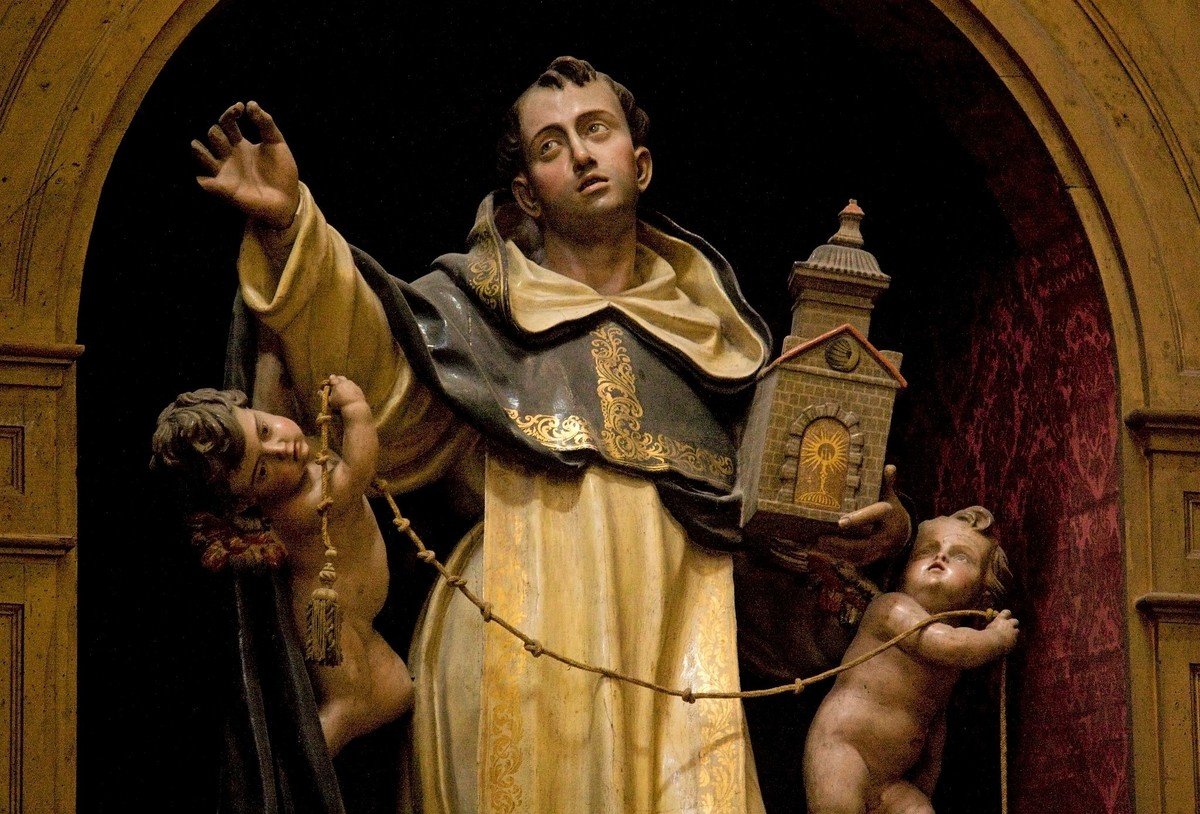

St. Thomas Aquinas was born between 1224 and 1225 at Roccasecca near Aquino, Italy. He studied with the Benedictines at the nearby Monte Cassino. He later moved to Naples and learned about the Greek philosopher Aristotle. It was in Naples that Thomas discovered his vocation to the Dominican Order.
Thomas’ family frantically opposed his Dominican vocation. They confined him for a while, and his brothers even secretly introduced a prostitute into his chamber to entrap him into sin. Thomas snatched up a firebrand and drove her out of the chamber. After this triumph over temptation, God granted Thomas the special grace of never experiencing temptations of the flesh for the rest of his life. Pope Benedict XVI said, “He was also called the Doctor Angelicus, perhaps because of his virtues and, in particular, the sublimity of his thought and the purity of his life.”
As a Dominican, Thomas studied under St. Albert the Great in Paris and Cologne. Thomas himself taught and preached at Paris, Orvieto, Rome, Viterbo, and Naples. The Dominican Reginald of Piperno was a companion and disciple of St. Thomas. The saint formed true and deep friendship with both Albert and Reginald. Benedict XVI said, “This is a characteristic of Saints: they cultivate friendship because it is one of the noblest manifestations of the human heart and has something divine about it, just as Thomas himself explained in some of the Quaestiones of his Summa Theologiae. He writes in it: ‘it is evident that charity is the friendship of man for God’ and for ‘all belonging to him.’”
Like his mentor, Albert the Great, Thomas harmonized human wisdom with divine faith. Benedict XVI said, “He made a thorough study of Aristotle and his interpreters… He commented on most of the Aristotelian opus, distinguishing between what was valid and was dubious or to be completely rejected, showing its consonance with the events of the Christian Revelation and drawing abundantly and perceptively from Aristotle’s thought in the explanation of the theological texts he was uniting. In short, Thomas Aquinas showed that a natural harmony exists between Christian faith and reason. And this was the great achievement of Thomas who, at that time of clashes between two cultures that time when it seemed that faith would have to give in to reason showed that they go hand in hand.”
St. John Paul II wrote, “Thomas recognized that nature, philosophy’s proper concern, could contribute to the understanding of divine Revelation. Faith therefore has no fear of reason, but seeks it out and has trust in it. Just as grace builds on nature and brings it to fulfilment, so faith builds upon and perfects reason. Illumined by faith, reason is set free from the fragility and limitations deriving from the disobedience of sin and finds the strength required to rise to the knowledge of the Triune God.”
Father Augustine Kalberer pointed out: “Though [St. Thomas Aquinas] constantly wrote on controversial topics, there is a remarkable serenity in his work; for he made a point for not writing in the first person, thus avoiding the word ‘I,’ and he never mentions contemporaries by name but simply states the various opinions currently held on the matter under discussion.”
Pope Urban IV commissioned St. Thomas Aquinas to compose the Proper for a Mass and an Office honouring the Holy Eucharist. The familiar hymns “O Salutaris Hostia” and “Tantum ergo” which were usually sung during Eucharistic Adoration were composed by the saint.
Benedict XVI said that the life and teaching of St. Thomas Aquinas could be summed up in the following episode: “Thomas was anxiously asking whether what he had written on the mysteries of the Christian faith was correct. And the Crucified One answered him: ‘You have spoken well of me, Thomas. What is your reward to be?,’ And the answer Thomas gave him was what we too, friends and disciples of Jesus, always want to tell him: ‘Nothing but Yourself, Lord!’”
Share your thoughts by sending us a letter to the editor.
信仰尋求理性
聖多馬斯·阿奎那於1224年至1225年間出生於阿基諾附近的羅卡塞卡。他在附近的蒙特卡西諾本篤會修院學習。後來他搬到那不勒斯,瞭解了希臘哲學家亞里士多德。正是在那不勒斯,多馬斯發現了他對道明會的召叫。
多馬斯的家人強烈地反對他道明會的召叫。他們把他關了一段時間,他的兄弟們甚至偷偷地把一個妓女引到他的房間,把他引誘到罪惡中。多馬斯搶過一把火,把她趕出了房間。在戰勝試探之後,天主賜給多馬斯特殊的恩典,讓他在餘生中永遠不會經歷肉慾的試探。教宗本篤十六世說:『他也被稱為天使般的聖師,是因為他的美德,特別是他的思想的崇高和生活的純潔。』
作為道明會士,多馬斯在巴黎和科隆師從聖雅伯。多馬斯本人在巴黎、奧維多、羅馬、維泰博和那不勒斯任教和講道。道明會士雷金納德是聖多馬斯的同伴和門徒。聖人與雅伯和雷金納德建立了真正而深厚的友誼。本篤十六世說:『這是聖徒的一個特徵:他們培養友誼,因為它是人心中最崇高的表現之一,並且其中更具神聖的事,正如多馬斯自己在他的《神學大全》所解釋的。「顯然,愛德是人對天主的友誼」和因為『一切都屬於祂的(Vol. II, q. 23, a. 1)。』
像他的導師雅伯一樣,多馬斯將人類的智慧與神聖的信仰相協調。本篤十六世稱:『他評論了亞里士多德的大部分作品,他對亞里士多德和他的解釋者進行了徹底的研究 … 他評論了亞里士多德的大部分作品,區分什麼是有效的,什麼是可疑的,或者完全拒絕的,表明它與基督徒的啓示相一致,並在解釋他正在整合的神學文本時從亞里士多德的思想中大量而敏銳地借鑒。簡而言之,多馬斯·阿奎那表明,基督徒信仰和理性之間存在自然的和諧。這是多馬斯的偉大成就,兩種文化發生衝撞時,信仰似乎不得不屈服於理性,他這表明它們是齊頭並進的。』
聖若望保祿二世寫道:『多馬斯認識到,自然—-它是哲學所當關注的—可以有助於理解神聖的啟示。因此,信仰不懼怕理性,而是尋求理性並信任理性。正如恩寵建立在自然之上並使之得以實現一樣,信德也建立在理性之上並使其完美。在信德的光照下,理性從因不順服的罪而產生的脆弱和限制中釋放出來,並找到上升到三位一體天主的知識所需的力量。』
奧斯定·卡爾伯勒神父指出:『儘管〔聖多馬斯·阿奎那〕經常寫有爭議的話題,但他的作品中有一種非凡的平和;因為他強調不以第一人稱寫作,從而避免使用「我」這個詞,他從不提到同時代人的名字,而只是陳述目前對正在討論的問題持有的各種意見。』
教宗伍朋四世委託聖多馬斯·阿奎那撰寫彌撒專用經文和崇拜聖體禱文。熟悉的讚美詩O Salutaris Hostia和 Tantum ergo通常在朝拜聖體期間唱詠,都是由聖人創作的。
本篤十六世說,聖多馬斯·阿奎那的生平和教義可以總結為以下一節:『多馬斯焦急地問他所寫的關於基督徒信仰奧秘的內容是否正確。被釘十字架的人回答他:「你對我說得很好,多馬斯。你的報酬是什麼?」。多馬給他的答案也是我們,耶穌的朋友和門徒,總是想告訴他的:「主啊,除了你自己,什麼都沒有!」』







