


Old age is a sickness, incurable since it ends in death. In the
Catholic faith to pray for a happy death is a tradition. My mother taught me to
pray that I may die happily. But how can there be happiness when the death
process itself is so excruciating and there is weeping all around the one who
is dying?
Given my advanced age, I want to follow the invitation of Pope Francis who said that “praying in difficult situation is like opening the door to the Lord, in order that he might enter.” The dying process is a sacred time – a final season to seek closure in this life and prepare for the next in the hope of sharing in Christ’s Resurrection.
In the Catholic faith, a happy death means that one is in good moral and religious conscience at the time. It requires that one does not die in some morally compromised situation, is not alienated from the Church, under the influence of drugs or engaged in some criminal activity, or, to terminate pain and infirmity, asking for euthanasia and physician-assisted suicide.
On Nov. 2, 2017, the commemoration of all the faithful departed, Archbishop J. Michael Miller, CSB, wrote to his diocesan faithful about the consequences of favouring the issue of assisted suicide which has arisen because of the legalization in Canada concerning this matter.
The archbishop wrote: “Catholic teaching remains clear: the Church defends and respects all human life from conception to natural death as a magnificent gift of God the Creator. For believers, death, the natural end of our human life, becomes an act of confident surrender to God. For this reason, it is never morally acceptable to choose euthanasia and physician-assisted suicide.”
He adds: “For those who deliberately choose euthanasia and physician-assisted suicide, the Church is unable to provide a funeral Mass – though other liturgical options remain available – and priests will always be ready to minister to families who are grieving.”
Archbishop Terrence Prendergast, of Ottawa, reminded us also that an act of suicide is a “grave sin” which directly contradicts the Fifth Commandment not to kill. He told Canadian Catholic News that it would be dishonest for the Church to anoint people bent on committing such a sin and also unfair to any priest to be asked to confer the sacrament of the sick in such circumstances. Anyone who seeks to terminate his or her life “lacks the proper disposition for the anointing of the sick.”
Asking to be killed is gravely disordered and is a rejection of the hope that the rite calls for. The archbishop added: “Of course, a pastor will try to dissuade a patient from requesting suicide and will pray with them and their family, but asking him to be present is in effect asking him to condone a serious sin.”
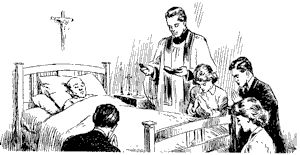
Catholics receive the sacrament of the sick when they are gravely ill, although not necessarily at the point of death. During the rite, the person is anointed on the forehead and hands with the holy oil while the priest says: “Through this holy anointing may the Lord in his love and mercy help you with the grace of the Holy Spirit. May the Lord who frees you from sin help you and raise you up.”
According to the Catechism of the Catholic Church, the sacrament confers on the person gifts of the Holy Spirit which include strength, peace and courage, unity with Christ and his Church, and the forgiveness of his or her sins.
The comments of Archbishop Prendergast represent the latest statement of strong opposition to euthanasia by the Canadian Catholic Church.
Canada has been on course for the creation of one of the world’s most permissive euthanasia regimes since the Supreme Court struck down the law against euthanasia and assisted suicide, creating a framework for such practices as courts hear applications for euthanasia and assisted suicide cases.
I question myself if Canon 1090 is not applicable when a person agrees to euthanasia for a spouse in order to help him or her “die with dignity,” and also with the intention to be free to marry again.
That canon says: “One who, with a view to entering marriage with a particular person, has killed that person’s spouse, or his or her spouse, invalidly attempts this marriage …” Later it says: “They also invalidly attempt marriage with each other who, by mutual physical or moral action, brought about the death of either’s spouse.”
For instance, a married doctor has a lover whom he wants to marry. His wife is diagnosed with pancreatic cancer that will kill her within three years. The doctor’s companion threatens to stop their relationship if he does not help his wife commit suicide. If he administers a lethal injection and becomes a widower, the pastor cannot marry them. Neither can the bishop dispense the impediment. Only the supreme authority of the Holy See can, and only provided the crime is not publicly known.







